

Scientists in China have developed a PV-powered direct drive cooling system for cooling electronic devices. The proposed system has so far delivered low exergy levels, but its cost is much lower than conventional vapor compression refrigeration technologies.
Researchers from Hebei University of Technology in China have designed a direct-drive photovoltaic cooling system low energy consumption for cooling electronic devices with high heat flow.
“The proposed system integrates photovoltaic power generation with direct cooling and vapor compression refrigeration (VCR),” said the study’s lead author, Xiaohui Yu, pv magazine. “The combination of micro evaporator and direct cooling method can achieve good heat exchange efficiency.”
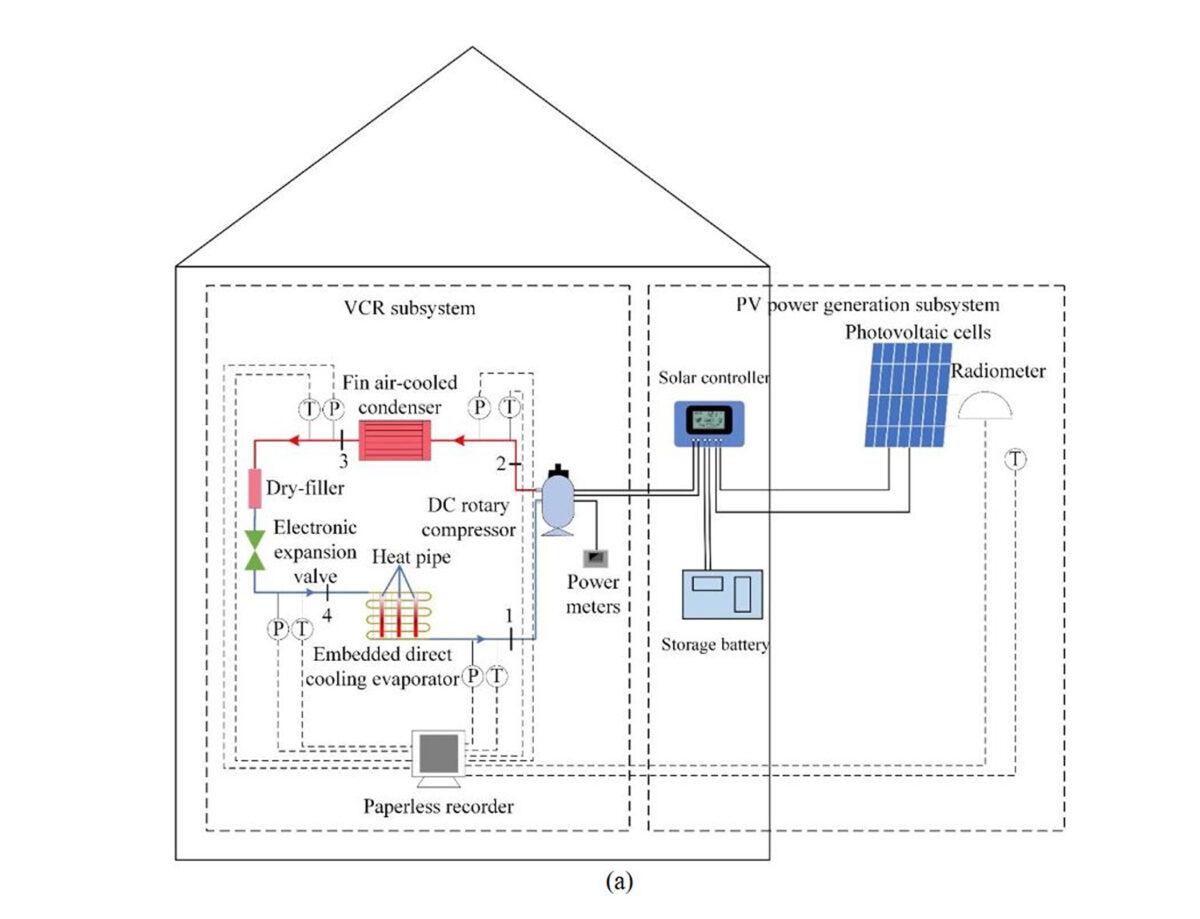
The system consists of two subsystems: a PV unit including battery and a Maximum Power Point Tracking (MPPT) controller; and a VCR unit consisting of a rotary DC compressor, an air-cooled finned condenser, an electronic expansion valve, an embedded evaporator for direct cooling and a dry filler.
In the proposed system configuration, the DC rotary compressor compresses the refrigerant into a high-temperature, high-pressure gas, which is then transported to the air-cooled fin condenser to release heat. “The refrigerant enters the state of a gas-liquid two-phase flow with low temperature and pressure through the electronic expansion valve and finally goes to the embedded direct cooling evaporator to absorb the heat from electronic devices,” the researchers explain.
The PV unit powers the DC compressor and the MPPT device is used to control battery charging and discharging.
The scientists emphasized that the heating power and compressor speed of the system have a major influence on the exergy performance of the VCR subsystem, which they say is closely related to the intensity of solar radiation. Exergy is the maximum amount of work that can be produced by an energy flow when it equilibrates to a reference environment.
The group tested the exergy and economic performance of the system under different operating conditions and found that the coefficient of performance reached 8.5 at a heating power and compressor speed of 400 W and 4350 rpm, respectively.
“When the average solar radiation intensity is 776.5 W/m2, the photovoltaic cells of the presented system with an operating time of 7 hours generate 1.81 kWh of electricity, with 24.9% of the electricity consumed by the VCR subsystem,” the report said. “The rest is stored and can ensure that this subsystem can run continuously for 5.3 hours without solar radiation.”
The academics describe the exergy performance of the PV unit and the compressor as insufficient. “The PV cells have the highest exergy destruction of 1059.4 W, accounting for 91% of the total exergy destruction of the system. The compressor exhibits the second largest exergy destruction, reaching 86.3 W and responsible for 7.4% of the total exergy destruction,” they added, noting that increasing the compressor speed from 4350 to 6500 rpm results in a twofold increase in the exergy destruction of the compressor itself.
However, their economic analysis showed that the system is 79.5% cheaper than conventional video recorders and that the payback period is approximately 2.2 years.
“Currently, the embedded microchannel evaporator with direct cooling is being tested for long-term use in our test bench,” Yu said. “Our work can provide direction for the future development and application of this system. Moreover, it can promote the development and application of the direct-drive vapor compression solar photovoltaic cooling system for domestic heating, cooling and hot water.”
The system was described in the article “Energy, exergy, economic and environmental assessment of direct drive solar photovoltaic cooling systems for cooling electronic devices”, which was recently published in Renewable energy.
This content is copyrighted and may not be reused. If you would like to collaborate with us and reuse some of our content, please contact: editors@pv-magazine.com.
