
Close Menu
  • News
  • Industry
  • Solar Panels
  • Commercial
  • Residential
  • Finance
  • Technology
  • Carbon Credit
  • More
    • Policy
    • Energy Storage
    • Utility
    • Cummunity
What's Hot

Dutch solar owners asked to switch off during peak periods to ease the distribution crisis

June 7, 2026

The hydrogen flow: Toyota demonstrates its racing prototype on liquid hydrogen

June 7, 2026

Era of electrification exposing Australia’s weakest link

June 6, 2026
Facebook X (Twitter) Instagram
Solar Energy News
Sunday, June 7
  • News
  • Industry
  • Solar Panels
  • Commercial
  • Residential
  • Finance
  • Technology
  • Carbon Credit
  • More
    • Policy
    • Energy Storage
    • Utility
    • Cummunity
Solar Energy News
Home - Technology - New doping strategy increases the efficiency of lead-free perovskite solar cells – SPE
Technology

New doping strategy increases the efficiency of lead-free perovskite solar cells – SPE

solarenergyBy solarenergyMay 9, 2024No Comments2 Mins Read
Facebook Twitter Pinterest LinkedIn Tumblr Email
Share
Facebook Twitter LinkedIn Pinterest Email

An international research group has developed a solar cell based on a lead-free perovskite material known as Cs2AgBiBr6. The cell’s absorber was doped with trans-polyacetylene, which reportedly allowed the device to improve efficiency by more than 20%.

May 9, 2024 Emiliano Bellini

A group of researchers led by the University of Lahore in Pakistan has developed a solar cell based on an absorber made with a lead-free perovskite material known as Cs.2AgBiBr6.

The novelty of their approach consisted in doping the material with polyacetylene (PA). one of the most promising organic polymers for applications in optoelectronics. This doping process is intended to reduce the high energy band gap of the Cs2AgBiBr6. material, which the scientists indicated at 1.9 eV.

“The decrease in the energy gap is the result of adjusting the edges of the conduction and valence bands, while leading to an increase in electron injection from the perovskite layer to the electron transport layer,” they explained. “The increase in peak intensity clarified the crystallinity of the material.”

At the end of the doping process, the perovskite material had an energy band gap of 1.84 eV.

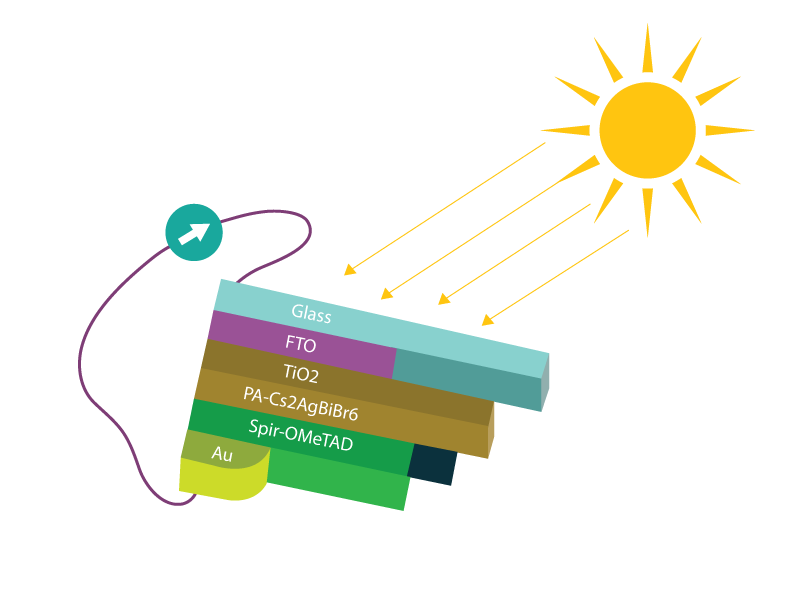
The team built the solar cell with a substrate made of glass and fluorine-doped tin oxide (FTO), an electron transport layer (ETL) that rests on a titanium oxide (TiO2), the perovskite absorber. hole transport layer (HTL) based on Spiro-OMeTAD and a gold (Au) metal contact.

The researchers tested the solar cell’s performance under standard lighting conditions and found that it achieved an energy conversion efficiency of 3.98%, an open-circuit voltage of 0.929 V and a short-circuit current density of 5.7 mA/cm.2and a fill factor of 75%. A reference device without doping achieved an efficiency of 3.29%, an open-circuit voltage of 0.920 V and a short-circuit current density of 5.13 mA/cm2and a fill factor of 69%.

See also  China tightens carbon accountability framework, increasing structural pressure on renewables – SPE

“These improvements, together with the aforementioned bandgap improvement, could open promising avenues for the future commercialization of high-performance solar energy harvesting technologies,” the academics said.

They introduced the new cell concept in “Trans-polyacetylene doped Cs2AgBiBr6: Bandgap reduction for high-efficiency lead-free double perovskite solar cells”, which was recently published in Results in physics. “The study demonstrates the mechanical and dynamic stability of the Cs2AgBiBr6,they concluded.

This content is copyrighted and may not be reused. If you would like to collaborate with us and reuse some of our content, please contact: editors@pv-magazine.com.

Source link

cells doping efficiency increases leadfree perovskite solar SPE strategy
Share. Facebook Twitter Pinterest LinkedIn Tumblr Email
solarenergy
  • Website

Related Posts

Dutch solar owners asked to switch off during peak periods to ease the distribution crisis

June 7, 2026

Letter from China’s PV Industry: Arctech wins 2.1 GW solar deal

June 5, 2026

ComEd starts a new energy pilot with a solar rebate on the roof of a brewery

June 5, 2026
Leave A Reply Cancel Reply

Don't Miss
Policy

Bangladesh launches 500 MW PV tender – SPE

By solarenergyJanuary 22, 20250

Bangladeshi authorities are pursuing proposals to build ten PV power plants with a capacity of…

Using excess PV energy for seasonal underground thermal storage – SPE

September 14, 2024

Greece faces increasing constraints on renewable energy sources, driving solar plus storage – SPE

March 4, 2026

Solar energy saves Groton Public Schools in Connecticut $40,000 in energy costs

May 23, 2024
Stay In Touch
  • Facebook
  • Twitter
  • Pinterest
  • Instagram
  • YouTube
  • Vimeo
Our Picks

Dutch solar owners asked to switch off during peak periods to ease the distribution crisis

June 7, 2026

The hydrogen flow: Toyota demonstrates its racing prototype on liquid hydrogen

June 7, 2026

Era of electrification exposing Australia’s weakest link

June 6, 2026

‘Come out from behind your screen, our industry is ultimately about people’

June 6, 2026
Our Picks

Dutch solar owners asked to switch off during peak periods to ease the distribution crisis

June 7, 2026

The hydrogen flow: Toyota demonstrates its racing prototype on liquid hydrogen

June 7, 2026

Era of electrification exposing Australia’s weakest link

June 6, 2026
About
About

Stay updated with the latest in solar energy. Discover innovations, trends, policies, and market insights driving the future of sustainable power worldwide.

Subscribe to Updates

Get the latest creative news and updates about Solar industry directly in your inbox!

Facebook X (Twitter) Instagram Pinterest
  • Contact
  • Privacy Policy
  • Terms & Conditions
© 2026 Tsolarenergynews.co - All rights reserved.

Type above and press Enter to search. Press Esc to cancel.