

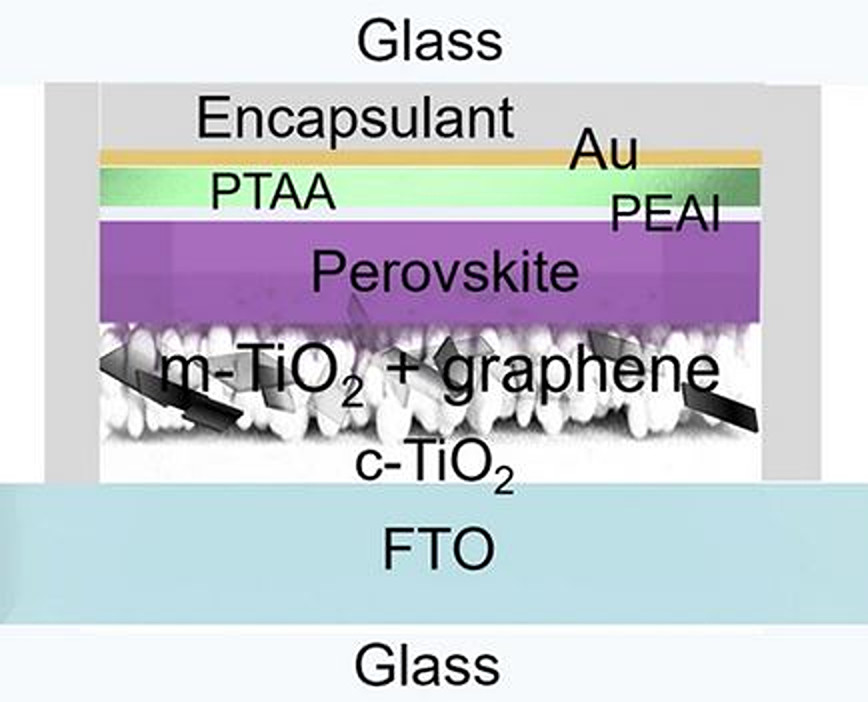
Researchers in Italy have developed a low-temperature encapsulation technique that reportedly improves the stability of perovskite PV devices. They said the new technique reduces thermomechanical stresses caused by both the encapsulation process and the temperature gradients that occur during accelerated aging stresses.
A group of researchers led by Tor Vergata University of Rome in Italy has developed a new perovskite solar cell and module encapsulation process that reportedly increases device stability without the need for advanced perovskite chemistry with high internal stability or specific edge sealants.
The team said their new encapsulation reduces thermomechanical stresses at the interface of the encapsulant and the back electrode. It is based on a highly viscoelastic, liquid adhesive polyisobutylene (PIB) material and is described as an industrially compatible solution that does not require solvents in a stress-free lamination process.
“In this work, unlike commercially available PIB-based encapsulants commonly used in the literature for perovskite solar cells, we propose low molecular weight homopolymer PIB as a transparent, viscoelastic, semi-solid liquid that is processable in the form of laminatable films,” the scientists said. specified. “Additionally, we demonstrate that the adhesion, barrier and thermal management properties of our homopolymer PIB encapsulant can be improved by the addition of two-dimensional (2D) inorganic fillers, namely single-layer hexagonal boron nitride (H-BN) (nano) flakes produced on an industrial scale via a patented wet-jet milling (WJM) exfoliation process of the indigenous bulk powder.”
The academics tested their solution on solar cells fabricated on glass substrates with both mesoscopic and planar nip configurations, plus a cell with an inverted pin configuration. A semi-transparent bifacial specimen was also tested. The researchers also created modules based on mesoscopic squeeze cells made with an absorber based on methylammonium (MA) perovskite material.
They tested two versions of the new encapsulant. One with two-dimensional fillers made of boron nitride material (PIB:h-BN) and one without. The cells were 1 cm2 in size, while the modules had an active area of 10 cm2, based on 5 cells with an active area of 2 cm2.
The devices were encapsulated at 90 C in a differential pressure laminating process, based on an automatic dual-chamber laminating machine supplied by Italian specialist Rise Technology, together with a cooling system. The cells and modules were subjected to multiple accelerated aging tests, as well as a custom thermal shock test and a custom humidity freeze test.
“The addition of thermally conductive two-dimensional hexagonal boron nitride to the polymeric matrix improves the barrier and thermal management properties of the encapsulant,” the researchers said. “Without any edge sealing, encapsulated devices passed versatile accelerated aging tests, retaining more than 80% of their initial efficiency.”
The group sees the work as a step toward long-term stable modules made with low temperature and cost-effective encapsulants that can be applied in a high-throughput production line, allowing perovskite solar cells to compete with conventional crystalline silicon solar technologies. It also provides compatibility with a wide range of perovskite compositions.
Popular content
“Overall, our results indicate that semi-solid/liquid encapsulation concepts efficiently reduce both thermal and thermomechanical stresses during the application of encapsulants, while providing excellent barrier performance for the realization of long-term stable PSCs and PSMs, with the aim of to tackle competition with Si capsules. based on PVs,” the team concluded.
The work is described in detail in the article “Low-temperature stress-free encapsulation for perovskite solar cells and modules that pass versatile accelerated aging tests,” published in communication about nature. The research team included scientists from the Università di Genova, Institute of Structure of Matter (ISMCNR), the Italian National Research Council (CNR) and Istituto Italiano di Tecnologia.
This content is copyrighted and may not be reused. If you would like to collaborate with us and reuse some of our content, please contact: editors@pv-magazine.com.
