

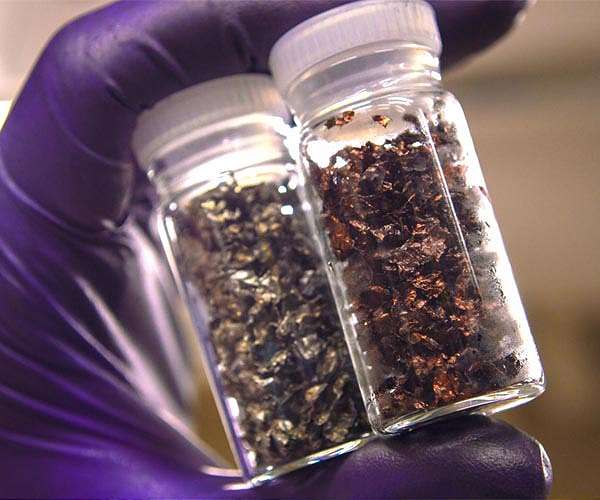
Rice develops efficient method for recovering lithium from battery waste
Lithium, often called the “white gold” of clean energy, is an essential component of batteries of all shapes and sizes, from mobile devices to large-scale energy storage systems. Despite the abundance of lithium, demand for lithium is growing rapidly due to the increase in electric vehicle (EV) use, ambitious net-zero targets and complex geopolitical issues. The global lithium-ion battery (LIB) market, estimated at over $65 billion by 2023, is expected to grow by over 23% over the next eight years, further exacerbating lithium supply challenges.
Traditionally, extracting lithium from used batteries is both harmful to the environment and highly inefficient. A team of researchers from Rice University, led by Pulickel Ajayan, is working on a solution to this problem. Their recent research in Advanced Functional Materials outlines a rapid, efficient and environmentally friendly method for selectively recovering lithium using microwave radiation and a biodegradable solvent. The process can recover up to 50% of the lithium from spent LIB cathodes in just 30 seconds, which is a significant improvement over current recycling technologies.
“We have seen a colossal growth in the use of LIB in recent years, which inevitably raises concerns about the availability of critical metals such as lithium, cobalt and nickel used in the cathodes,” explains Sohini Bhattacharyya, a lead author of the magazine, out. study and a Rice Academy Postdoctoral Fellow in Ajayan’s Nanomaterials Laboratory. “It is therefore very important to recycle used LIBs to recover these metals.”
Current recycling methods often use aggressive acids, while alternative environmentally friendly solvents, such as deep eutectic solvents (DESs), struggle with efficiency and cost-effectiveness. Furthermore, existing methods recover less than 5% lithium, mainly due to contamination, in-process losses and the energy-intensive nature of recovery.
“The recovery rate is so low because lithium is usually precipitated last after all other metals, so our goal was to figure out how to target lithium specifically,” said Salma Alhashim, another lead author of the study and a Rice doctoral alumna . “Here we used a DES that is a mixture of choline chloride and ethylene glycol, knowing from our previous work that during leaching in this DES, lithium is surrounded by chloride ions from the choline chloride and leached into solution.”
To leach metals such as cobalt or nickel, both choline chloride and ethylene glycol are required. Knowing that only choline chloride effectively absorbs microwaves, the researchers immersed the battery waste in the solvent and exposed it to microwave radiation.
“This allowed us to selectively leach lithium over other metals,” Bhattacharyya noted. “Using microwave radiation for this process is similar to how a kitchen microwave heats food quickly. The energy is transferred directly to the molecules, causing the reaction to occur much faster than conventional heating methods.”
Compared to traditional heating methods such as oil bath, microwave heating can achieve comparable efficiency almost 100 times faster. For example, the microwave-based process required 15 minutes to leach 87% of the lithium, while the oil bath method required 12 hours to achieve the same recovery rate.
“This also shows that selectivity for specific elements can be easily achieved by tuning the DES composition,” Alhashim added. “Another advantage is the stability of the solvent: because the oil bath method takes so much longer, the solvent begins to decompose, while this does not happen with the short heating cycles of a microwave.”
This innovative method could significantly increase the economic and environmental impact of LIB recycling and provide a sustainable solution to a growing global problem.
“This method not only increases the recovery rate, but also minimizes the impact on the environment, making it a promising step toward the widespread deployment of DES-based recycling systems for selective metal recovery,” says Ajayan, the corresponding author of the study, and Benjamin M. and Mary Greenwood Anderson Professor of Engineering and professor and department chair of materials science and nanoengineering.
Research report:Microwave-assisted ultrafast selective lithium extraction in deep eutectic solvent for LIB cathode recycling
