

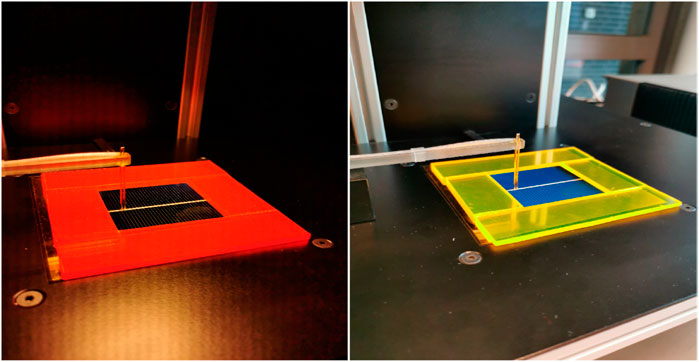
Scientists in Poland have tried for the first time to improve the yield of PV cells with a new type of concentrator based on dyes. The device uses tinted and luminous acrylic glass known as polymethyl methacrylate, which reportedly increases power generation by 1.21%.
Researchers from the Silesian University of Technology in Poland have investigated the improved performance of photovoltaic modules using dye concentrators, finding that their use could result in an efficiency increase ranging from 0.05% to 1.42%.
The scientists explained that the dyes used for their concentrators have different requirements than those used in dye-sensitized solar cells (DSSC), the thin-film solar cells also called Grätzel cells, after the name of their inventor. convert light into electricity via photosensitizers. The DSSC dye compounds absorb light and inject electrons into an array of oxide nanocrystals, which are then collected as an electric current.
The photosensitizers are attached to the surface of nanocrystalline mesoporous titanium dioxide films, which are saturated with redox-active electrolytes or a solid charge transport material. The entire design aims to generate electrical current by moving electrons from the photosensitizer to an electrical output, such as a device or storage unit.
“The requirements for dyes used as concentrators are not as stringent as those for dyes used in DSSC cells,” the academics explained, noting that they must have three key properties: high stability, the ability to sunlight focusing and long-term usability.
“These dyes are used as elements that concentrate solar radiation on a silicon cell; they do not generate electricity themselves and therefore do not have to undergo a series of chemical reactions, do not exhibit properties that allow connection to the conductor surface, or possess redox properties.”
The scientists used yellow and red dye concentrators, luminous or pigmented, based on a tinted and luminous acrylic glass known as polymethyl methacrylate (PMMA). In their tests, they took into account parameters such as cell temperature and illuminance intensity.
“The tested cells showed an average efficiency increase of 1.21% for red luminescent PMMA, 0.25% for yellow luminescent PMMA, 0.41% for yellow pigmented PMMA and 0.13% for red pigmented PMMA,” they specified, stating they noted that the concentrators play a key role in increasing the short-circuit current of the cell. “During testing, the largest increase in short-circuit current was observed for red luminescent PMMA and pigmented yellow PMMA.”
They also identified the red luminescent PMMA concentrator as the best performing of all the devices tested. “It can be concluded that this technology offers potential in improving the efficiency of solar cells, especially for countries that experience all four seasons, with significant dispersed irradiation during the winter season,” they concluded.
The team explained that the proposed concentrators are an optimal solution for large-area photovoltaic systems, as well as for areas where natural light is diffused, as they can operate without direct irradiation.
The new technique was introduced in the study “Improving the efficiency of photovoltaic cells through the use of dye concentrators,” published in Frontiers in energy research. “The tested system was only analyzed on a laboratory scale. It has the potential to be used in large power plants,” the group said referring to the future directions of their work.
This content is copyrighted and may not be reused. If you would like to collaborate with us and reuse some of our content, please contact: editors@pv-magazine.com.
