

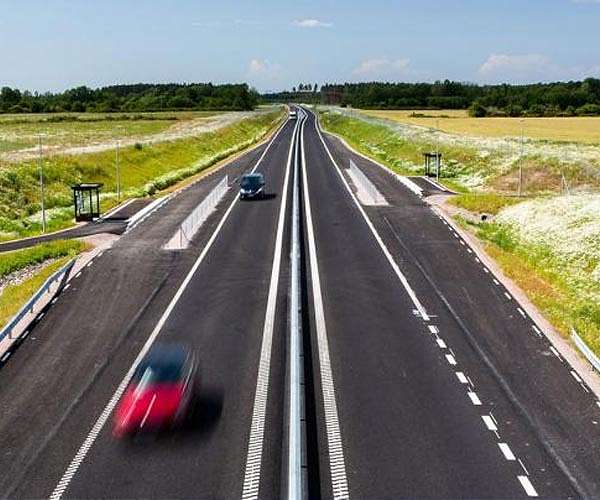
Solar panels above highways can significantly reduce emissions and increase road safety
Covering highways around the world with solar panel roofs could significantly reduce carbon emissions and improve road safety, new research shows. This study, which assessed the costs and benefits of installing solar roofs on global highways, suggests that such a move could reduce CO2 emissions by about 28% by reducing dependence on fossil fuels.
The research proposes a network of solar panels, high above highways and main roads, that would generate electricity while protecting vehicles from bad weather. This study was published in Earth’s Future, an open-access AGU journal focused on interdisciplinary research on the planet and its future.
“There are some pilot programs for highway photovoltaic roofs, but not on the scale we imagined,” said Ling Yao, a remote sensing scientist at the Chinese Academy of Sciences and lead author of the study. “Covering the planet’s highways with solar roofs could generate 17.58 PWh of electricity per year, equivalent to more than 60% of the world’s total electricity consumption in 2023.”
The authors note that these types of innovative solutions are essential to achieving the 1.5 degrees Celsius (2.7 degrees Fahrenheit) warming goal set by the International Panel on Climate Change. Solar photovoltaics have become a major component of new renewable energy installations, accounting for 40% of the total between 2012 and 2021. As the cost of solar panels falls, projects like Yao’s can facilitate the global shift to sustainable energy.
A vision for a renewable and safer future
Yao was inspired by his evening commute when he came up with this study.
“I suddenly looked at the road and thought, ‘The roads are connected. It’s like a network: the cars can move freely from one place to another,'” he said. “I thought, ‘Why don’t we turn our roads into a solar photovoltaic network?'”
Building solar roofs over highways would use already developed land to generate electricity, reducing demand for greenhouse gas-emitting energy and thus reducing carbon emissions. There are over 2 million miles of highways on Earth – enough to circle the equator 251 times.
Although solar parking lots have become more common recently, photovoltaic paved and covered roads are still in their early stages. Although some countries have launched small pilot-scale photovoltaic projects on highways, extensive solar-panel-covered highways remain a distant goal.
The researchers evaluated highways and major roads around the world and estimated the costs of building and maintaining solar panel networks in each region. Their analysis used polysilicon photovoltaic panels with a maximum power generation of 250 watts, angled at 10 degrees towards the outer lanes of the highway.
Yao stated that installing solar roofs on global highways and major roads would require 52.3 billion solar panels. These panels could produce up to 17,578 terawatt hours per year, more than four times the annual energy production of the United States. If this is extended to the main roads, it could generate an additional 13,570 terawatt hours per year.
Cost per megawatt hour and energy potential vary by location, with most installations located near densely populated areas with extensive highways, such as eastern China, western Europe, and the east coast of the US.
By installing these solar roofs globally, the energy generated could replace up to 9.66 gigatons of carbon dioxide generated by fossil fuels annually, equivalent to about two-thirds of U.S. greenhouse gas emissions in 2022.
“This really surprised me. I didn’t realize that highways alone could support the deployment of such large photovoltaic installations, which could generate more than half of the world’s electricity demand and significantly increase the pressure to reduce global CO2 emissions can alleviate,” Yao said.
The study also estimated that solar highway roofs could reduce global traffic fatalities by 10.8%, especially in areas with heavy rainfall, by protecting motorists from the elements. Improved road safety could also reduce the economic costs of road accidents.
Overcoming challenges
Despite the promise, this futuristic highway setup faces obstacles, including high initial costs (potentially up to four times that of ground-based arrays) and maintenance costs. Practical matters such as cleaning billions of solar panels also pose challenges.
Yao remains optimistic, hoping that small pilot programs will expand and that some countries will adopt solar roofs on highways on a large scale. He anticipates that these roofs will be most feasible on long, flat highways, such as those in the southwestern United States.
“Actually putting this into practice is the best evidence to make anyone believe this idea is practical,” he said.
Research report:Covering highways with solar panels significantly reduces CO2 emissions and traffic losses
