

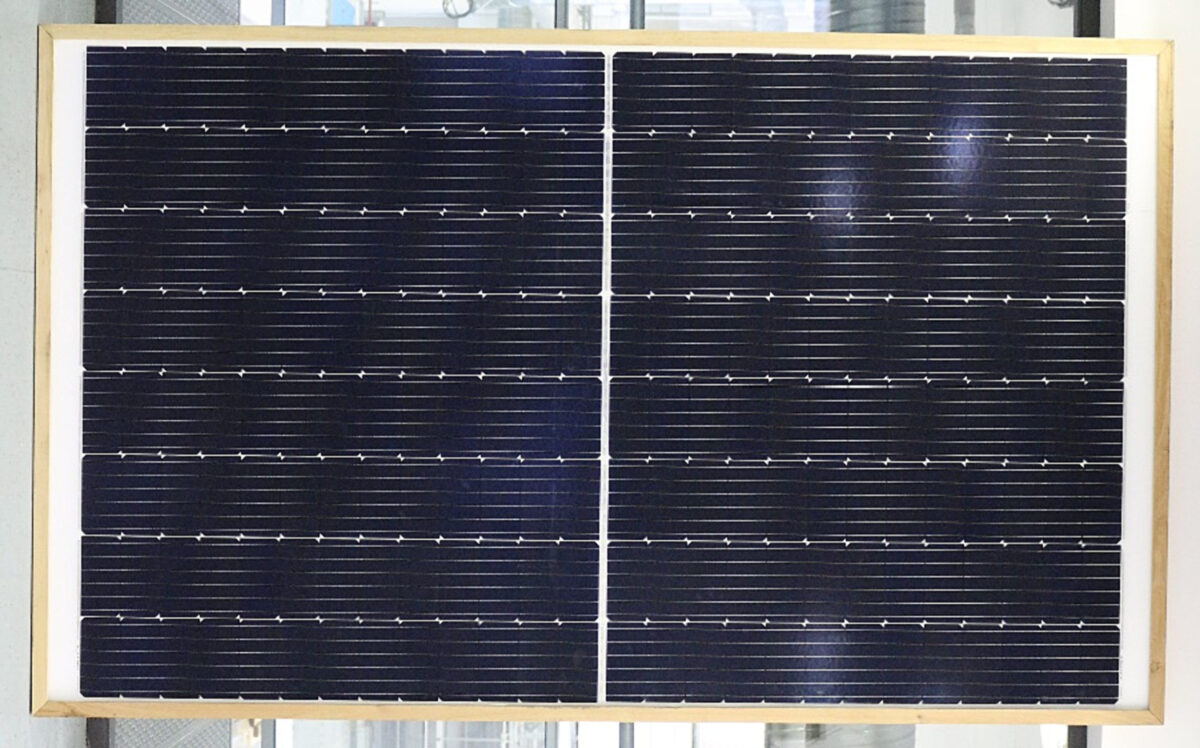
The French research institute presented in a scientific article the technical details of its recyclable heterojunction module with a power of 566 W and an ecological footprint of only 313 kgCO2eq/kW.
Researchers from the French National Institute of Solar Energy (INES) – a division of the French Alternative Energy and Atomic Energy Commission (CEA) – have published a paper describing the technical features of the industrial-scale prototype of a silicon heterojunction (SHJ) module announced early last year.
“The article explains all the technical details and additional results,” corresponding author Timea Béjat told us pv magazine, noting that the team used an in-house ECO PV life cycle assessment (LCA) tool to optimize PV module design with low environmental impact. Béjat also pointed out that a key outcome of the research was that very low carbon designs could be achieved with technologies available today.
The scientists built the panel using a CEA-INES pilot line. They used 130 μm M2 Czochralski wafers, vapor deposition and transparent conductive oxide on both sides in a 6-rail design, cured at 200 C for 15 minutes. The cell bifaciality factor was on the order of 92%, the team noted.
“For a standard PV module, we identify the most important steps we can improve to reduce the ecological footprint,” the research team said. “This prompted us to address the components with the greatest impact on the environmental footprint, namely the wafer, the glass faceplate and the aluminum frame.”
At the cell level, the academics have reduced the thickness of the wafers, which they say are obtained through ‘the European value chain’. Metallization and cell interconnection were optimized to reduce silver consumption. At module level, glass thickness was reduced and the conventional aluminum frame was replaced by a wooden frame with a glass back plate.
“In addition, we applied a ‘design for recycling’ approach to the choice of the encapsulant and backsheet,” the team said. “The combination of these innovations has led us to the realization of a recyclable 566 W module using a tile connection, cells with an average efficiency of 22.57% with an ecological footprint of 313 kg CO2eq/kWp.”
The prototype’s reported carbon footprint of 313 kgCO2 eq/kW is better than that of current conventional modules, which the team estimates ranges between 700 kgCO2eq/kWp and 800 kgCO2eq/kWp.
It is also reported to be lower than that of products from the ‘pioneering manufacturers’ that have achieved CO2 emissions of less than 450 kg2eq/kWp modules, such as Korea’s Qcells, Belgium’s Bisol, Singapore’s REC and Chinese manufacturers JinkoSolar, Trina Solar and Huasun, as noted by the research team in a non-exhaustive list.
In terms of the BOM, the group said it took a “design for recycle” approach, which meant opting for a thermoplastic encapsulant, a fluorine-free backplate and thin glass on the front. Furthermore, using a wooden frame instead of aluminum reduced the carbon footprint by more than 50-60 kgCO2eq/kWp, the researchers noted, but they also emphasized that the full qualification of this type of frame material is not complete.
The team concluded that by optimizing technical parameters and selecting environmentally friendly materials, it was “able to develop an ecologically designed PV panel with a very low carbon footprint,” and demonstrated the importance of finding a compromise between optimizing environmental impact and module performance. and sustainability.
Future work will seek to improve performance and reduce material consumption, such as silver, both at the cell and module level, and integrate recycled material content at all stages of the value chain, the team said. The team also plans to investigate alternative backsheet materials without aluminum and fluorine materials and work to establish the reliability of the alternative frame material.
The “Design for the environment: SHJ module with ultra-low carbon footprintstudy was recently published in Progress in photovoltaics.
This content is copyrighted and may not be reused. If you would like to collaborate with us and reuse some of our content, please contact: editors@pv-magazine.com.
