

Aazzum Yassir, director of technology & operations at Pulse Clean Energy, discusses the technological shift in BESS applications over the past decade as the importance of energy storage has been proven.
When the Paris Agreement was finalized in 2015, it set the world on course to limit global temperature rise to less than 2°C above pre-industrial levels, and ideally to 1.5°C. Few could have predicted how central battery energy storage systems (BESS) could achieve these goals. This groundbreaking agreement required a transformation in the way we generate, distribute and consume energy. Ten years later, we are witnessing the rise of battery storage, not only as an enabling technology, but also as the linchpin of the energy transition itself.
The economics of scale
The contrast between 2015 and 2025 is remarkable in all dimensions. Early projects rarely exceeded 10 MW and offered discrete services, typically frequency response or time-shifting. Current installations routinely reach 50MW to 100MW+, with gigawatt-scale co-located projects becoming standard in markets such as the EU, Texas and Australia. This increase in scale reflects both the maturity of the industry and changing network requirements.
More fundamentally, technology has shifted from custom engineering to standardized commodity products. Projects pre-2015 required bespoke design, with fewer than five major suppliers worldwide and costs of around £800/kWh. Each installation was essentially a prototype. By 2025, we will deploy standardized products priced below £100/kWh from over 100 competitive suppliers across the value chain. This commoditization has eliminated much of the technical and commercial risks that made financing early projects difficult, if not challenging.
The technological innovation
The chemical landscape has been completely redrawn. Sodium-sulfur and lead-acid batteries dominated early stationary storage, with nickel-manganese-cobalt (NMC) lithium-ion emerging as the premium option. Today, lithium iron phosphate (LFP) is responsible for more than 95% of new network-scale installations worldwide.
This transition was not just about cost, as LFP provides superior thermal stability, eliminates dependence on cobalt and extends the overall lifecycle of BESS.
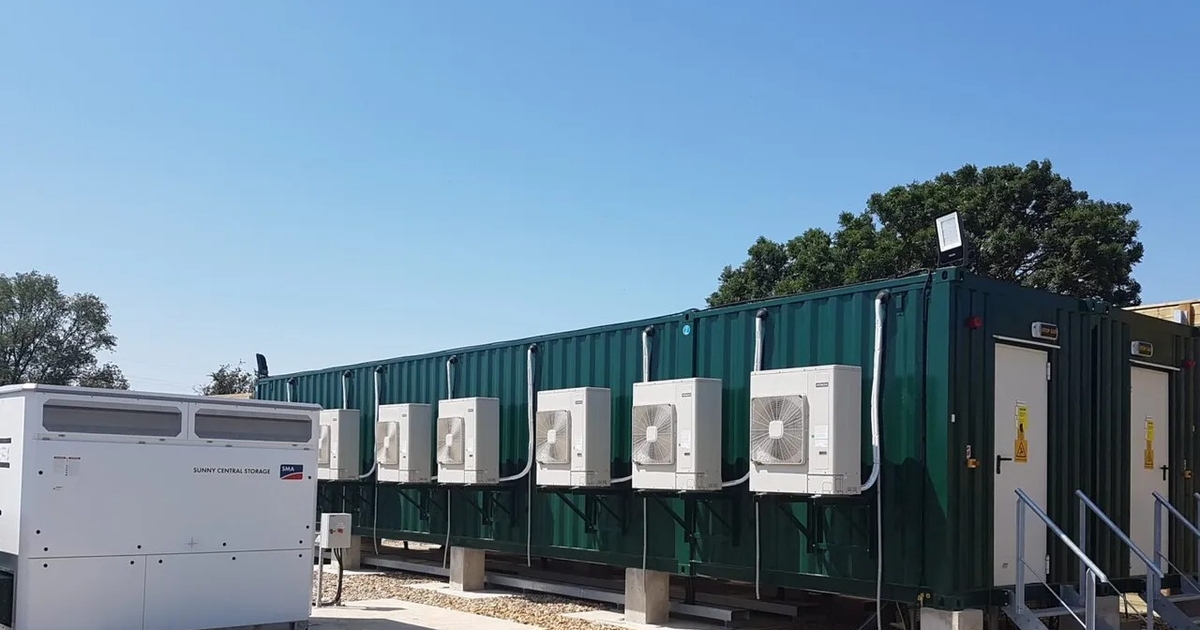
Physical packaging has evolved in parallel. Ten years ago it was standard to put 1MWh into a 40-foot container using NMC chemistry. Today’s systems pack 6MWh or more into 20-foot containers – a 12-fold improvement in volume energy density. This progress is also reflected in the project economics: less land required, lower, simplified interconnection and lower system balance costs. For developers, this means that the same site that could host 10MWh in 2015 can now host 120MWh or more.
Sodium-ion batteries are now on the horizon as the potential successor to LFP and the next frontier for grid-scale applications. The relative abundance of this mineral gives it the potential to become much cheaper in the future, making it a viable alternative to lithium-ion. According to BloombergNEF, sodium-ion batteries could account for 23% of the stationary storage market by 2030, translating into a capacity of more than 50 GWh. That estimate could even be surpassed if advances are made in technology and supply chains using similar equipment as for lithium-ion batteries.
BESS as an investable asset class
The commercial structures underlying battery projects have matured along with the technology. Early UK projects relied heavily on innovation funding through Ofgem’s. By 2025, the market will have evolved towards stackable products for sellers and various income-enhancing products. These include energy arbitrage, frequency response services (such as Dynamic Containment), capacity market payments and participation in balancing mechanisms. Long-term service agreements have evolved from a limited offering to comprehensive packages that make projects truly profitable and attractive for private investment.
Data as a basis for investments
Across countries and technologies, data is becoming an important part of the storage strategy. Accurate data and insights on hourly carbon emissions are critical for optimizing deployment and verifying impact – for investment decisions, ESG reporting and building credibility with policymakers and communities.
As the rollout of BESS continues to accelerate, the industry needs consistent frameworks for measuring and verifying impact. There are a number of industry innovations aiming to address this, including our work with LCP Delta and the UK National Wealth Fund to develop an industry-first carbon emissions calculator. This tool allows BESS asset managers to track and certify emissions saved through operations, providing the standardized proof points asset managers need to track and certify carbon emissions saved through BESS use.
This verified data shows that it will build trust, attract capital, and give investors and policymakers the evidence they need to confidently support the energy transition.
The grid of the future
The UK energy system is facing a significant and necessary transformation. Peak demand is expected to rise from 58 GW to 144 GW in 2050 – an increase of 150%. Annual consumption could almost triple from 290 TWh to 800 TWh. To meet this demand in a sustainable manner, an expansion of renewable capacity from 49 GW to 250 GW is required. Therefore, storage capacity must increase to meet this demand and absorb the excess energy.
The decade since Paris has transformed battery storage from promising technology to indispensable infrastructure. The systems we deploy today stabilize networks, enable sustainable integration, provide support services and generate verifiable carbon savings. Looking ahead, BESS will evolve to offer a growing portfolio of services. These systems will increasingly be co-located with data centers and renewable generation to form localized microgrids, creating resilient energy ecosystems at the point of demand.
With continued innovation in chemistry and production efficiency, BESS can fulfill its role as a technology that not only enables the energy transition, but also technically and economically superior at scale.
