

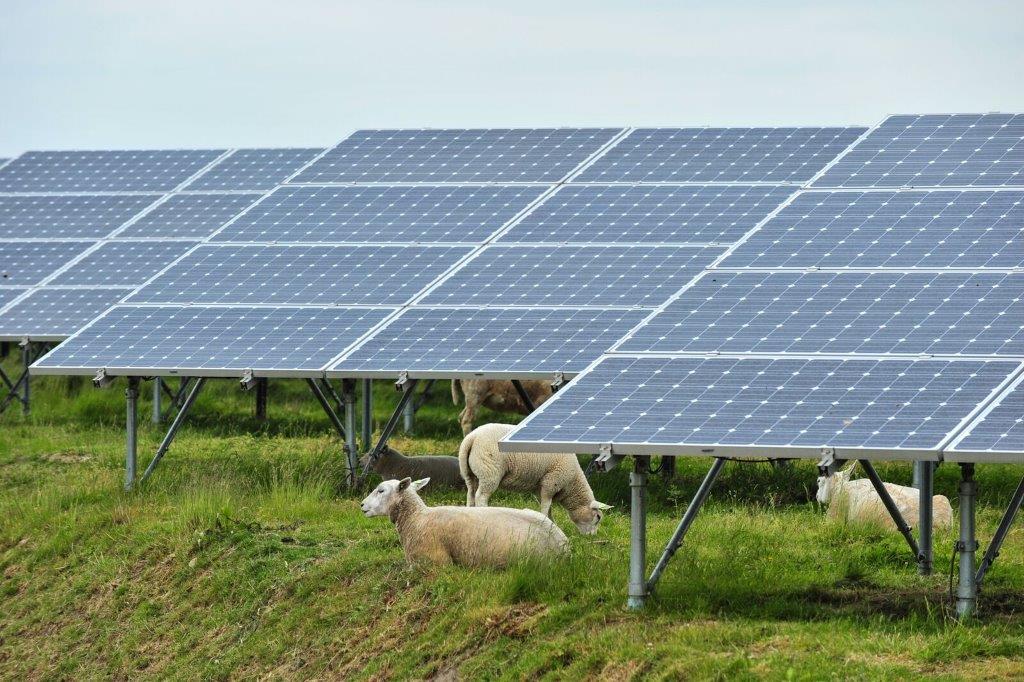
Researchers have analyzed the biomass and nutritional value of grasses and legumes for grazing dairy cattle, which grow on agrivoltaic fields. The results showed that forage quality in agrivoltaic environments can be maintained or even improved.
A research team from the University of Minnesota in the United States has investigated the impact of agrivoltaic installations on the yield and nutritional quality of grasses and legumes for grazing dairy cattle.
“This study is one of the first to evaluate forage biomass and forage quality of multiple grass and legume species grown under different agrivoltaic solar panel designs in a grazing dairy system,” said corresponding author Bradley J. Heins. pv magazine. “We wanted to determine how solar intensity and solar panel configuration affect both forage yield and forage quality. We need more research on what to grow under solar panels, and this is some of the early research that gives farmers and solar developers guidance on what to plant.”
He added that his team plans to expand the research next summer and investigate vertical bifacial solar panels. “We’ll compare this to a regular ground-mounted solar installation for livestock grazing. We’ll really look at the economics of different solar panel configurations,” he said. “We will also evaluate animal performance and long-term grazing behavior in agrivoltaic systems.”
The crops were planted under a 30 kW PV site, a 50 kW PV site and one control site near the university.
The 30 kW solar site had fixed solar panels mounted at 35 degrees south latitude, while the 50 kW site was square in shape, with a flat top array and reflectors. At both locations the panels were mounted 2.5 to 3.0 m above the ground. During the study, which was conducted from May 2022 to September 2022 and from May 2023 to September 2023, no livestock were allowed to graze on the test plots.
Forages include alfalfa, field peas, meadow fescue, orchard grass, red clover, brown midrib sorghum-sudan grass and white clover. In addition, the crop range included three mixtures of grass and legumes with alfalfa, red clover or white clover. Feed samples were cut three times per year when the feed reached a height of approximately 25–35 cm, which corresponded to the recommended height for lactating dairy cows.
Samples were dried at 60°C for 99 hours to determine dry matter concentration, and two samples from each plot were randomly selected for botanical composition. They were then sent to a laboratory, where they were analyzed for crude protein, neutral detergent fiber, acidic detergent fiber, mineral concentrations, and total neutral detergent fiber digestibility (TTNDFD).
The analysis showed that forage biomass was lower on the 50 kW solar installation (3,223 kg/ha) than on the 30 kW solar installation (8,968 kg/ha) and the control pasture (9,987 kg/ha). The 50 kW forage contained more crude protein on a dry matter basis, 23.8%, compared to 20.1% at the 30 kW site and 18.2% at the control pasture. The 50 kW forages also had a higher TTNDFD, at 54.4%, compared to 52.3% at the 30 kW site and 49.1% at the control pasture.
“The results showed that feed quality can be maintained or even improved in agrivoltaic systems,” Heins concluded. “We didn’t really know what to expect. But we discovered that grasses – namely orchard grass and meadow fescue – have high biomass production under solar panels compared to growing in a regular pasture.”
The results appeared in “Agrivoltaic arrays and effects of forage biomass and nutritional value of grasses and legumes for grazing dairy cattle”, published in JDS communications. Scientists from the University of Minnesota and the University of New Hampshire participated in the research.
This content is copyrighted and may not be reused. If you would like to collaborate with us and reuse some of our content, please contact: editors@pv-magazine.com.
