Researchers in Denmark have found that using a large-scale air-to-water heat pump in solar district heating can significantly reduce levelized heating costs. The proposed system configuration was simulated for an existing district heating plant in Denmark and was shown to improve the flexibility of the system in response to energy prices.
Researchers from the Technical University of Denmark have investigated how large-scale air-to-water heat pumps can be combined with PV-powered district heating systems with the aim of reducing levelized heating costs and improving system flexibility. They explained that air-to-water heat pumps have the ability to produce and store heat in tanks when electricity prices are low, allowing the stored heat to be used during periods of high electricity prices.
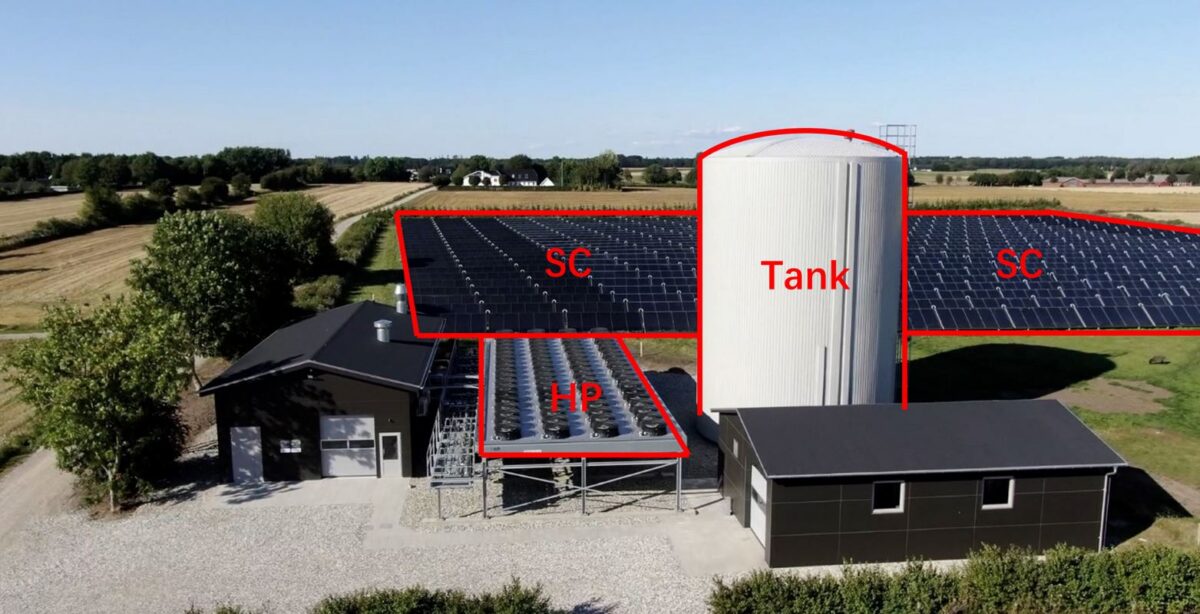
The proposed approach was simulated via TRNSYS software in an existing solar district heating system in the Danish city of Ørum. The system consists of a ground-mounted solar thermal power plant, a 2.5 MW heat pump, a gas boiler and a 1,000 m3 vertical cylindrical hot water tank.
“In this system, the heat pump plays a dominant role in a fluctuating energy market due to its flexibility in collaboration with the boiler,” the scientists explain. “The medium to low temperature water in the tank can preheat the refrigerant before it enters the compressor, increasing the coefficient of performance (COP) of the heat pump. Consequently, the heat pump is expected to improve equipment compatibility and heating system flexibility.”
The group assumed the system would operate between 2020 and 2022 and specified that it would operate without a heat pump in the first year, while it would operate in the second and third years. The 6,355 The m2 solar thermal system can meet the heat demand in summer, but in winter gas boilers are needed to meet the higher demand. The tank can be used in different modes to decouple heat production and demand.
Image: Technical University of Denmark, Renewable Energy, Common License CC BY 4.0
It is assumed that the heat pump uses ammonia as a refrigerant and relies on a screw compressor and a reciprocating compressor. The exhaust temperature is indicated at 67 C.
“An economizer is incorporated to increase the temperature of the refrigerant before it enters the compressor,” the group points out. “This improvement leads to a reduction in electricity consumption, as the compressor maintains the required outlet temperature more efficiently compared to a heat pump system without an economizer.”
The scientists’ techno-economic analysis showed that the economizer was able to increase the COP of the heat pump from 3.33 to 3.53 at an ambient temperature lower than 5 C. It also showed that the levelized heat costs of the system improved by up to 3.53. 19% in 2021 and 37% in 2022.
“The heat production of the heat pump decreases as electricity prices rise to an acceptable level,” the group explains. “As soon as the spot price for electricity exceeds a certain threshold, the heat pump is switched off and the boiler becomes the main additional heating.”
The analysis also found that the system’s annual seasonal COP increased from 1.22 to 2.62 over the three-year time frame of the simulation.
“However, the coupling effect of the heat pump and its economizer only slightly improved the efficiency of the solar collector and the heat pump itself,” the academics said. “Replacing the air heat pump with a water-to-water heat pump could reduce the return water temperature of the SC field, which is expected to increase SC efficiency.”
The details of the system are available in the study “Thermoeconomic analysis of a solar district heating system with an air-water heat pump”, published in Renewable energy.
This content is copyrighted and may not be reused. If you would like to collaborate with us and reuse some of our content, please contact: editors@pv-magazine.com.
Popular content