

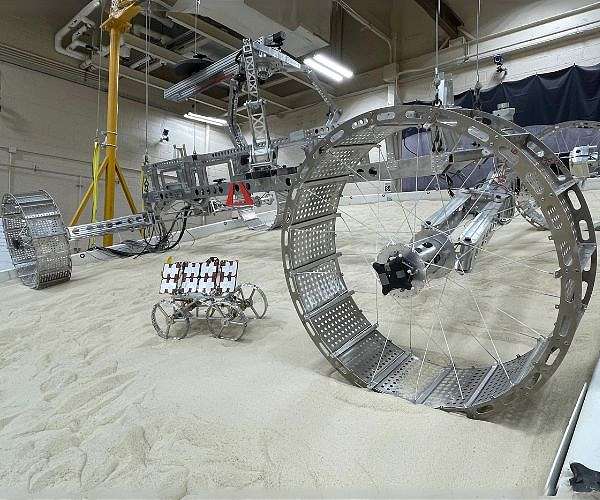
Astrobotic’s VOLT rover passes key tests on the moon’s surface
Astrobotic has further ramped up its efforts to create a power grid on the moon by launching a summer-long test campaign for its VSAT Optimized for Lunar Traverse (VOLT). Designed to traverse the lunar surface, the VOLT rover features a vertical solar panel to harness solar energy to charge various lunar resources such as habitats, rovers and scientific instruments, especially at the moon’s south pole.
The VOLT engineering model mobile base underwent rigorous testing at the Simulated Lunar Operations Laboratory (SLOPE) at NASA’s Glenn Research Center in Cleveland. These tests assessed the rover’s stability, gimbal functionality, and sun tracking on a simulated lunar regolith slope. Although designed for slopes of 15 degrees, the rover exceeded expectations by maintaining stability on a 20-degree slope without skidding.
VOLT’s gimbal maintained a horizontal position within a tolerance of 3 degrees, proving it can support the 18-meter-high vertical solar panels that will be integrated later this year. NASA Glenn’s motion capture cameras confirmed the rover’s stability on a regolith surface, ensuring its ability to navigate the expected terrain of the moon’s south pole.
“To provide continuous power to the moon’s poles, we need to take advantage of existing peaks of persistent light: locations with near-constant sunlight throughout the year. Because most of these locations are on crater rims with high slope angles, we designed VOLT to be deployed on extreme slopes. These tests have proven that our system can work successfully, with sufficient margin for more extreme locations,” said Robert Rolley, Astrobotic principal investigator for VOLT.
Before the test campaign, the Astrobotic team developed, prototyped and assembled the mobile base of the VOLT, a rover with a chassis the size of a minivan. Assembly, including electronics and gimbal system, was completed within 12 weeks. The gimbal is crucial for orienting the solar panel to collect sunlight, leveling it on uneven terrain, and maintaining stability as it autonomously tracks the sun in 360 degrees. The VOLT can be delivered to the moon on Astrobotic’s lunar lander Griffin and operate independently without the need to be towed.
VOLT is an integral part of Astrobotic’s LunaGrid system, designed to provide power to the moon. LunaGrid is a network of tethered VOLTs that generate and distribute power via wired connections and wireless chargers on board tethered CubeRovers, which act as mobile plugs. This system aims to support lunar systems during the day and ensure their survival during the lunar night.
“It is imperative that we solve the lunar power generation challenge for sustainable long-term operations,” said John Landreneau, Senior Project Manager at Astrobotic. “VOLT’s ability to precisely drive and operate in the most desirable areas for solar energy capture and distribution sets this technology apart. With strategic partnerships and new technology developed in-house by our team, VOLT and the LunaGrid system are making great strides to deliver reliable energy to lunar surface systems such as landers, rovers, habitats and science suites.”
The full VOLT engineering model will be unveiled in late October at the Keystone Space Conference in Pittsburgh, PA. Astrobotic aims to deploy and demonstrate LunaGrid elements on the lunar surface by mid-2026, with the first operational LunaGrid expected at the moon’s south pole by 2028.
