

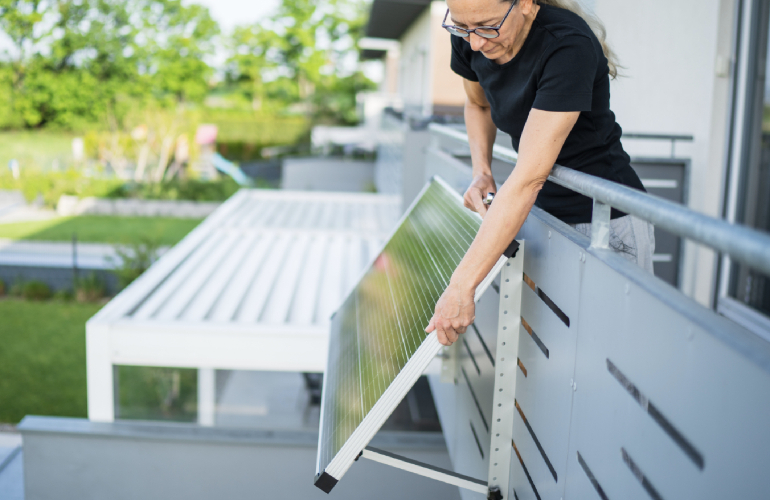
Plug-in solar, also called balcony solar, is a popular option in Europe and is now being introduced in the United States. Utah introduced legislation last year and became the first state to enable 1.2 kW plug-in solar panel systems without utility approval. Now, plug-in solar is finding interest in the nation’s largest solar state.
 Earlier this week, Senate Bill 868 was introduced in the California Senate, written by Senator Scott Wiener (D-San Francisco). The “Plug Into the Sun Act” would eliminate red tape and set statewide safety standards for portable solar energy systems – commonly seen on balconies across Europe. Reducing permitting and interconnection barriers would allow households to generate their own clean energy and reduce electricity costs with plug-and-play solar technologies.
According to Environmental working groupSolar systems for balconies can be mounted to a railing or tilted in a backyard and plugged directly into a standard 120 V outlet using an integrated microinverter. Some plug-in systems also include a battery. The solar systems are small, often no more than 1.2 kW, and cost barely more than $1,000.
Standards group UL Solutions has taken notice and unveiled a new testing program for plug-in solar systems. The program is an evaluation based UL 3700the standard for interactive plug-in PV equipment. It defines construction, performance and labeling criteria tailored to plug-in solar energy systems and provides manufacturers with a reliable basis for designing products that consistently meet safety and performance requirements.
“Our new certification program for plug-in solar systems gives manufacturers and consumers the clarity they need to embrace plug-in solar systems with confidence,” said Ken Boyce, VP Principal Engineering, Industrial Testing, Inspection and Certification at UL Solutions. “By defining how these systems should be built, assessed for safety and safely installed, UL 3700 helps mitigate potential risks and opens the way for more people to access resilient solar energy.”
Solar energy systems connected to a household circuit pose certain risks, such as systems becoming overloaded and the possibility of electricity flowing back into the pipes. In addition to defining safety standards for manufacturers, UL 3700 addresses these additional risks by requiring features that reduce accidental contact with hazardous electrical parts, promote safe installation, protect against overloads, and prevent electrical current from flowing in the wrong direction. Plug-in solar systems certified to UL 3700 may be suitable for renters and homeowners who cannot install rooftop systems and can be used to provide backup power for essential appliances during outages.
