

The development and construction of battery energy storage systems (BESS) in Massachusetts has become more feasible with the expansion legal protections and the implementation of new safety regulations. Energy storage has been called a ‘Swiss army knife’ because it enables a wide range of applications, including peak shaving, grid stabilization and distributed generation grid integration. Despite its versatility and increasing energy demand, BESS development has faced significant barriers. Local safety concerns and inconsistent municipal permitting procedures have often delayed or discouraged projects. Even with these challenges, energy storage remains essential to the Commonwealth’s clean energy transition, with the Clean Energy Act of 2024 calling for 5,000 MWh of storage by 2030.
An important turning point in the development of BESS occurred with the 2025 Massachusetts Land Court decision regarding an energy storage project in Duxbury. That case ruled that the Commonwealth’s “Solar Energy Provision” applies to stand-alone BESS systems. The Solar energy facilities reads:
“No zoning ordinance or regulation shall prohibit or unreasonably regulate the installation of solar energy systems or the construction of structures that facilitate the collection of solar energy, except as necessary to protect the public health, safety or welfare.”
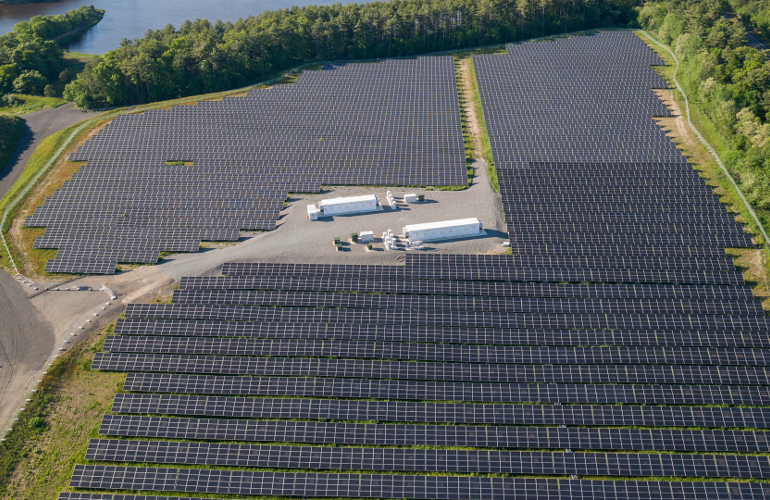
A solar + storage facility in Assonet, Massachusetts. (Credit: Borrego/Cleanleaf Energie)
The court reasoned that the legislature intended the solar energy provision to promote the generation of solar energy, and that the law explicitly includes structures that support or facilitate the use of solar energy, including the construction of stand-alone BESS facilities. The court rejected the argument that BESS facilities must only store solar-generated electricity to qualify for protection under the Solar Energy Provision of the Dover Amendment, thus extending protection to such storage systems, and further reasoned that a BESS structure is within the meaning of the Solar Energy Provision. This means that municipalities cannot ban or unreasonably regulate such systems. The Duxbury decision follows long-standing precedent in support of renewable energy infrastructure in Massachusetts, including Tracer Lane II Realty, LLC v. Walthamwhere the Supreme Court ruled that restricting solar energy development without a reasonable purpose to protect public health, safety, or welfare violated the Dover Amendment’s solar energy provisions.
In recent years, applying for permits, and not installation, has been the real barrier to the development of BESS. Duxbury removes one level of complexity by forcing municipalities to make BESS requirements substantially the same as those for solar. After the summer of 2025, Massachusetts made a concerted effort to standardize the permitting process for all BESS systems. This has taken the form of a new one zoning planin which cases such as Duxbury And Tracer Avenue are explicitly stated to provide municipalities with a framework of which restrictions are no longer appropriate and to better set expectations for developers.
While the Duxbury decision clarifies the scope of legal protections for BESS projects and reduces restrictive local zoning; many municipalities continue to focus on safety and operational risks when evaluating proposed facilities; Concerns about such risks have influenced local decision-making as much as zoning considerations. However, modernization of technical and fire safety standards specific to energy storage has significantly weakened the argument that BESS facilities pose a threat to public safety. Understanding how current standards address and mitigate risk is essential to appreciating the framework within which BESS projects are currently assessed and permitted in Massachusetts.
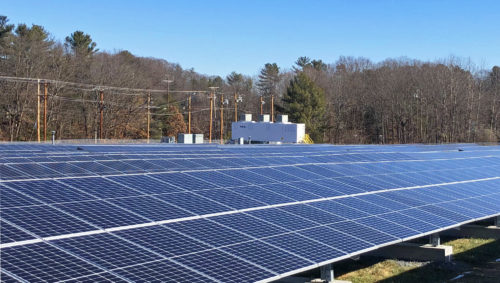
A 4.5 MW solar project installed with a 3.8 MWh lithium-ion storage solution at a landfill in Amesbury, Massachusetts. Credit: CS Energy
Nationally recognized safety standards and tests, including NFPA 855 and UL 9540A, now provide a framework for system design and operation. Although fire risk is not eliminated, these safety standards significantly reduce both the likelihood and severity of a thermal event.
The American Clean Power Association Study from 2025 The 35 documented BESS fire incidents revealed that the majority of BESS fires occurred in older systems built before the adoption of current standards. This study highlighted that the environmental impact of such incidents has been limited, and that “airborne emissions are short-lived and localized, risks of soil and water contamination are minimal, and existing fire suppression strategies further limit potential damage to the environment.”
The BESS approval will of course always be subject to additional safety requirements. Massachusetts developers should take this into account 2020 NFPA 855not only because this is the most recent safety regulation regarding BESS, but because its contents have been adopted into the Massachusetts Fire Code. The bar for approving a BESS system is still high, but at least it is now clear where it lies.
Massachusetts’ ambitious clean energy goals establish BESS technology as a critical, yet cost-effective component for integrating renewable generation and ensuring grid reliability. Stronger regulatory protections, enabling reforms, and improved safety standards have created a more predictable development and permitting environment for BESS developers, fueling the growth of battery storage projects across the Commonwealth.
Developers entering this market still must navigate complex zoning regulations, changing fire safety requirements and project-specific permitting challenges.
Tanya M. Larrabee, partner at Sherin and Lodgen, represents renewable energy clients in the acquisition, development and financing of solar, wind and energy storage projects, including advice on government incentive programs. Tanya assists with complex renewable energy transactions, including advising lending institutions and borrowers on construction and term financing for clean energy projects and advising developers, commercial property owners and landowners on local permitting, project development and leasing for solar and battery energy storage projects. She works directly with clients to draft and negotiate a wide range of renewable energy agreements, including power purchase agreements, solar leases and financing documents.
Wilson Redfield is a paralegal at Sherin and Lodgen.
