

February 25, 2026
Business Renewables Center Canada (BRC) provided its vision on the solar energy market in Canada for the period 2025-2026 via an open webinar on January 28. While the power purchase agreement (PPA) market in Alberta plummeted in 2025, BRC offers hope for growth in other provinces – most notably Nova Scotia – in 2026.
BRC is a Calgary-based renewable energy PPA facilitator that claims more than 90% of renewable PPAs in Canada to date have been executed by a BRC member, either on the buyer or developer side. The agency operates the Deal trackerwhich launched in 2019 and provides an overview of all new sustainable projects in Canada on a quarterly basis, as information becomes publicly available.
In the short term, results for renewables in Alberta are weak, according to Jorden Dye, the director of BRC-Canada, who moderated the webinar: “It is very doubtful that renewables [generation] Investments will pick up again in the short term.”
“There is currently a complex mix of this [provincial] policy is still taking shape. So once these are taken care of, we will see the market slowly open up and absorb more activity,” said Margret Nellissery, a senior analyst at BRC-Canada who also spoke during the webinar.
Top 100 sustainable goals of companies
Short-term slowdowns in PPAs are expected to increase in coming years, Dye suggested.
“We looked at the 100 largest companies in Canada and their environmental commitments and asked what that would mean for demand? [we found] a large demand number with 7.7 GW of new renewable energy demand from the top 100 companies alone, through 2040,” says Dyes. “That alone would be enough to power just under 2 million homes in Canada.”
This long-term business planning for additional renewable energy sources will impact most of Canada, BRC found.
“The 7.7 GW of the top 100 companies was spread across mainly eight provinces, and of course Ontario came out on top with a majority of the project share,” says Nellissery.
Dye adds that Alberta may no longer be the largest renewable energy investment in the province in the coming years.
“In reality, all nine other provinces in Canada [aside from Alberta] have initiated or implemented initiatives in recent years to grow renewables, meaning Alberta could fall from its five-year reign at the top of the renewables investment list to the bottom or near the bottom,” says Dye, adding that “if you push that through [Top 100 planning] to the top 500 companies in the Canadian economy, we are talking about tens of gigawatts of demand in 2040.”
Aside from the sluggish corporate PPA market, solar micro-generation has grown significantly, Dye says.
“Congratulations to the micro-generation in [Alberta] where the total capacity has doubled between 2023 and 2025, connected to the electricity grid. We know from utilities that there is much more in the pipeline, he adds.
Optimism for storage emerges
While “policy reforms have resulted in almost total pessimism for wind and solar energy, it has also led to some emerging optimism around storage,” says Dye. “[Storage] is poised to expand dramatically in other jurisdictions that have enabled its use in the coming months and years.”
Dye added that the U.S. market helps predict activity in Canada.
“I think this is a very important point: we have seen an explosion in the number of storage and storage-related power purchase agreement projects in the US market over the last five years,” says Dye. “The U.S. market has always been a good indicator of where deals in the Canadian market are going.”
The overall national impact of the renewable PPAs signed since 2019 is significant. “Collectively, these projects generated approximately CAD7.6 billion in investment and supported more than 7,000 jobs during the construction sector’s peak,” BRC calculated.
Benjamin Thibault, senior strategy advisor at Prairie Sky Strategywho was also a webinar speaker, summarized a dozen or more renewable energy policy and legislative issues that BRC is tracking. Tracking all these issues is complicated, but “BRC’s annual report – Renewables in Review 2025 – released yesterday contains a very complete policy timeline to 2025, and is the best way to track this,” he says. BRC also provides a bimonthly update on the policy.
Alberta PPA market flat
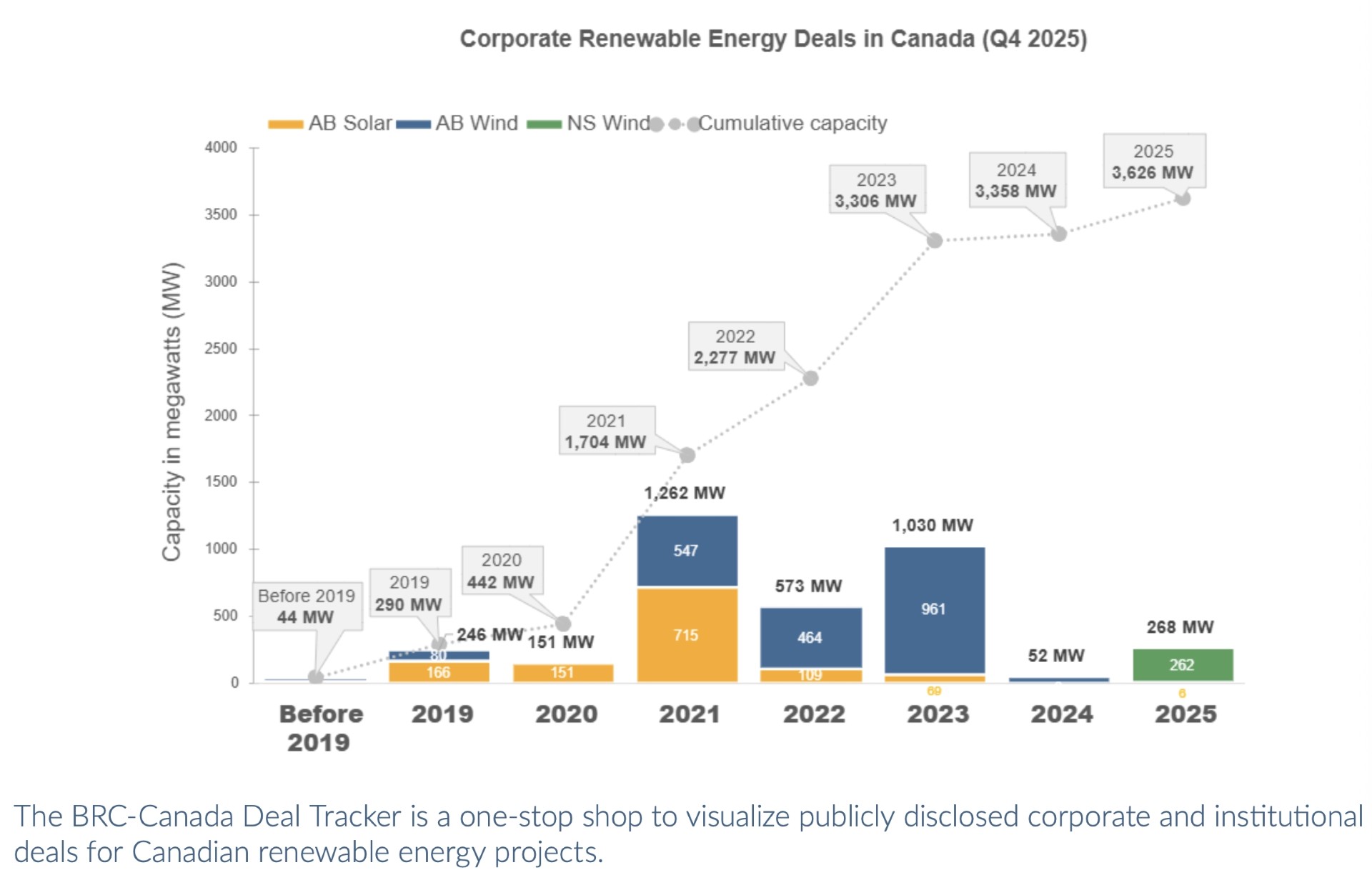
“Looking at [Alberta in] In 2025, things weren’t as strong for deals overall,” says Nellissery. “While deal volume increased compared to 2024, Alberta experienced its largest ever decline in offtake volume. Only 6 MW from a solar project was contracted in the entire province.”
Dye underscored the delay in Alberta’s development planning.
“As the corporate procurement market stalled in late 2023, developers continued to complete their projects under construction and kept their development pipeline alive,” he says. “But this year tells a slightly different story, and the headline is that with a frozen commercial offtake market, many developers have given up and walked away.”
Nevertheless, the historical development total in Alberta alone is significant. “The PPA back projects we just saw have produced more than 12 TWh of energy annually, and this is enough to power approximately 1.7 million homes in the province,” BRC counted.
This market development in Alberta has also helped local and provincial governments through tax collection. “Focusing just a little bit on Alberta, projects made possible by these PPAs alone have generated approximately $30.8 million in municipal tax revenue across the province,” BRC said.
Nova Scotia, Saskatchewan renewables rising
“We finally added a new province [to our Deal Tracker]something we have been eagerly awaiting for the past few years and that is with Nova Scotia. Through the Green Choice Program, Nova Scotia Power has enabled the purchase of approximately 262 MW of wind energy,” Nellissery said. The Nova Scotia deal brokered through the Green Choice Program will produce more than 2 TWh of energy annually, which could power more than 200,000 homes in the province, according to BRC.
In addition to the warming market for new renewable energy sources in Nova Scotia, Saskatchewan also showed growth in development through 2025 and promise through 2026.
“We also saw a new deal emerge from another province that was slowly starting to open its market to PPAs, and that is Saskatchewan. We saw a deal between K+S Potash Canada and George Gordon Development, an Indigenous developer, for a 32 MW solar project,” says Nellissery. This deal, the Wicehtowak Solar Project, is significant because it is Canada’s largest indigenous solar project to date.
Tags: Canada, energy storage, PPA
