

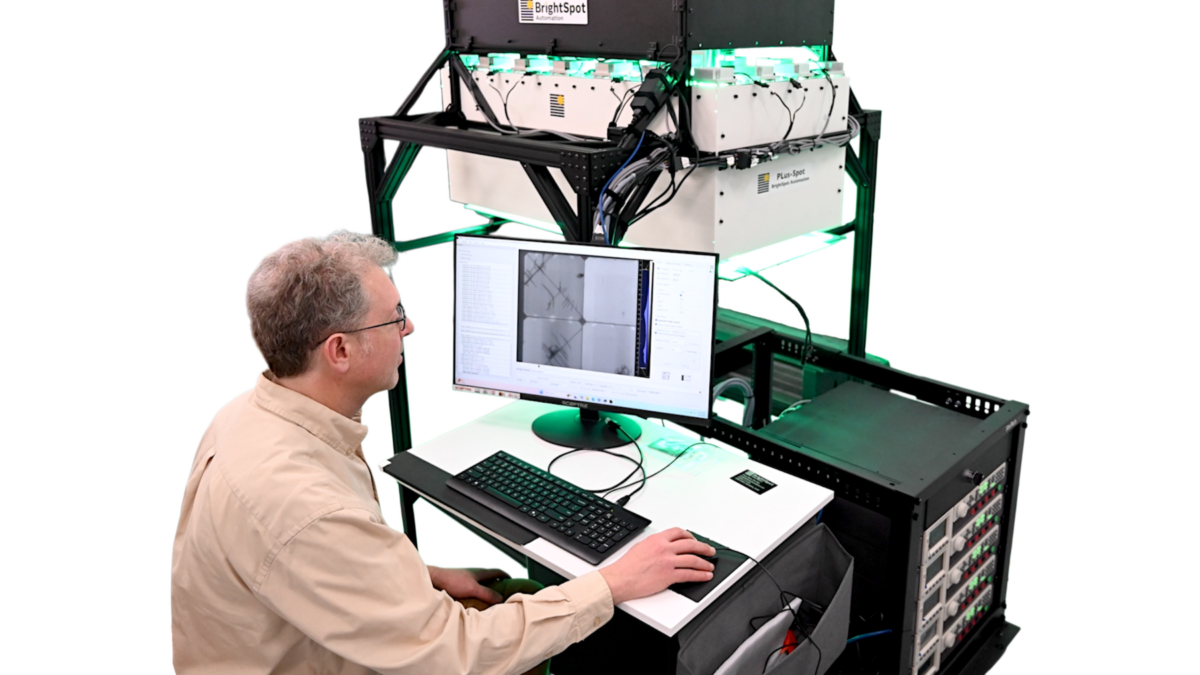
The US-based metrology equipment manufacturer has launched a non-contact photoluminescent imaging system to reveal defects and other non-uniformities in silicon, thin-film and III-V multi-junction PV devices.
US-based inspection equipment manufacturer Brightspot Automation has launched Plus-Spot, a non-contact photoluminescence (PL) imaging tool to reveal defects such as cell cracks, thin-film shunts in panels and other non-uniformities. It is suitable for quality control in silicon, thin film and III-V multi-junction space cell manufacturing applications, supporting devices ranging in size from mini-modules to large-scale conventional panels.
The new Plus-Spot tool supports off-line and in-line quality control processing, as well as pre-installation quality control and research and development activities. According to the company, the panels can be partly processed or finished.
As a non-invasive or contactless system, it quickly detects defects and non-uniformities without cabling. “Standard capabilities include single-intensity PL imaging, intensity-stepped PL imaging and time series imaging,” a company spokesperson said. pv magazinenoting that multispectral imaging with a filter wheel and electroluminescence (EL) imaging are also supported.
Additionally, the tool enables biased PL imaging, monochromatic and bichromatic light IV and dark IV measurements, spot spectral characterization, and detection of backside glass cracks in superstrate cadmium telluride (CdTe) panels.
“Front glass cracks in CdTe panels are easily seen on standard PL images. Successful PL imaging has been confirmed using hazy encapsulant for layup table applications,” the company spokesperson said.
The system’s cameras have resolutions from 20 to 61 megapixels with customizable filters to match customers’ semiconductor band gaps. The dimensions of the test area are also customizable.
The LED arrays have heat dissipation, support up to 1 solar intensity and are available in blue or green depending on customers’ applications. Programmable power supplies control the LED arrays. The arrays are enclosed to eliminate room light artifacts and improve light intensity and uniformity, the company said.
The housing is a custom metal frame for integration into a factory conveyor system or above a table. “The tool can be oriented for sunny side up, sunny side down or sunny side side panel orientations,” the spokesperson said.
It can be used by thin film manufacturers developing products based on perovskites, CdTe and copper indium gallium selenide (CIGS) to check film quality after each processing step for statistical process control. “For example, imaging can be performed after the perovskite layer deposition step and then again after the electron transport layer step,” the spokesperson said.
Building-integrated PV (BIPV) and vehicle-integrated PV (VIPV) manufacturers who typically purchase panels to integrate into end products can use them to test incoming devices prior to integration, or to test them after integration.
Another customer group is satellite solar panel manufacturers who can use the system to inspect purchased panels for cell cracks prior to integration, or to test panels mid-production or to inspect panels after installation.
Brightspot Automation claims more than 200 customers use its PL and EL systems worldwide across the PV value chain. The proprietary IMPEL software reportedly embodies its expertise in detecting defects in EL and PL images and assessing these images based on customer requirements.
This content is copyrighted and may not be reused. If you would like to collaborate with us and reuse some of our content, please contact: editors@pv-magazine.com.
