

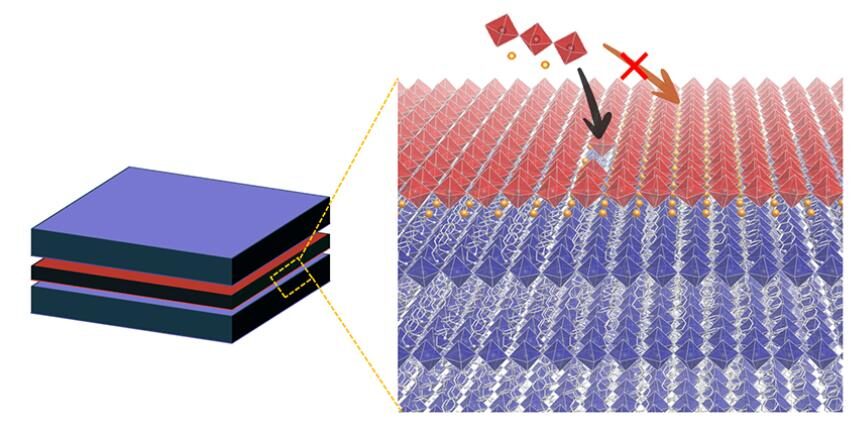
A University of Cambridge-led team of researchers has demonstrated precisely controlled layer-by-layer epitaxial vapor growth of two-dimensional halide perovskite films in an industrially compatible process. Their findings could help in the development of more thermally stable perovskite solar cells.
A team led by researchers from the University of Cambridge in the United Kingdom has demonstrated layer-by-layer (LbL) vapor-phase based growth of halide perovskites, specifically cesium, lead and bromine (CsPbBr3), grown on a two-dimensional (2D) perovskite single crystal. The 2D substrate was PEA2PbBr4, where PEA is an acronym for 2-phenylethylammonium.
“The resulting CsPbBr 3-PEA 2 PbBr 4 heterostructure exhibited accurate and uniform layer thicknesses at the Angstrom level down to the monolayer, which is important for quantum-confined applications,” the researchers said in “Layer-by-layer epitaxial growth of perovskite heterostructures with tunable band offsets,” published in Science.
“The hope was that we could grow a perfect perovskite crystal while changing its chemical composition layer by layer, and that’s what we did,” said co-first author Yang Lu in a statement. “It’s like building a semiconductor from scratch, one atomic layer after another, but with materials that are much easier and cheaper to process.”
The scientists emphasized that the process is scalable, solvent-free and industrially compatible and stated that, to their knowledge, it was a first for such precise LbL growth in perovskite-related heteroepitaxy.
There is potential for the technology in solar PV processing, among other optoelectronic applications the study’s corresponding author, Samuel Stranks. “For perovskite deposition, vapor equipment is commercially available, brought online over the past five years, and more and more options are coming to market, with increasing attention from both academia and industry,” Stranks shared. pv magazine, notes that the research opens new approaches for further improving and stabilizing PV.
The group is now trying to turn these sandwich structures into multilayer structures and demonstrate them in “fully functioning” devices, such as solar cells, light-emitting diodes (LED), radiation detectors and quantum devices, Stranks said.
The article emphasized that uniform thickness control “enables tunable band offsets, overcoming the major limitations of solution-based synthesis.”
It said combining “computational simulations and optical spectroscopic measurements” helped show that large band offset shift can be achieved by “precisely controlling the interfacial structure by tuning deposition conditions, allowing for type I or type II heterojunctions and enabling tailored charge transport and recombination dynamics.”
The heteroepitaxial template also enabled a reduction in defect densities, improved carrier transport and resulted in higher photoluminescence quantum yields (PLQY) in the CsPbBr 3 layer, according to the study.
After experimenting with depositing CsPbBr 3 on several other types of 2D substrates, the researchers said they expect LbL epitaxy “can also be extended to other halide systems,” but cautioned that when it comes to iodide perovskites, further phase management research is needed “to enable the desired phase formation under the growth conditions.”
The British researchers were joined by teams from AMOLF in the Netherlands and the University of Colorado, Boulder in the US.
This content is copyrighted and may not be reused. If you would like to collaborate with us and reuse some of our content, please contact: editors@pv-magazine.com.
