

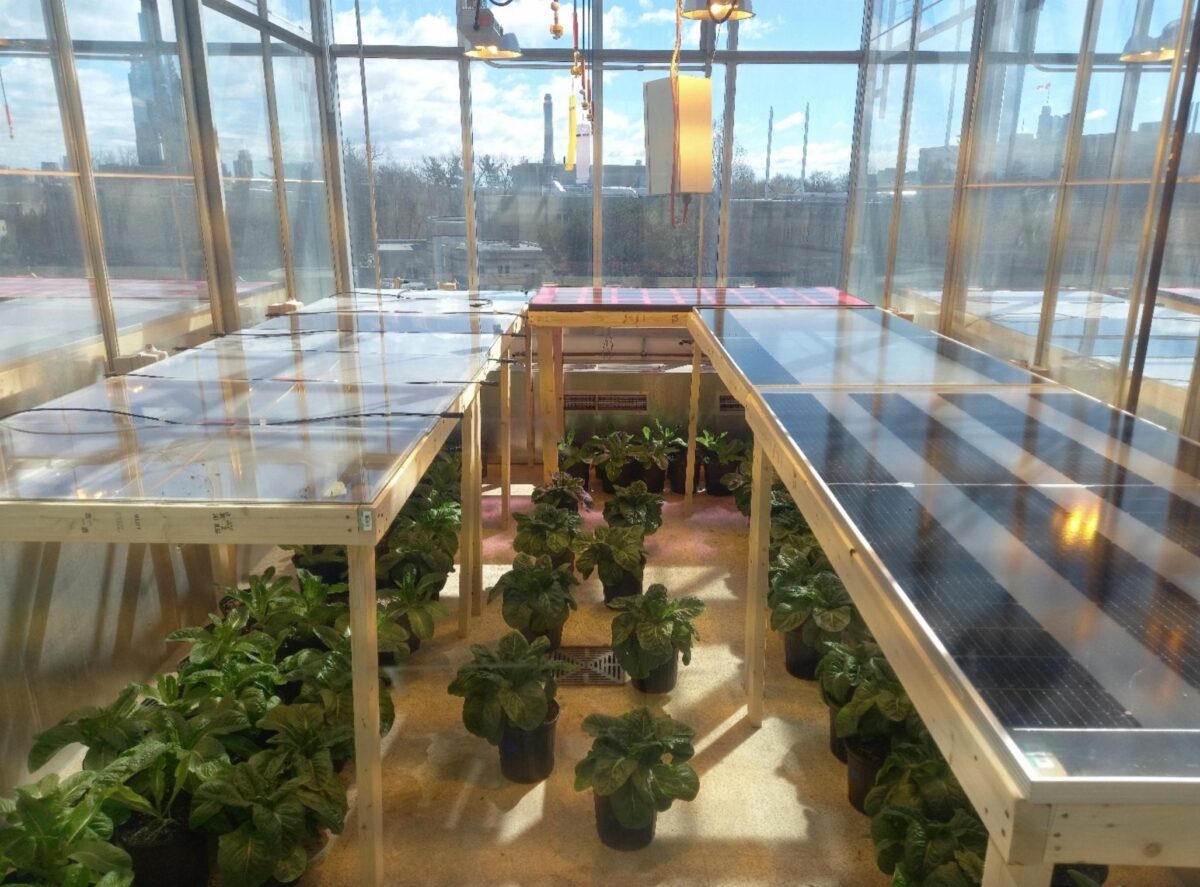
Canadian researchers investigated how the transparency of solar panels with cadmium telluride and crystalline silicon affects lettuce growth in agricultural voltaic systems. They found that 69% transparent silicon panels increased lettuce yield by 3.6%, while cadmium telluride panels led to a reduction in yield.
Researchers from Western University in Canada have investigated how the transparency of photovoltaic panels affects lettuce cultivation in agricultural voltaic systems.
The team grew heart lettuce under different lighting conditions: uniform illumination of thin-film PV panels containing cadmium telluride (CdTe) and non-uniform illumination of bifacial crystalline silicon (c-Si) PV panels.
“The purpose of this study was to assess the impact of PV transparency type on the physiological and yield responses of lettuce, and to evaluate the potential of agrivoltaic energy as a sustainable solution for lettuce production in Canada,” said corresponding author Uzair Jamil. pv magazine. “Experiments were conducted with CdTe modules providing uniform transparency at 40%, 50% and 70% transparency and bifacial c-Si modules providing non-uniform transparency at 44% and 69% transparency.”
Experiments took place in a controlled environment biome designed to mimic summer conditions in London, Ontario. The day temperature was maintained at 25 C and the night temperature at 15 C. A 16-hour photoperiod (6:00 AM – 10:00 PM) was provided by four 600 W high-pressure sodium lamps, followed by an 8-hour dark period.
The setup included 14 lettuce plants under each c-Si module, six plants under each CdTe module, and a control group of eight plants grown without panels. Each plant was grown in an insulated 1.5 gallon pot, initially seeded with three plants and later thinned to one per pot. Researchers measured parameters such as chlorophyll fluorescence, leaf area, gas exchange, plant height, leaf count and fresh weight.
The results showed that lettuce grown under 69% transparent c-Si modules achieved a 3.6% yield increase compared to open field controls, while CdTe modules with similar transparency caused a 6% yield reduction. According to Jamil, these results highlight how non-uniform light distribution in c-Si systems can improve plant growth.
“Scale-up of agrivoltaic energy supply across all lettuce farms in Canada with 69% transparent PV modules could potentially generate 1,200 MW of clean energy, nearly doubling Ontario’s current solar PV installations,” said Jamil. “With 44% transparency, capacity could approach 2,300 MW, which amounts to almost 40% of current PV capacity in Canada.”
The study also estimated significant economic benefits. If all Canadian lettuce farms adopted the 69% transparent c-Si modules, they could collectively generate CAD$342 million ($245 million) in additional electricity revenue. Using the 44% transparent panels could increase this to CAD $629 million. A modest 3% increase in lettuce yields would bring total sales to over CAD $737 million, approximately $20 million higher than conventional farming methods.
“These findings demonstrate that spatial light heterogeneity – characteristic of c-Si systems – can improve crop performance, providing an opportunity for sustainable intensification,” Jamil concluded.
The tests were presented in “Transparency effects in agrivoltaic lettuce cultivation using uniform/non-uniform semi-transparent photovoltaic modules in controlled environments”, published in Solar energy.
This content is copyrighted and may not be reused. If you would like to collaborate with us and reuse some of our content, please contact: editors@pv-magazine.com.
