

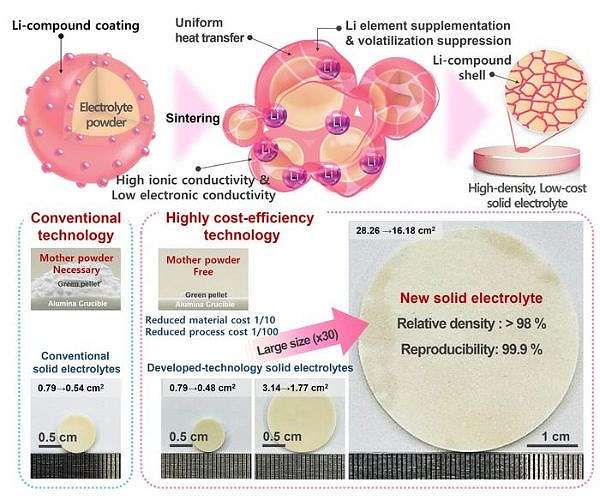
The Korea Research Institute of Standards and Science (KRISS) has reported a material breakthrough that brings all oxide-based batteries closer to commercial use. The work focuses on the high costs and manufacturing challenges of solid garnet-type electrolytes, a key component in next-generation non-flammable lithium batteries designed to eliminate fire and explosion risks.
All solid-state batteries replace conventional flammable liquid electrolytes with solid electrolytes, improving intrinsic safety in applications such as electric vehicles and grid-scale energy storage systems. Oxide-based systems have attracted interest because they provide high energy density and avoid the toxic gas generation problems associated with sulfide-based solid electrolytes.
Garnet-type solid electrolytes combine high ionic conductivity with strong chemical stability, but producing dense, defect-free membranes typically requires sintering at temperatures above 1000 C. Under these conditions, lithium, an essential component of the electrolyte, tends to evaporate during firing, compromising structural integrity, reducing ionic conductivity, and increasing interfacial resistance, especially in membranes with larger surface areas.
To reduce lithium loss, manufacturers have relied on a sintering approach in which the electrolyte membrane is buried in a large amount of lithium-containing mother powder. This sacrificial material helps maintain lithium activity during sintering, but results in more than ten times the amount of parent powder being discarded compared to the mass of usable electrolyte, greatly increasing production costs and hindering large-scale application.
The KRISS Emerging Material Metrology Group has developed a different approach in which garnet-type solid electrolyte powders are coated with lithium alumina (Li Al O)-based multifunctional compounds before sintering. This thin surface coating delivers lithium locally during processing at high temperatures and acts as a barrier to lithium evaporation from the membrane.
The coating also promotes a solder-like effect at particle contacts, improving interparticle bonding and causing higher densification during sintering. Using this method, the team reports solid electrolyte membranes with a relative density of more than 98.2 percent without the use of expensive mother powder, producing high-strength structures with minimal chemical or mechanical defects.
Ion transport performance improved significantly, with ionic conductivity more than doubling compared to conventionally processed garnet electrolytes. At the same time, electronic conductivity dropped by more than a factor of 20, reducing parasitic internal current leakage and further improving both efficiency and safety in all solid-state cell designs using these membranes.
The process also supports the production of larger formats. The researchers fabricated solid electrolyte membranes with a surface area of 16 square centimeters, more than ten times the surface area of standard laboratory pellets, while achieving a reported yield of 99.9 percent. The combination of high density, large-area scalability and very low scrap rates addresses long-standing barriers to industrial production.
Dr. Baek Seung Wook, principal investigator at the Emerging Material Metrology Group at KRISS, said the work solves materials and process challenges that have existed for more than two decades in solid garnet electrode research. He stated that by sharply reducing production costs, the new process is expected to accelerate the commercialization of oxide-based solid-state batteries and support innovation in the energy storage and electric vehicle markets.
Postdoctoral researcher Dr. Kim Hwa Jung noted that Korea currently imports all garnet-type solid electrolyte pellets at a unit price of more than US$550 for discs with a diameter of only 1 centimeter. The ability to domestically produce high-quality solid electrolyte membranes using a mother powder-free process is expected to strengthen the local supply chain for the next generation of battery materials.
The research was conducted in collaboration with Professor Park Hyeokjun and colleagues from the Department of Materials Science and Engineering at Korea University. The project received support from the Ministry of Science and ICT and the National Research Foundation of Korea through the Nano and Materials Technology Development Program.
According to KRISS, the results appear in the January issue of the journal Materials Today, which reports an impact factor of 22.0 and a Journal Citation Reports ranking in the top 3.5 percent of its field. The paper is entitled “Revitalizing multifunctionality of the Li Al O system enabling mother powder-free sintering of garnet-type solid electrolytes” and documents the development and performance of the coated powder process.
Research report: Revitalizing the multifunctionality of the Li AlO system, enabling the powder-free sintering of garnet-type solid electrolytes
