

Manufacturing polysilicon for the photovoltaic industry in Europe remains a major industrial challenge, as its production relies on highly energy-intensive, ultra-high purity processes that require consistently cheap and reliable electricity, as well as deeply integrated chemical supply chains – advantages that are already well-entrenched and significantly more cost-competitive in regions such as China than within the European industrial landscape.
Despite these difficulties, the CEO of Dutch startup Resilicon, Remco Rijn, is confident that Europe can still gain a competitive and strategically important foothold in polysilicon production through the use of low-carbon electricity, advances in process efficiency and a more circular, localized supply chain model. He argues that Europe may struggle to match existing cost structures in Asia, but the country can instead differentiate itself through cleaner production methods and security of supply, in line with the continent’s broader goals of energy transition and industrial resilience.
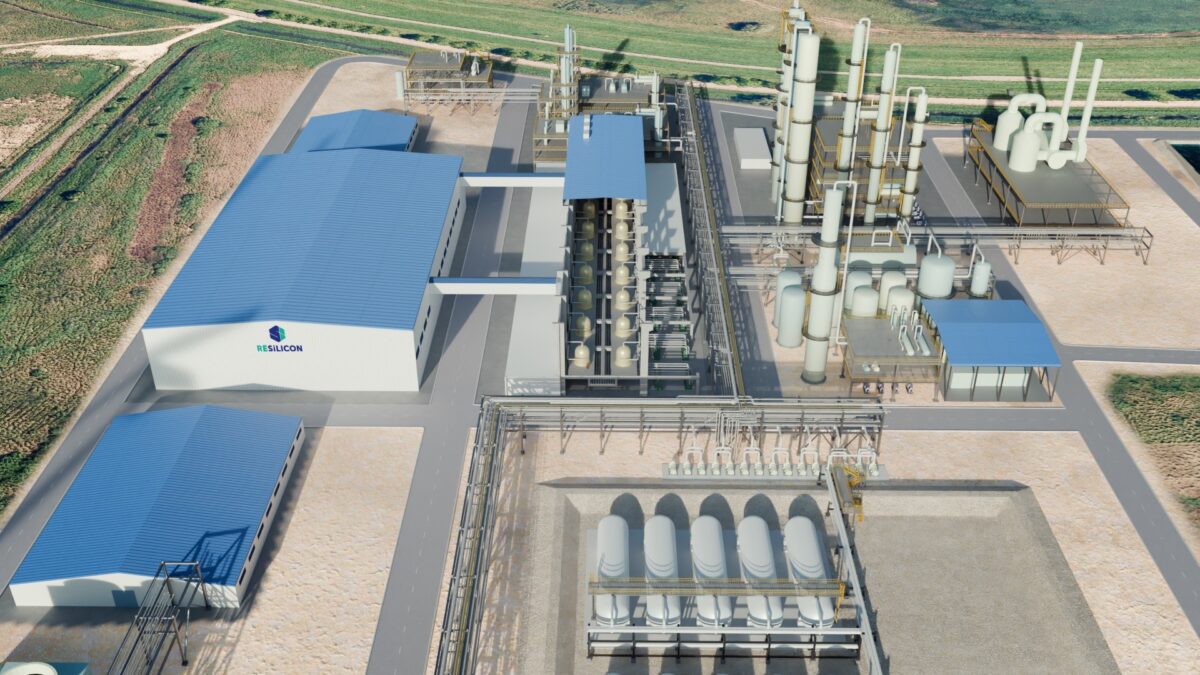
Resilicon plans to build a polysilicon factory in the Groningen Sea Ports area in the northeast of the Netherlands. It has already secured more than €14 million ($16.3 million) in funding and support from the Dutch government for this project.
“We started with a small team and secured some funding for what we call initial basic engineering. And we are now almost at the end of this phase,” Rijn said. pv magazine. “We aim to produce so-called 11N or 12N pure silicon, which means a purity of 99.999999999% and 99.9999999999% respectively. We will use the Siemens process and buy almost all production equipment in Europe.”
Diversification
Resilicon focuses on three key markets: the semiconductor industry, the solar PV industry and the silane market, which also serves fast-growing applications such as battery anodes. PV is expected to remain the dominant market for polysilicon, as is already the case across the industry, but the company plans to adopt a more flexible product strategy.
“By diversifying our product mix, we can adjust production between polysilicon, silane and other specialty gases depending on market demand, especially to better serve the semiconductor industry,” said the company’s strategic advisor Jan Vesseur. “Nevertheless, a substantial part of our volumes will still be intended for solar PV applications.”
The startup is currently targeting an annual production capacity of approximately 13 kilotons, with plans to scale up to approximately 26 kilotons. In industrial terms, 13 kilotons corresponds to approximately 6 to 7 GW of solar capacity, with the rule of thumb being that approximately 2 kilotons of polysilicon are required per gigawatt. “On a full commercial scale, we ultimately aim for an annual production capacity of approximately 30,000 tons,” Vesseur added.
Pressure on prices
Currently, polysilicon prices remain highly volatile, with Chinese producers charging extremely low price levels, often at a loss, in what is widely seen as an unsustainable market situation. Despite reports of factory closures, significant overcapacity remains and the sector remains stuck in a cycle of oversupply, with no clear short-term solution in sight. In this environment, competing on costs alone is neither realistic nor strategically feasible for newcomers to Europe.
“Instead of competing purely on price, the focus is shifting to the more expensive segments of the market,” says Rijn. “The demand for high-quality, premium polysilicon is growing, especially for advanced solar energy applications and semiconductor use. This is the segment in which we want to position ourselves, alongside established players such as Wacker Chemie. We are already in discussions with customers who are specifically looking for this premium material.”
With polysilicon prices currently hovering around $5/kg, Rijn argues that this level does not reflect a stable market equilibrium, but rather a disruption caused by global overcapacity and aggressive pricing strategies that are not sustainable in the long term.
“If you look at the United States, where tariffs have been imposed, prices could go up to around $26/kg,” he added. “This shows that even relatively simple policy measures can help create a more level playing field for companies. Such a framework would allow companies to operate competitively under similar conditions.”
“It also raises an important question,” he continued. “What would be the real impact of higher input costs, such as $26/kg, on the final price of solar panels? From a macroeconomic perspective, this creates a clear win-win dynamic. End consumers may see a modest temporary increase in solar panel prices, but this can be offset over time by innovation and scale.”
Cheap electricity
An important part of the company’s strategy is the use of renewable electricity, mainly from offshore wind farms in the North Sea. Wind energy prices are expected to drop significantly over time as new capacity becomes available. This is particularly relevant towards 2029, when additional projects from auctions and UK supply are expected to increase the electricity surplus.
“Today, energy costs remain a challenge and grid expansion is still needed. However, as the build-out of wind and solar power continues, prices should fall and deliver structural benefits to electrification across all sectors, including home appliances,” Vesseur said. “Lower energy prices could accelerate demand for electrical appliances and broader electrification trends in homes and industry. This reinforces the long-term logic of locating energy-intensive production close to renewable sources.”
The same dynamics could support industrial relocation to regions with abundant green energy, such as Spain. “If successful, our project can also expand to other European countries in the future,” says Rijn. “Our concept links low-energy silicon production with renewable energy ecosystems, with the aim of producing silicon and silane using clean electricity at scale, and this approach could be replicated elsewhere.”
Policy
Both Rija and Vesseur argue that establishing polysilicon production in Europe fundamentally depends on a stable and coherent policy framework. According to them, silicon should be formally recognized as a strategically critical material under the EU’s industrial and raw materials strategies.
They emphasize that a predictable regulatory environment is essential to unlock finance, as current uncertainty significantly deters large-scale investments. The piecemeal implementation of existing frameworks, including instruments such as the NZIA, is seen as insufficient to support investor confidence, leading to project delays or cancellations.
“To make European production viable, we need temporary protective measures such as tariffs or equivalent trade instruments to create a level playing field with low-cost global competitors,” said Rijn. “Targeted public support, including subsidies and demand-side incentives, is necessary to bridge the initial phase of market ramp-up.”
Both interviewees also agree on the view that policymakers face a trade-off between short-term cost increases and long-term industrial sovereignty. They argue that without coordinated policy support, Europe risks missing the opportunity to rebuild capacity in a strategically important sector.
This content is copyrighted and may not be reused. If you would like to collaborate with us and reuse some of our content, please contact: editors@pv-magazine.com.
