

An international research group conducted a literature review on capital expenditure-driven levelized costs of electricity optimization strategies for utility-scale PV systems. Tracking optimization, system voltage escalation and advanced system design are identified as the most promising cost savings areas. “The next wave of PV research must be LCOE-native, system-level and implementation-validated,” said a member of the research group.
An international research group led by scientists from Hamad Bin Khalifa University in Qatar has conducted a systematic analysis of capital expenditure (Capex) choices that can be strategically optimized to reduce the levelized cost of electricity (LCOE) in utility-scale PV.
The team reviewed 114 peer-reviewed scientific articles, along with 41 additional online resources, and found that LCOE can be reduced by as much as 20% through capex-driven strategies such as system-level optimization, smart balance-of-system (BOS) designs, and digital tools.
“The report makes clear that the next wave of PV research must be LCOE-native, system-level and implementation-validated,” said author Veronica Bermudez Benito of French consultancy Be Renewable Be Technology Innovation (Berbetin). pv magazine. “The industry no longer needs just incremental component innovation, but integrated research that directly reshapes asset design, financing, operations and long-term performance. The industry needs quantified impacts on discount rates, warranties and insurance premiums, not just technical performance gains.”
Bermudez emphasizes that yield-oriented reliability metrics, not efficiency-oriented ones, are needed for utility-scale PV, which are, after all, 30-year assets. “This is critical for financing, insurance and bankability decisions,” she added. “Future research should move beyond standard test condition (STC) efficiency and even beyond overall degradation rates toward yield-at-risk, performance ratio (PR) volatility, and lifetime energy uncertainty as primary metrics of merit.”
The study identified a number of areas for CAPEX-driven LCOE optimization. Areas the team investigated include PV module selection, configuration and performance strategies. That includes research areas such as surface coating, tilt angle, distance, trackers, DC-AC ratio and system voltage. They have also focused on smart BOS design choices, including electrical BOS and structural BOS.
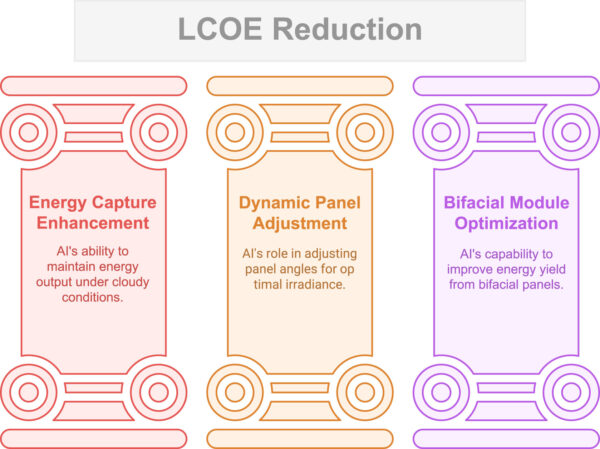
Image: Hamad Bin Khalifa University, Solar Energy, CC BY 4.0
In a section on digitalization-based strategies, they discussed applications of artificial intelligence (AI), information modeling and digital twin frameworks. Finally, they also explored several innovative but not yet fully commercialized strategies that show great potential to reduce the LCOE of utility-scale PV projects.
“Emerging solutions (AI analytics, advanced monitoring, new cleaning, new module formats) require research that explicitly answers: Does this reduce the risk perceived by lenders and insurers?” Bermudez said. “We know AI is necessary for predictive maintenance, but the industry needs the next step: hybrid models that combine inspection data (IR, EL, PL, UVF) with physical degradation mechanisms. Purely data-driven models struggle with portability across climates, technologies and portfolios.”
According to the group’s research, the most significant gains are consistently achieved through tracking optimization, system voltage escalation and advanced BOS designs, which deliver LCOE reductions of 5 to 20%. Improvements at the module and surface level – such as coatings and large format modules – contribute to incremental but steady savings of 1–5%. “Emerging digitalization and AI-driven optimization frameworks further promise sustainable reductions and long-term performance stability, strengthening the transition to a data-centric, system-optimized paradigm for next-generation utility-scale PV deployment,” the team added.
Bermudez added that “while building information modeling (BIM) and digital twins are identified as high-impact tools, the industry now needs research that closes the loop between design assumptions, construction realities and operational data – quantifying where digital models systematically deviate from field behavior and how that affects LCOE.”
The paper “A comprehensive overview of CAPEX-driven LCOE optimization strategies for utility-scale PV systems‘ has appeared Solar energy. It is the work of researchers from Hamad Bin Khalifa University in Qatar, Texas A&M University in the United States and Texas A&M University in Qatar. Researchers from France’s Senergy Technical Services, Berbetin, Turkey’s Gazi University and Italy Polytechnic University of Milan were also part of the team.
This content is copyrighted and may not be reused. If you would like to collaborate with us and reuse some of our content, please contact: editors@pv-magazine.com.
Popular content

