

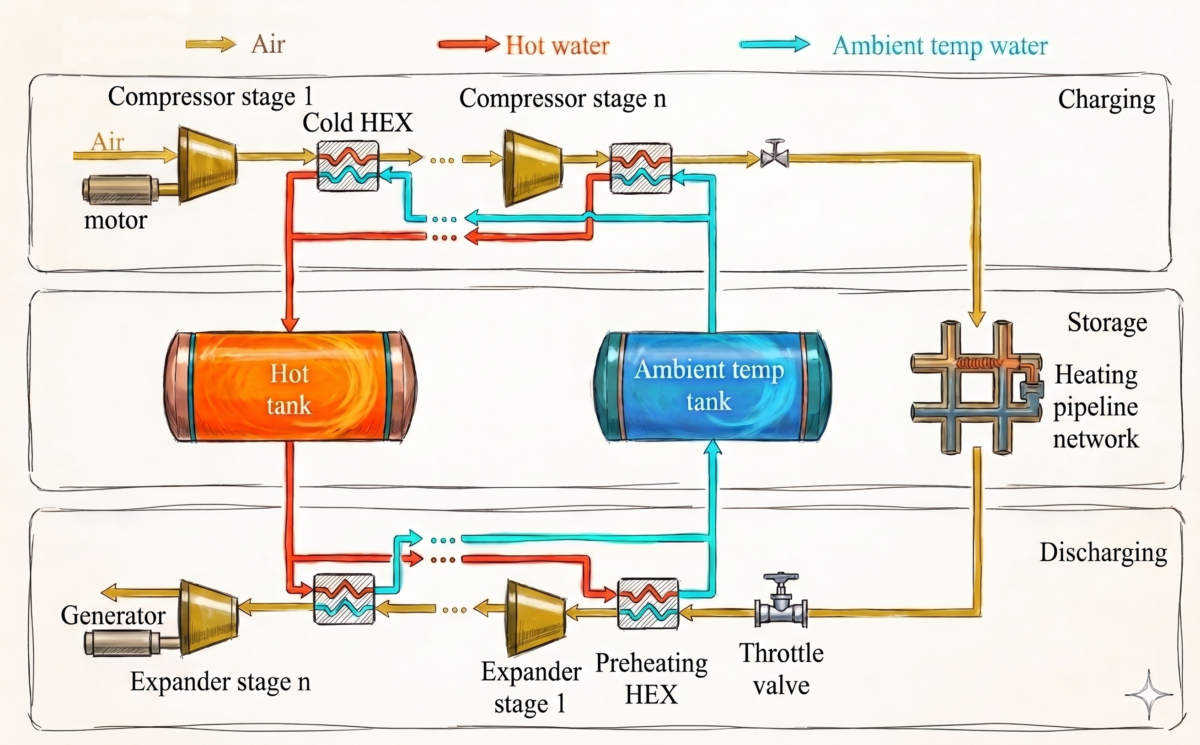
Researchers in China have developed a compressed air energy storage concept (HP-CAES), which reuses urban district heating networks as large-scale storage vessels for excess renewable electricity. The system stores compressed air and recovered compression heat in existing pipelines, enabling both energy storage and heating functions with improved efficiency and lower infrastructure requirements compared to conventional tank-based CAES.
Researchers in China have proposed a new method to store excess renewable energy by converting it into compressed air and integrating it into urban district heating pipelines. In this concept, the existing infrastructure used to circulate hot water or steam for heating buildings is reused as an energy storage medium. The system works on an adiabatic principle, where the heat generated during air compression is captured and reused rather than dissipated, improving overall efficiency.
“This method does not require complex structural modifications and does not affect the original heating functionality,” the researchers said. “In addition, it enables gas storage during periods when the heating system is inactive, overcoming geographical limitations and enabling widespread application in different urban heating networks. In addition, because the system can simultaneously perform both heating and energy storage functions, there is no need to leave the heating pipeline.”
The compressed air heating pipeline energy storage system (HP-CAES) is designed using thermodynamic models and simulations based on the central district heating infrastructure of Zhumadian city, Henan province, China.
The proposed HP-CAES system stores compressed air in the heating pipeline network during non-heating seasons, allowing the existing infrastructure to serve as an energy storage device. During periods of low electricity demand, surplus electricity powers multi-stage compressors that compress the ambient air. The heat generated during compression is recovered via heat exchangers and stored in hot water tanks, while the compressed air is injected into the heating pipes.
Unlike conventional metal tanks, the insulated steel pipeline walls possess significant thermal inertia and absorb some of the heat of compression, stabilizing air temperature and pressure during storage. When demand for electricity increases, compressed air is released from pipelines, reheated using stored thermal energy and expanded through turbines to generate electricity.
In the simulations, the HP-CAES system had a total compressed air storage volume of 38,334.69 m³, consisting of three pipeline sections: 7,792 m of 1,400 mm diameter pipe, 13,622 m of 1,200 mm diameter pipe, and 13,946 m of 1,000 mm diameter pipe. They all had a basic wall thickness of 15 mm and an insulation layer of 50 mm. The system operated at a charging pressure of 10 MPa and a discharge pressure of 4 MPa. In further pressure sensitivity analyzes these were extended to 5-11 MPa final pressure of loading (EPC) and 1-6.5 MPa final pressure of discharging (EPD)
The model used three-stage compressors and three-stage expanders, each with a nominal isentropic efficiency of 0.88 and 0.92, respectively. The mass flow rates of the compressor and expander were both 120 kg/s, while the cooling and preheating water flow rates were each 36 kg/s. Thermal storage consisted of 2,178 m³ of ambient hot water and storage tanks, and the resulting base system provided an input power of 72.32 MW, an output power of 43.68 MW and an energy storage capacity of 229.33 MWh.
This system was compared with a metal tank-compressed air energy storage (MT-CAES) system, which served as a reference case. In the MT-CAES configuration, compressed air was stored in conventional metal pressure vessels. At the same time, all other major system components and operating conditions were kept identical to those of the proposed system to isolate the effect of the storage method itself.
The analysis showed that the air temperature in the storage system varies during operational cycles due to compression, heat losses and subsequent expansion. In the case of a system operating between an EPC of 10.00 MPa and an EPD of 4.00 MPa, the metal storage tank experiences a maximum temperature variation of 75.18 K. In contrast, the heating pipeline network shows only a small thermal variation of 14.52 K, attributed to the higher thermal inertia and effective insulation. At an equivalent storage volume of 38,334.46 m³, the heating pipeline configuration was found to achieve an energy storage density of 5.98 kWh/m³, which outperformed the metal tank system by 34.68%.
The scientists also found that using sliding pressure (SP) mode instead of constant pressure (CP) improved round-trip efficiency by 4.77% for HP-CAES and 3.29% for MT-CAES, mainly by reducing throttling losses. Under SP operation, the HP-CAES system achieved a higher initial expansion pressure and an efficiency 2.64% higher than MT-CAES. The analysis also showed that optimizing pressure ranges and stage numbers requires a balance between energy efficiency, storage density and environmental performance. Under SP operation, the HP-CAES system achieved a higher initial expansion pressure of 9.91 MPa, resulting in a higher expansion ratio during discharge and a 2.64% higher round-trip efficiency (RTE) than the MT-CAES system. The research team also found that optimizing pressure ranges and stage numbers requires a balance between energy efficiency, storage density and environmental performance.
“Under the conditions of EPC at 10 MPa and EPD at 4 MPa, the investment cost of the HP-CAES system is $29.61 million, accounting for only 56.58% of that of the MT-CAES system; the static payback period (SPP) is 4,324 days, which is only 40.65% of that of the MT-CAES system,” the group said. “Further economic analysis under different combinations of EPC and EPD shows that the HP-CAES system achieves the shortest SPP of 3,524 days when EPC and EPD are set at 5.0 MPa and 3.0 MPa respectively. Under the conditions of EPC at 5.0 MPa and EPD at 3.0 MPa, a 1 MW HP-CAES system can be deployed per 2.90 km2 of district heating district, which indicates that it has favorable application potential in district heating networks.”
The system was presented in “Research into compressed air adiabatic energy storage systems using district heating pipelines as a storage device”, published in Applied thermal technology. Scientists from China’s Xi’an Jiaotong University, Zhengzhou University and the Chinese Academy of Sciences participated in the study.
This content is copyrighted and may not be reused. If you would like to collaborate with us and reuse some of our content, please contact: editors@pv-magazine.com.
