Removing carbon dioxide is most likely necessary to rebalance the climate and meet the 1.5 degrees Celsius target set in the Paris Agreement, as data suggests this level is already being exceeded annually. In addition to natural climate solutions and land use changes, technological and biotechnical solutions are the most promising. Solar energy can play a key role in minimizing area demand and supporting cost optimization, even in unexpected places like Iceland.
The latest data shows that the 1.5 degrees Celsius level of average temperature deviation targeted by the Paris Agreement has already been reached. Although the El Niño may have contributed to this Despite the warming peaks in recent years, warming records are constantly being broken. This means that the transition to a highly renewable energy system is no longer sufficient to meet the 1.5 C target, and CO2 must be actively removed from the atmosphere.
Carbon dioxide removal (CDR) can have two different effects at the system level: offsetting remaining fossil emissions or creating a net-negative emissions system. The latter is preferable, because compensating for fossil emissions does not reduce emissions negative effects of increased CO22 levelswhile deep defossilization and the transition to a highly renewable energy system bring many environmental, health and economic benefits. Solar PV could be a major enabler of CDR globally due to its promising cost prospects high capacity density.
Spatial demand for technological versus biotechnical CDR
The transition of energy systems is often seen as limited by the available space for sustainable energy capacity. While for some regions, such as South Asia or the densely populated regions of Europe and Southeast Asia, the situation is indeed worth a closer lookno real restrictions on land availability could yet be identified. However, if large-scale CDR is to be implemented with technological (direct air capture and carbon sequestration, DACCS) or biotechnical (bioenergy with carbon capture and sequestration, BECCS) options, the question arises whether the demand in the area is sufficient to provide both a highly renewable energy industry system and also extra large-scale CDR. After all, technological CDR must run on renewable energy, and biotechnical CDR requires a significant amount of biomass, while sustainable residual flows will not be sufficient.
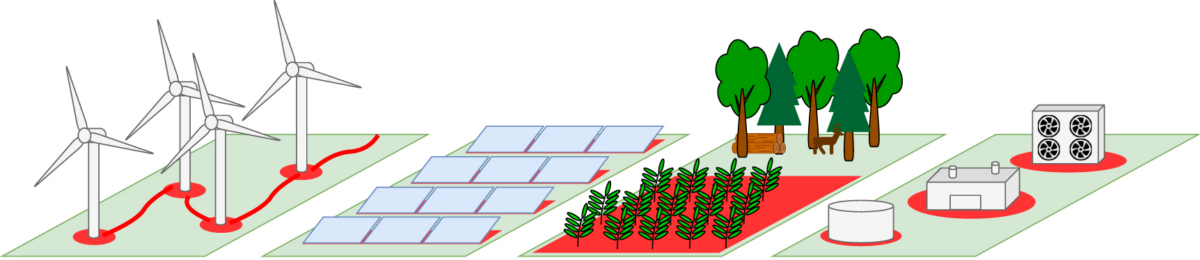
From a recent study “Quantification of area demand for negative emissions integrated into the energy system based on carbon dioxide removal portfolios“, published in Environmental Research Letters, this question is specifically addressed. The study distinguishes between gross and net area demand. Gross area demand includes the entire area for energy supply, including space, staging area, etc., while net area demand includes only the depleted area excluded from co-use, such as agriculture or forestry, or considered to have negative impacts on biodiversity, such as short-rotation energy crops. The latter is important for biotechnical CDR, because large-scale BECCS will only be possible through energy crops, as sustainable residual flows may have more value in other areas of the energy industry system. The underlying energy system is largely based on solar energy and wind energy as the main future energy sources.
Energy crops (left) and solar PV plants (right) both require surface area. Technological CDR, powered by renewable energy sources such as solar energy, outperforms biomass-based biotech CDR options due to its higher energy density. Images: Lignovis GmbH, Jeffrey Beall, Wikimedia Commons, CC BY-SA 4.0
The research shows that there are significant differences between technological CDR portfolios largely run on solar PV electricity, and CDR portfolios with a high share of biotechnical options for the 1.5 C target. The biomass priority portfolio shows high values of both gross and net surface demand, while especially the high net surface demand of 2.8 million km22 globally, while technological CDR portfolios dependent on DACCS, powered by a large share of solar energy, show 1.3 million km2both figures include the energy supply of the entire energy industry system. For even more ambitious climate target of 1.0°C gross area demand increases for all portfolios due to increased dependence on afforestation, while net area demand suggests that technological options powered by renewable energy sources such as solar energy are preferable from an area demand perspective. The increasing development in solar PV technology largely contributes to this conclusion. Cheap solar PV can also be used to enable seawater desalination afforestation in arid or even desert areas for long-term CDR.
The role of solar energy for scaling a CDR industry in Iceland
Iceland has unique characteristics that could enable a large-scale CDR industry in the country. Its geological composition makes it very suitable for mineralization on sitewhere CO2 is dissolved in water and pumped underground in porous basalt, where it turns into minerals in a relatively short time, thus retaining the CO2 in a safe way for a long time. The heat for direct air capture (DAC) can be supplied by low-cost geothermal power plants. The feasibility of this concept has already been demonstrated in the CarbFix project.
Whether a large-scale CDR industry is possible in Iceland, and what potential bottlenecks may be present, has been discussed in a recent publication “In search of El Dorado: Capabilities of Iceland’s Carbon Dioxide Removal Service to Meet Global Demand and a New Look at Overnight Transition Costs” published in Gondwana research. The authors applied different scaling objectives for CDR in Iceland, varying its availability geothermal energy to identify the role of other unexplored renewable energy options, such as solar energy, in these scenarios.
The results identified an interesting role for solar energy, even in the rugged Scandinavian countries close to the Arctic Circle. To provide electricity for baseload CDR demand at low cost, the optimization suggested a key role for solar energy to balance the reduced wind energy production during summer with solar PV electricity, which is abundantly available in the far north during summer. Although increased CDR demand with a significant baseload demand profile drives energy costs, the flexible CDR demand scenario focused on renewable energy availability has not reduced costs due to the large capacities required. Overall, levelized costs for carbon dioxide removal can be kept relatively stable below €60/tCO2also due to the low cost nature and overall competitiveness of solar energy in countries like Iceland.
Solar PV as the workhorse of a future system
It has already been established that many sectors benefit from cheap solar PV electricity cheap batteries support such conclusions. Indicative research shows that solar energy can also play an important role in the CDR sector, with a positive impact on the sector environmental, social and governance criteria of CDR. Technological improvements that go beyond efficiency, such as single-axis tracking, bifacial technology or floating structures, are increasing the share of solar energy in modern energy systems. Solar PV is indeed the new king, and the world is about to enter it era of several terawatts.
Authors: Dominik Keiner and Christian Breyer
This article is part of a monthly column from LUT University.
Research at LUT University includes various analyzes related to energy, heat, transport, industry, desalination and negative CO2 emission options. Power-to-X research is a core subject at the university, integrated into the focus areas Planetary Resources, Business and Society, Digital Revolution and Energy Transition. Solar energy plays a key role in all aspects of research.
The views and opinions expressed in this article are those of the author and do not necessarily reflect those of the author pv magazine.
This content is copyrighted and may not be reused. If you would like to collaborate with us and reuse some of our content, please contact: editors@pv-magazine.com.
Popular content