

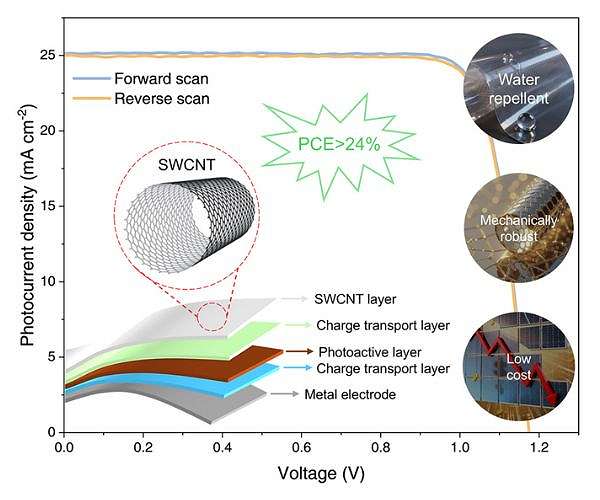
Perovskite solar cells can be made more robust, efficient, scalable and cheaper to produce by replacing indium tin oxide with single-walled carbon nanotubes in the device architecture, according to research led by the University of Surrey. The team reports that replacing indium tin oxide, a fragile and expensive photovoltaic material, with single-walled carbon nanotubes could support flexible perovskite modules that are more affordable and mechanically resilient.
In work led by Surrey’s Advanced Technology Institute with international partners, researchers show that a simple treatment with sulfuric acid increases the electrical conductivity of carbon nanotube films, while keeping them transparent enough to allow sunlight to reach the perovskite absorber beneath. The treatment also forms a thin, nickel-based stabilizing bridge layer, described as a NiSO4-NiOx interfacial layer, which improves the electrical connection between the layers in the solar cell stack.
Professor Wei Zhang, lead author from the University of Surrey’s Advanced Technology Institute, said:
“Our process resulted in a flexible perovskite solar cell, free of indium tin oxide, that achieved energy conversion efficiency of more than 20% in large areas, with small-scale devices reaching a record 24.5%. It’s safe to say that our own results surprised us all.”
Because carbon nanotube films can be produced using roll-to-roll chemical vapor deposition, a process already used in large-scale electronics production, the researchers argue that this electrode strategy is compatible with the industrial production of flexible solar panels. They claim this could yield high-quality flexible modules manufactured in volumes suitable for commercial deployment.
Tests showed a clear improvement in operational stability. After one month of simultaneous exposure to heat, humidity and simulated sunlight, the devices retained more than 95% of their original performance and outperformed conventional indium-tin oxide-based designs under similar conditions.
Professor Ravi Silva, co-author of the study and director of the University of Surrey’s Advanced Technology Institute, said:
“We are now convinced that carbon nanotube electrodes can do what indium tin oxide cannot: combine high performance with mechanical strength and low cost. These results bring flexible, scalable solar technology a big step closer to real-world applications.”
The team also assessed mechanical durability by repeatedly bending the modules. Traditional indium-tin oxide-based devices lost nearly three-quarters of their efficiency after 1,000 turns, while devices using single-walled carbon nanotube electrodes lost only about 5% and showed no visible cracks or delamination.
Researchers also examined the costs and environmental impacts. They estimate that producing single-walled films of carbon nanotubes via roll-to-roll chemical vapor deposition is about six times cheaper than sputtering indium tin oxide, reducing production costs by about $200 per square meter. Because indium is scarce and energy-intensive to extract, the switch to carbon-based electrodes could reduce both production costs and the overall carbon footprint of solar panel production.
The team places these results in the broader context of perovskite technology, a class of materials often emphasized in solar research for combining low-cost components with high light-harvesting efficiency. Perovskites can be processed at lower temperatures than silicon and formed into lightweight, flexible devices that can bend, flex and integrate onto a range of surfaces. However, long-term stability and fragile components have slowed commercial acceptance, and the new electrode design directly addresses these limitations.
Professor Wei Zhang added: “Our work addresses one of the biggest barriers to commercialization: cost and scalability. Flexible, lightweight solar panels like these could power everything from wearable electronics to next-generation building materials.”
Research report:Integrating SWCNT to bridge the stability gap in scalable and manufacturable flexible perovskite solar panels
