

In a new weekly update for pv magazineOPIS, a Dow Jones company, provides a brief overview of the major price trends in the global PV industry.
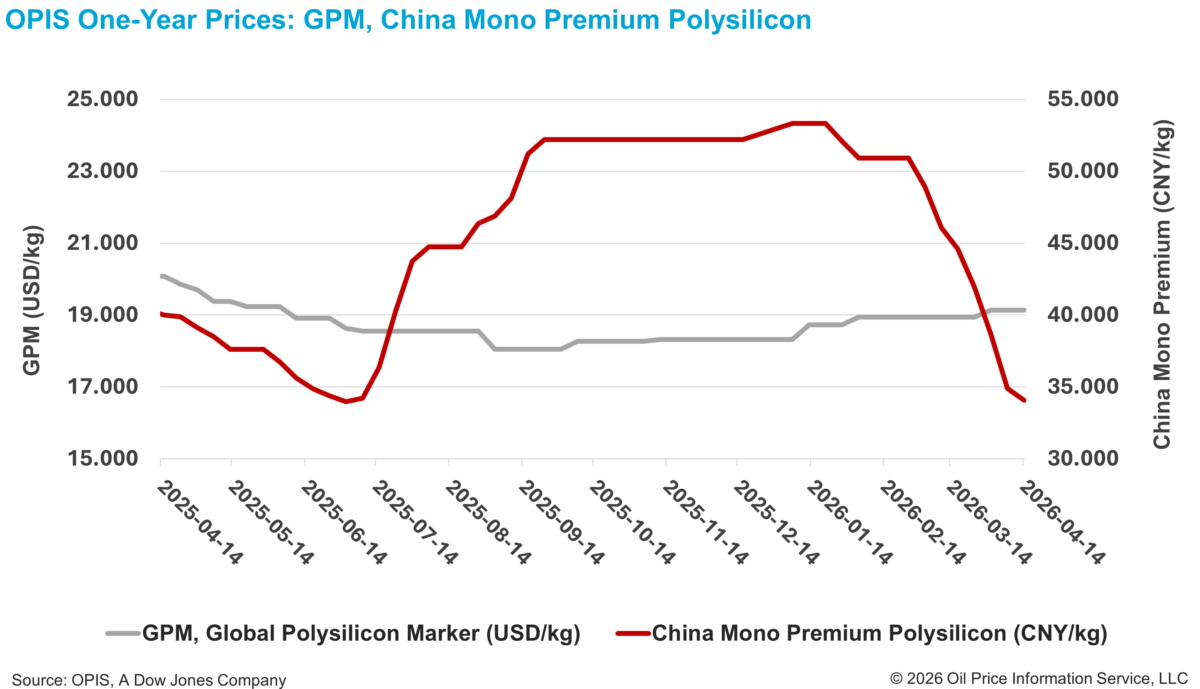
According to the OPIS Global Solar Markets Report published on April 14, China Mono Premium – OPIS’ rating for mono-grade polysilicon used in the production of n-type ingots – fell 2.36% week-on-week to CNY 34.071 ($4.99)/kg, or CNY 0.072/W.
Market insiders generally believe that the downward trend in polysilicon prices and the continued accumulation of inventories in China are continuing, with no clear signs of reversal at this point.
One market participant noted that order volumes per transaction from major billet and wafer producers remain extremely limited, reflecting efforts to minimize inventory losses amid rapidly falling prices and further underscoring the current weakness in demand.
In response to prevailing market conditions, manufacturers have taken measures such as initiating maintenance activities and further reducing business rates. According to feedback from sources, several polysilicon production bases in the northwestern regions have already implemented production cuts to varying degrees. Against this backdrop, the Silicon Branch of the China Nonferrous Metals Industry Association predicts that China’s polysilicon production will decline by about 8% in April from March.
However, one market participant noted that current operational levels are already limited, with some manufacturers operating only a single production line, operating at 50% to 70% capacity utilization. Under such circumstances, a further significant reduction in business rates becomes increasingly difficult, the source said.
Another source indicated that major polysilicon manufacturers can currently only cover raw material and electricity costs at a price level of around CNY 31-32/kg, leaving limited room for further price declines. Nevertheless, smaller producers facing loan repayment pressures may still be forced to sell at lower prices, potentially putting additional downward pressure on the market.
Earlier this month, the China Photovoltaic Industry Association (CPIA) issued a notice calling for the development of a standardized production cost model for the four major manufacturing segments, aimed at improving cost transparency and helping clarify the definition of non-compliant pricing practices. Industry opinion on the initiative remains divided, with some participants arguing that meaningful relief will depend less on the model itself than on whether it leads to effective measures to phase out outdated production capacity.
Outside of China, the fundamentals of the global polysilicon market remain largely unchanged as the policies expected to have the greatest impact on the next phase of the market – namely the pending results of the US Section 232 investigation – have yet to be implemented.
The Global Polysilicon Marker (GPM) – the OPIS benchmark for polysilicon produced outside China – was estimated at $19,138/kg, or $0.040/W, unchanged from the previous week.
However, market participants have started taking precautions. Some downstream players with stable export channels to the US have attempted to secure long-term contracts for US-produced polysilicon to ensure supply chain compliance. This trend has contributed to a
notable decline in spot trading activity, with current monthly spot transaction volumes limited to just a few hundred tonnes according to market participants.
Spot trading in non-US polysilicon has also remained subdued. One market observer noted that polysilicon from non-Chinese and non-US sources currently faces a challenging position. Some key buyers who prioritize compliance are willing to pay significant premiums for American polysilicon to ensure supply chain security. Meanwhile, certain players able to rationalize compliant supply chains in regions such as Africa and the Middle East would reportedly be able to use traceable, Chinese-produced polysilicon, significantly reducing overall costs, the Observer explained.
Industry insiders further indicated that a significant portion of global non-US polysilicon supply is currently concentrated in Southeast Asia, mainly held by buyers with long-term contracts. However, downstream demand is still insufficient to absorb these contracted volumes. According to sources, a manufacturer in Vietnam closed part of its cell and module production facilities last month, while the remaining wafer, cell and module integrated projects are running at low production levels.
OPIS, a Dow Jones company, provides energy prices, news, data and analysis on gasoline, diesel, jet fuel, LPG/NGL, coal, metals and chemicals, as well as renewable fuels and environmentally friendly feedstocks. It acquired assets with pricing data from Singapore Solar Exchange in 2022 and now publishes the OPIS APAC Solar Weekly Report.
The views and opinions expressed in this article are those of the author and do not necessarily reflect those of the author pv magazine.
This content is copyrighted and may not be reused. If you would like to collaborate with us and reuse some of our content, please contact: editors@pv-magazine.com.
