

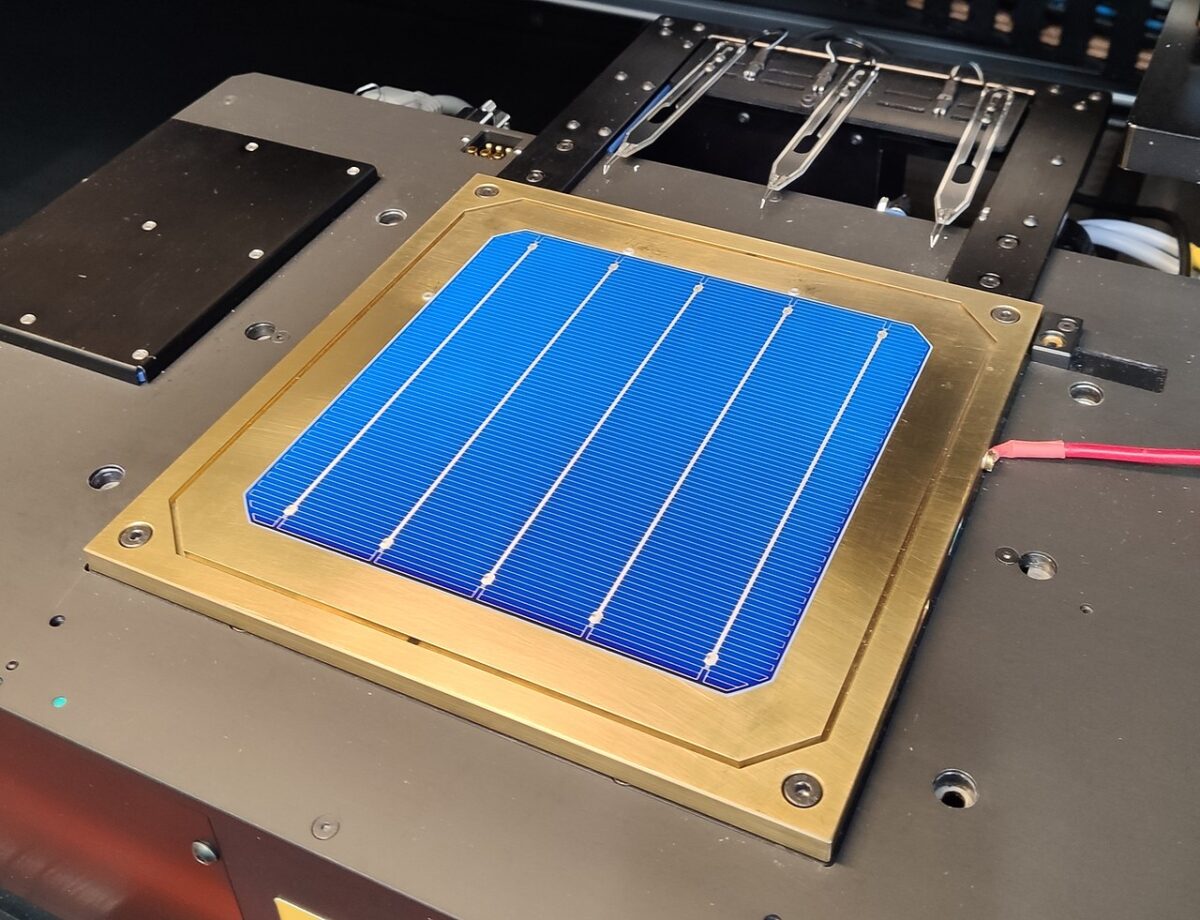
Researchers in China have developed a model to predict the lifetime of heterojunction (HJT) modules made with ultraviolet cut-off polyolefin elastomer (POE) encapsulant. The approach takes into account factors such as temperature, humidity and UV radiation.
To address concerns about degradation of heterojunction solar panels, a team of scientists led by the Chinese Academy of Sciences developed a model to predict the lifespan of heterojunction modules.
The model takes into account factors such as temperature, humidity and UV radiation and was used by the research team to predict the lifespan of modules made with ultraviolet cut-off POE encapsulation films.
The scientists emphasized that ultraviolet radiation-induced degradation in heterojunction panels is “largely caused by a decrease in short-circuit current” and that it “can be effectively suppressed” by using POE encapsulants because it has durability properties.
The group tested its approach on heterojunction modules fabricated with a double-glass configuration and 144 pieces of half-cut M2-sized cells. One set of panels was laminated with an ultraviolet passive POE (UVP) encapsulant and the other set was laminated with an ultraviolet cut-off POE (UVC) encapsulant.
The samples were exposed to accelerated UV irradiation tests from 60 kWh to 300 kWh in the ultraviolet chambers of the National Center of Inspection on Solar Photovoltaic Products Quality of China.
The modeling and UV testing allowed the team to draw some early conclusions. “Overall, the UVC modules have a longer lifespan than the UVP modules, which can be extended by an average of approximately 4.2 years in different regions. This benefit is mainly attributed to the UV cut-off POE, which blocks the damage of UV photons to the HJT solar cells,” the academics said.
Because temperature and humidity also affect the module’s degradation rate and the group did not want to rely solely on UV data, it conducted subsequent moist heat (DH) testing on the UVC encapsulant material alone. Mini modules were fabricated with one M2 size HJT cell in a double glass configuration and laminated with UVC films.
Fifteen samples of the single-cell mini-modules were prepared. They were divided into three groups to be exposed to moist heat conditions as follows: 85 C at 85% relative humidity, 55 C at 85% relative humidity, and 25 C at 85% relative humidity.
All mini-modules were then subjected to the moist heat (DH) conditions for 500 hours, and the current-voltage output parameters were measured every 50 hours under standard test conditions of the 1,000 W irradiation./m2 at 25 C.
The team then used the model to make degradation predictions on HJT modules based on specific climate parameters for five locations in China corresponding to different climate zones: Daqing, Hainan, Qinghai, Ningxia and Shanghai.
The analysis showed that the systems in Daqing and Ningxia can achieve a lifespan of more than 30 years because these locations have lower UV radiation of 48 kWh/m2 and lower relative humidity, less than 55%.
“It is clear that the lifetime of HJT modules can be easily calculated when temperature, humidity and irradiation data from a specific location are input into the Peck model,” the team concluded.
The details of the study appear in “Prediction of the service life of HJT modules in the real outdoor environment”, which was recently published in Solar energy materials and solar cells.
The researchers who participated in the study were from the Chinese State Key Laboratory of Materials for Integrated Circuits, the University of Chinese Academy of Sciences, Tongwei Solar, Huaneng Clean Energy Research Institute and Huaneng Gansu Energy Development.
This content is copyrighted and may not be reused. If you would like to collaborate with us and reuse some of our content, please contact: editors@pv-magazine.com.
