

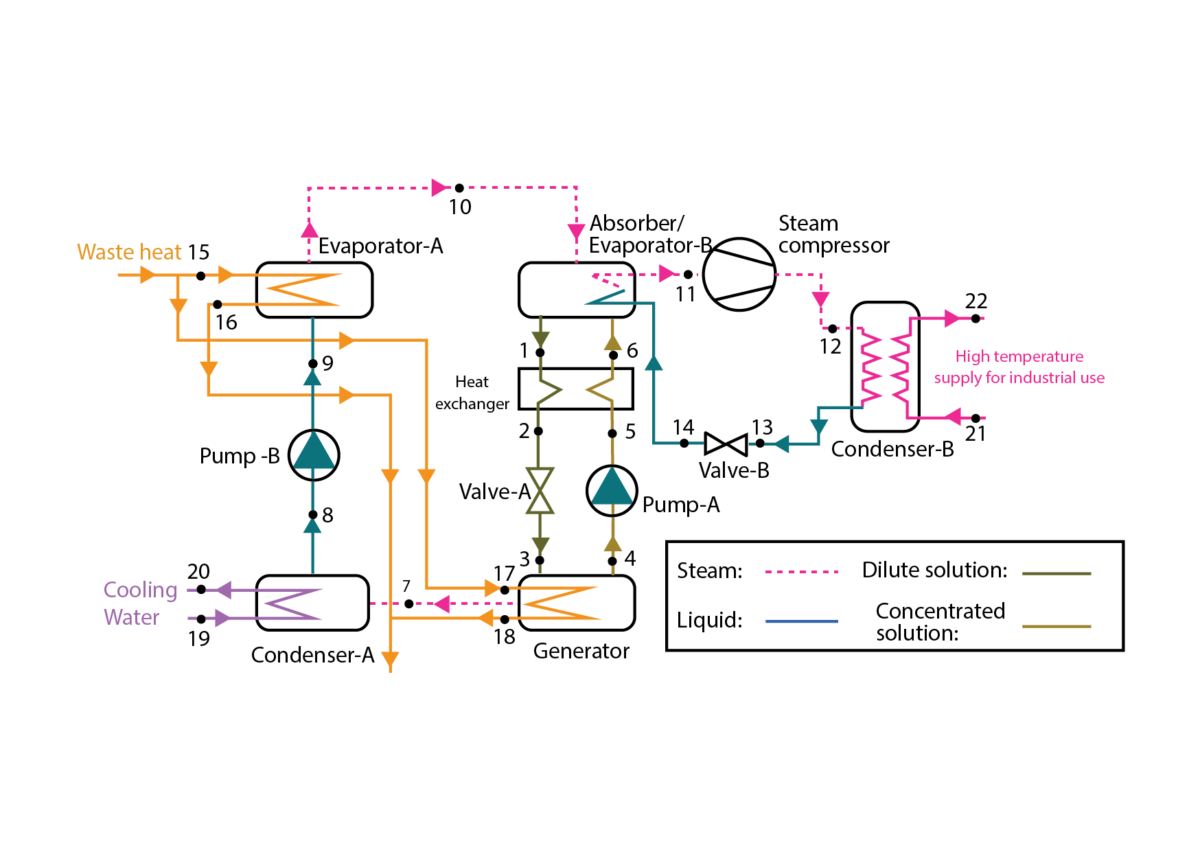
The proposed system utilizes waste heat by thermally coupling a water-lithium bromide absorption heat transformer with heat of compression of water vapor
pump. It reportedly achieved a temperature increase of up to 110 C and ultra-high temperature heating of up to 180 C.
Researchers from Shanghai Jiao Tong University in China have designed an industrial high-temperature heat pump that uses water as a working medium and waste heat recovery technology.
“By taking full advantage of the unique advantages of absorption heat transformers at low temperatures and compression heat pumps at high temperatures, the proposed system can achieve high temperature increases while maintaining high energy efficiency and low irreversible losses. This is of great significance for promoting the application of ultra-high temperature heat pumps in industrial environments,” said the study’s corresponding author RZ Wang. pv magazine.
The heat pump system uses residual heat by thermally coupling a water-lithium bromide (H₂O/LiBr) absorption heat transformer to a water vapor compression heat pump. “Both the H2O/LiBr absorption heat transformer and the water vapor compression heat pump naturally use water as the working medium for waste heat recovery and utilization, but they operate based on different principles and energy sources,” Wang added.
The system consists of an H2O/LiBr subcycle for absorption heat transformer, a subcycle for water vapor compression and the absorber/evaporator-B serving as a coupling component.
The subcycle of H2O/LiBr absorption heat transformer mainly includes absorber, generator, condenser-A, evaporator-A, heat exchanger, pump and valves. The water vapor compression subcycle consists of an evaporator-B, a steam compressor, a condenser-B and valves.
The heat transformer is powered by waste heat, while the water vapor compression heat pump uses electricity. To fully utilize both technologies, a hybrid absorption-compression system is needed to integrate the absorption heat transformer subcycle with the compression heat pump subcycle through thermal coupling. -high temperature output.
“The hybrid heat pump system uses the H2O/LiBr absorption heat transformer subcycle to recover low-grade waste heat through heat-controlled processes, initially increasing the temperature of the low-grade waste heat by more than 10 C,” the research team said. explained.
“At the same time, the water vapor compression subcycle, powered by electricity, further increases the temperature of the upgraded waste heat, achieving an output of 180 C.”
The academics simulated the performance of a 100 kW system under different waste heat temperatures and coupled temperatures. The analysis showed that when the waste heat temperature is between 70 C and 90 C, the evaporation temperature in the absorber increases from 100 C to 170 C. Meanwhile, with evaporation temperatures ranging from 110 C to 140 C, the waste heat temperature increases from 68 C to 170 C. C to 90 C.
They also found that the system’s coefficient of performance increases as evaporator temperatures increase. For example, when this temperature reached 110 C, the COP value was 2.48, while at 140 C it reached a COP of 2.81.
“Overall, improving the waste heat temperature and evaporator temperature in the absorber is critical to improving the COP of the system,” they further explained. “In addition, simulation results show that performance evaluation parameters, including COP, second-law efficiency and exergy efficiency, exhibit maximum values, which are affected by both evaporator temperature and waste heat temperature.”
The new system was introduced in the study “Performance study of a new hybrid high-temperature heat pump with natural water medium”, published in Energy.
Looking ahead, the researchers say they plan to optimize the two interconnected subcycles, which will require more sophisticated control strategies, precise operating conditions and careful system design. “This may increase initial investment and maintenance costs, as well as the need for specialized technical expertise to ensure smooth operation,” they warned. “Therefore, future research should focus on simplifying system design without compromising performance, and on developing easy-to-use controls that improve system usability and enable wider industrial adoption.”
This content is copyrighted and may not be reused. If you would like to collaborate with us and reuse some of our content, please contact: editors@pv-magazine.com.
