

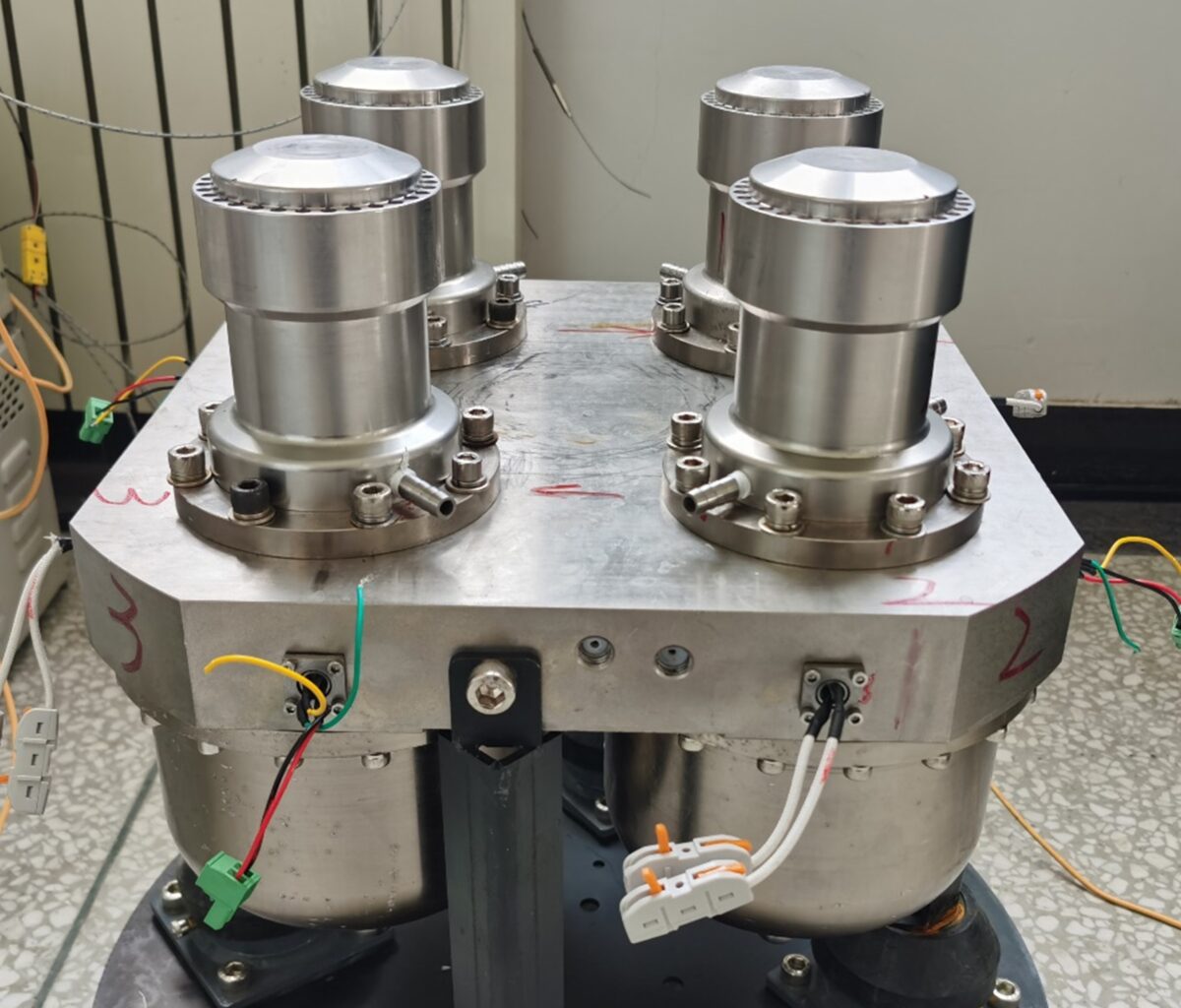
Researchers from the Chinese Academy of Sciences have developed a thermoacoustic Stirling heat pump prototype that offers high thermal performance, a peak coefficient of performance of 1.68 and potential applications in high-temperature industrial processes, enabling carbon-free heating for sectors such as petrochemicals and metallurgy.
The Chinese Academy of Sciences (CAS) announced this week that a group of its researchers have developed a prototype thermoacoustic heat pump that can reach an output temperature of more than 200 C.
Acoustic heat pumps transfer heat using sound waves instead of traditional mechanical parts such as compressors. A loud sound in a specially designed tube causes air molecules to vibrate, creating pressure changes that move heat from one end to the other. Because they have no moving parts, they are quieter and more durable than conventional systems, although high cost and performance limits still hinder commercial adoption.
Thermoacoustic heat pumps are a specialized type that utilizes the thermodynamic interaction between sound waves and temperature changes in a stack or regenerator, providing greater efficiency and precise thermal control for certain applications.
For their prototype, the researchers used thermoacoustic Stirling heat pump technology (TAHP), which uses sound waves in a closed gas loop to transfer heat. This system mimics a Stirling engine, a closed-cycle regenerative heat engine that uses a permanent gaseous working fluid, such as air or gas, where heat-driven compression and expansion create mechanical motion, with a heat transfer fluid providing the energy as needed.
The system uses an electrical phase switching mechanism to implement what the scientists describe as a “reverse phase operation” of the acoustic field for the double-acting heat pump. This design reportedly allows for the reverse transfer of acoustic power within the system, allowing the high and low temperature heat exchangers to switch functions.
The system configuration allows the compressor to operate at lower temperatures, effectively addressing the challenges of ultra-high temperature compressor development. “Using this approach, we have successfully created the world’s first prototype of a free-piston dual-action Stirling thermoacoustic heat pump, capable of reaching pumping temperatures above 200 C,” the academics said. “The experimental prototype, powered by thermal energy, can pump low-grade heat energy of around 14 C to a heat source above 270 C. “
Experimental results showed that the system can significantly increase the temperature from 25 to 166 C, and it can achieve a peak coefficient of performance (COP) of 1.68 within a temperature range of 74 C. When the ambient temperature rises to 67 C, the system delivers a heating supply temperature of 214 C, with the corresponding COP and relative Carnot efficiency reaching 1.5% and 45.2% respectively.
Looking ahead, the research group plans to develop the proposed heat pump technology for high temperature industrial processes such as petrochemicals, metallurgy and ceramics, which require higher temperature requirements.
“For example, the heat source, which is only about 300 C for pressurized water reactors or 400 C to 500 C for parabolic trough collectors, can be increased to between 500 C and 800 C using super-high temperature thermoacoustic heat pump technology, providing a completely new technical approach for carbon-free high-temperature heating in heavy industry,” said the study’s lead author Luo Ercang.
The system was described in “An ultra-high temperature free piston thermoacoustic Stirling heat pump capable of reaching temperatures above 200°C”, published in Letters on applied physics.
This content is copyrighted and may not be reused. If you would like to collaborate with us and reuse some of our content, please contact: editors@pv-magazine.com.
