

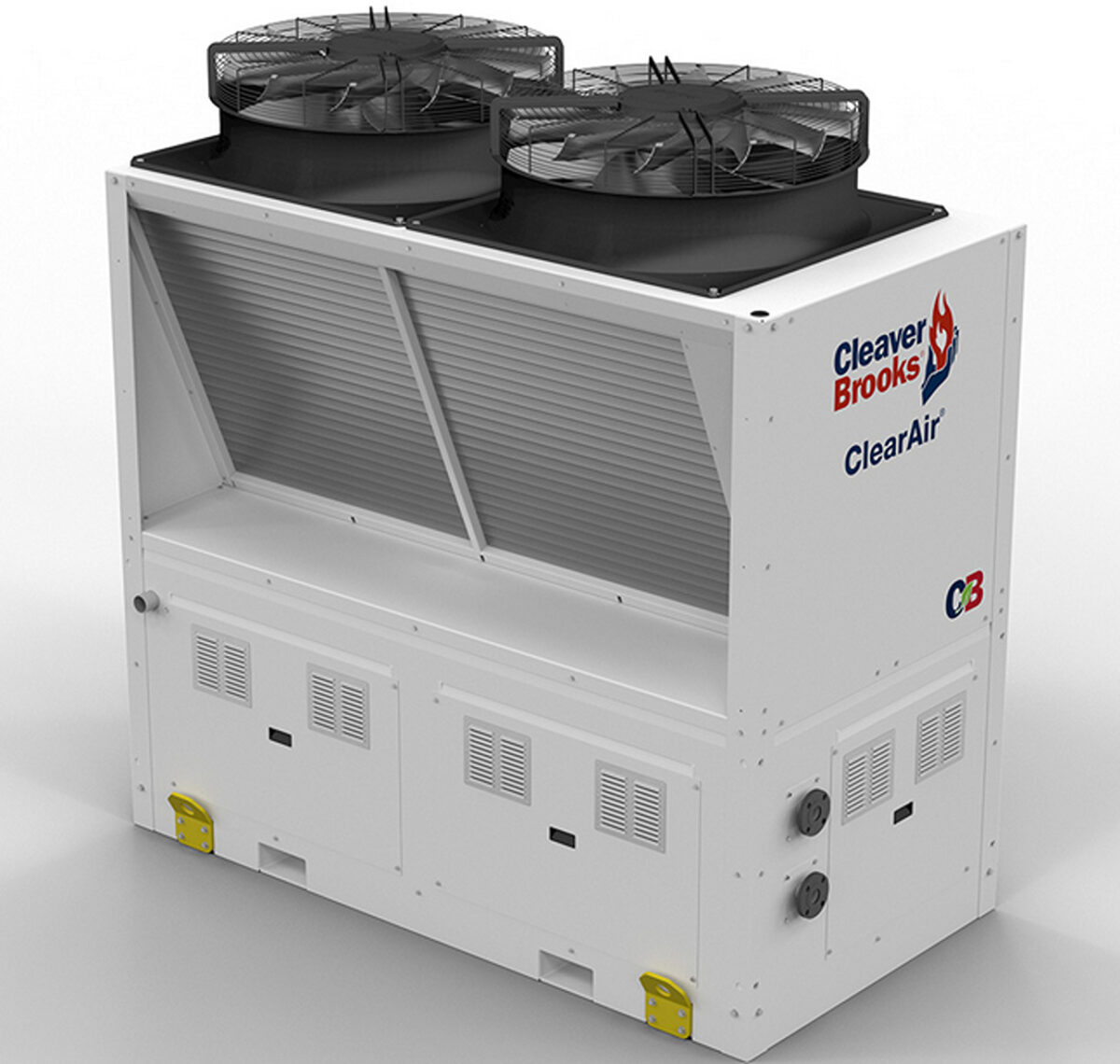
The ClearAir air-to-water heat pump is designed for hydronic heating in residential, commercial and industrial buildings. It is capable of generating hot water up to 80 C with integrated controls and supports hybrid configurations for various applications.
US industrial heating company Cleaver-Brooks has launched a new air-to-water heat pump for hydronic heating applications.
Hydronic systems circulate hot water through pipes to radiators, baseboards or underfloor heating pipes, heating spaces efficiently. The water, heated by a boiler or heat pump, flows in a closed circuit and provides energy-efficient heat. These systems are widely used in residential, commercial and industrial buildings.
“The ClearAir heat pump is designed for versatility in a wide range of building types,” the company said. “From schools and universities to offices, hospitals and multi-family homes, it delivers consistent performance at any scale. Whether serving a single facility or a large campus, the system adapts to the heating needs of any application.”
The system can reportedly generate hot water up to 80 degrees Celsius, a threshold the manufacturer describes as compatible with high-temperature coils, radiators and other hydronic terminal units without the need for distribution upgrades.
The ClearAir unit measures 2,488mm x 1,316mm x 2,421mm and weighs 1,677kg. It delivers 103 kW of thermal power with a coefficient of performance (COP) of 2.7 under standard conditions. The system has a monobloc design and uses R-513A refrigerant.
Connectivity and control are handled via an integrated, factory-installed controller that supports BACnet and Modbus protocols, allowing seamless integration with building management systems.
Cleaver-Brooks points to the potential for hybrid installation designs, combining ClearAir with existing boilers for backup heating during extreme conditions or peak demand.
“The ClearAir heat pump is well suited to both new construction and renovation projects and can be seamlessly integrated into existing hydronic systems or new designs,” the company added. “The compact, modular and scalable design ensures that owners, contractors and engineers can rely on a single platform to meet diverse project needs.”
In setups with one heat pump, one system serves the entire heating need. In multi-unit designs, two or more heat pumps share the load. In a hybrid configuration, one or more heat pumps are linked to one or more boilers, making this the preferred design for most applications. This arrangement addresses capacity, redundancy and low outdoor temperature limitations common to single or multi-heat pump systems.
This content is copyrighted and may not be reused. If you would like to collaborate with us and reuse some of our content, please contact: editors@pv-magazine.com.
