

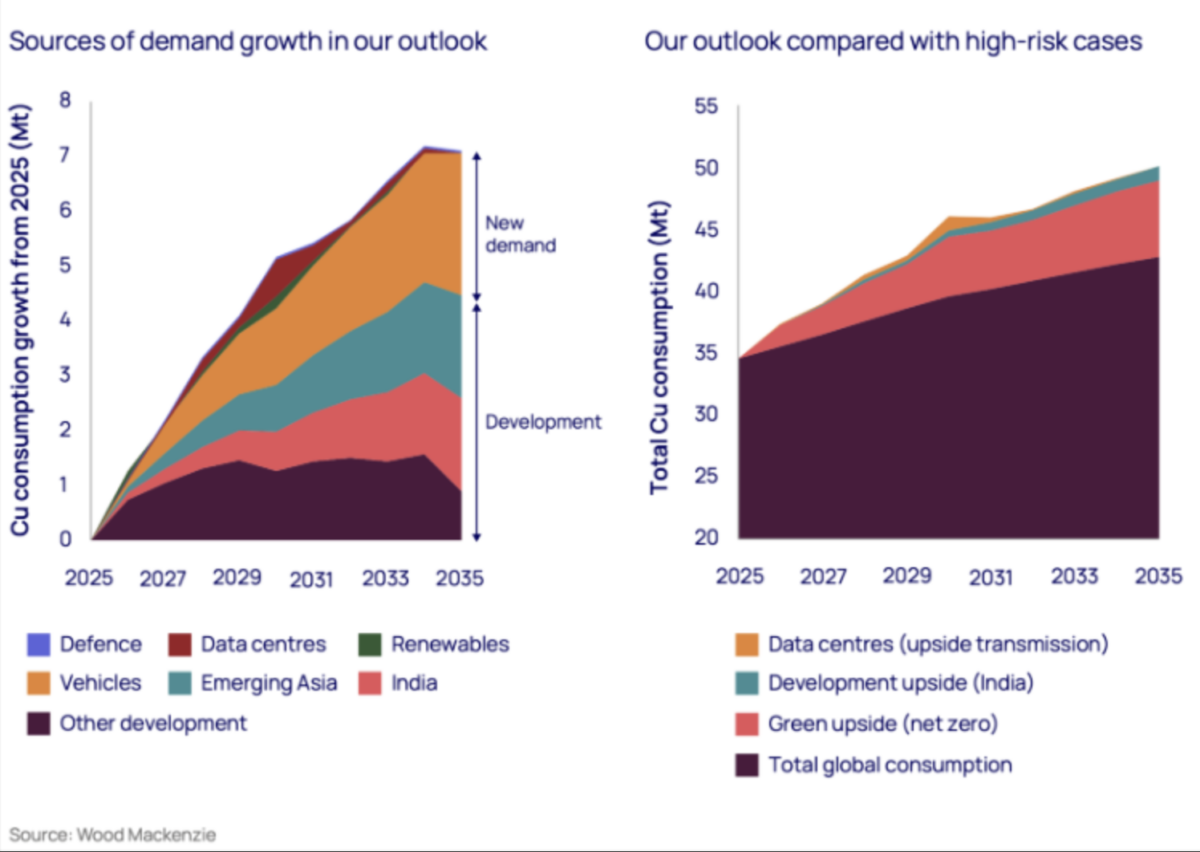
Demand for copper, often considered one of the most valuable alternatives to silver in solar energy production, is expected to increase by almost a quarter globally by the middle of the next decade. Wood Mackenzie says the energy transition is one of four ‘disruptors’ that could cause demand to increase further.
According to an analysis by the US research agency, global demand for copper will increase by 24% by 2035 Wooden Mackenzie.
The consultancy firm’s latest report says global copper demand will increase by 8.2 million tonnes per annum (Mtpa) to 42.7 Mtpa by the middle of the next decade, with growth driven by traditional economic development and new structural demand driven by electrification and digitalisation.
While Wood Mackenzie says this growth trajectory appears “certain,” it adds that there are four “powerful disruptors” that could further boost demand, adding an additional three million tonnes by 2035, or 40% of total copper demand growth.
These disruptors are cited as a global increase in data centers, industrialization in India and Southeast Asia, defense spending and the energy transition.
Wood Mackenzie says the wider energy transition is “fundamentally reshaping copper consumption patterns”, with the shift to renewables expected to require an additional 2 Mtpa of copper supplies over the next decade.
Analyst Peter Schmitz explained that as battery technologies continue to develop, demand for copper in charging infrastructure and energy systems will remain high. “According to our forecasts, copper demand associated with electric vehicles will double by 2035, reinforcing the metal’s role at the heart of the global energy transition,” Schmitz added. “Each electric vehicle contains up to four times more copper than a conventional car.”
Wood Mackenzie’s analysis warns that in a supply-constrained environment, these four disruptive factors could result in prolonged periods of high prices and unpredictable market fluctuations.
Analyst Charles Cooper called copper the “strategic bottleneck of the global energy transition.”
“From Detroit to Shenzhen, the impact of raw material supply chain disruptions and the industry’s inability to deliver results will be acutely felt,” Cooper said. “If governments and investors fail to act, we risk turning the metal of electrification into the metal of scarcity.”
Copper is often considered the most valuable alternative to silver in solar energy production. In September, pv magazine reported solar module manufacturers faced increasing pressure to restrict the use of silver prices rise.
More recently, researchers from the University of New South Wales and the Fraunhofer Institute for Solar Energy Systems said efforts to reduce silver use in solar cells will not compromise module quality if it is well designed.
This content is copyrighted and may not be reused. If you would like to collaborate with us and reuse some of our content, please contact: editors@pv-magazine.com.
