

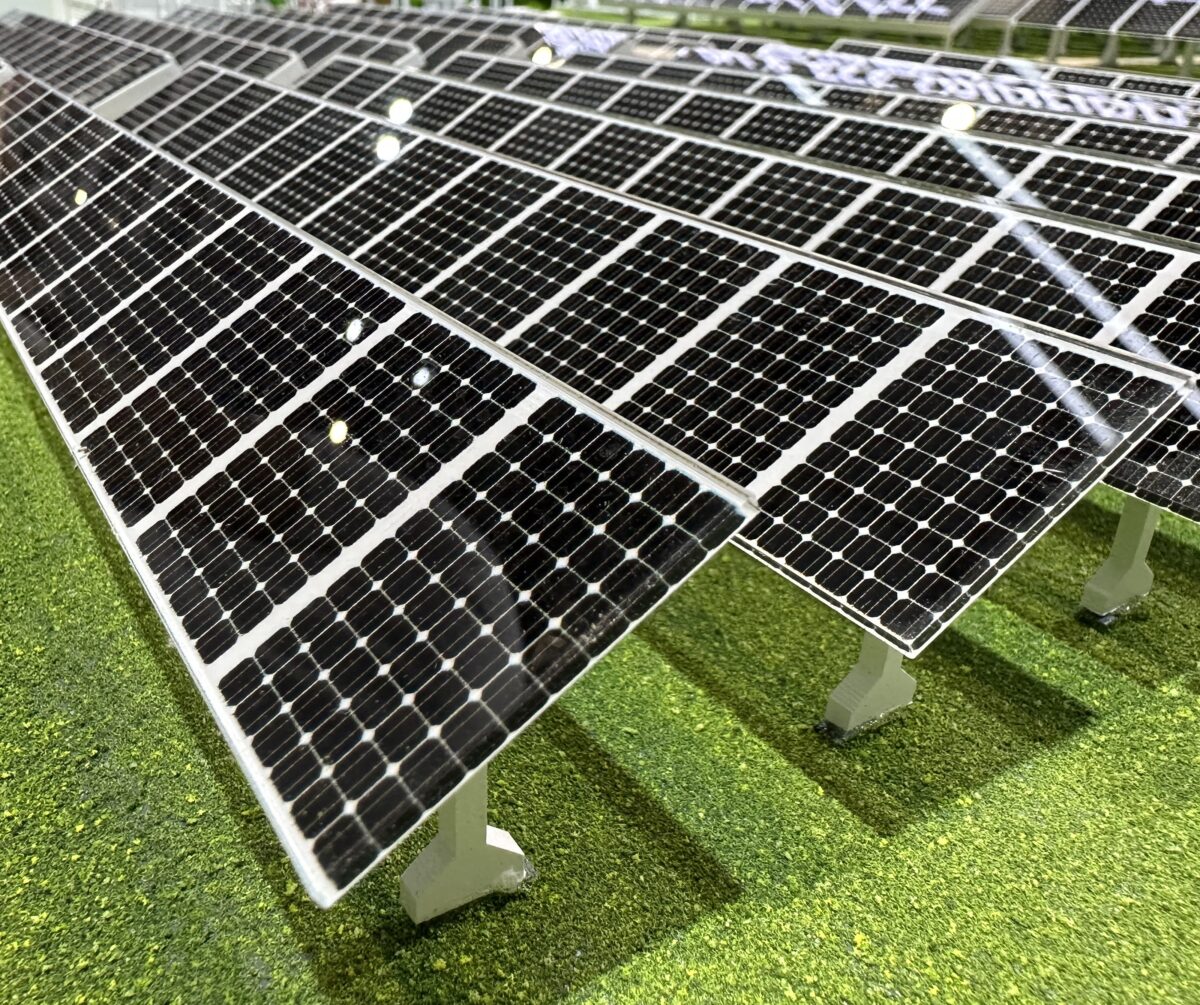
An international research team has created a digital twin that reportedly enables the analysis of different scenarios for the air monitoring of PV installations. The new tool is claimed to reduce the risk associated with real-world experimentation and help identify the most effective strategies to improve PV system monitoring.
An international research team has created a digital twin (DT) platform for testing autonomous air monitoring of large-scale PV power plants. DTs are virtual representations of physical systems, allowing operators and researchers to assess scenarios without the risk associated with real-world experiments.
“The new digital twin-based solution called Digital-PV has been developed for the simulation and managed execution of autonomous air monitoring of PV power plants,” the researchers explain. “It provides a virtual test platform for autonomous flights and missions, including boundary detection, path planning and fault detection, along with data generation capabilities for developing data-driven monitoring and inspection models.”
The DT was based on Unreal Engine (UE), created by American video game company Epic Games to develop game environments. The scientists created a 4 km2 area with small terrain variations and natural features, adjusting the mood and lighting settings to mimic real-world lighting.
“To add installation components such as PV panels and wind turbines to the tier, we purchased the necessary assets and 3D models, including a wind turbine and a PV panel prototype, from 3D model marketplaces,” the group added . “The UE’s built-in static mesh editor was used to create custom meshes of bird droppings in various shapes and sizes, which were used as error marks.”
The company used Microsoft’s AirSim simulator to simulate an aerial robot in the simulated environment. It was set to record RGB images, identify bird droppings, descend to the location of the fault and take an image of the surface of the likely faulty panel. These images can then be used to train error detection models for artificial intelligence (AI).
“One of the challenges of using AI techniques is collecting a significant amount of annotated data. This is because the publicly available datasets are quite limited,” the academics said. “We demonstrate the potential of Digital-PV in generating datasets for developing monitoring models. To do this, bird droppings were used as an example of an error, while other defects will be included in the future.”
In total, the aerial robot took photos of 2,469 simulated PV samples containing bird droppings. It used an encoder-decoder based fully convolutional network architecture (FCN), adapted from the VGG16 model, for error detection. About 85% of the images were allocated for model training, 10% for validation during the training process and 5% for testing.
The scientists found that the average accuracy for training and validation was 98.31% and 97.93% respectively, which they say shows that the trained model can accurately locate birds falling on PV modules with an average accuracy of 95.2% for test data.
The DTs can also be used to evaluate AI boundary extraction, that is, to identify the PV plant in relation to the environment. The team also demonstrated that they can be used to test the path planning models. For the boundary extraction, they used classical image processing (CIP) and a deep learning (DP)-based model, while for the path planning they used algorithms from the scientific literature. However, the quantitative results of those tests were not presented.
“By assessing their performance and effectiveness, we gain valuable insights into their capabilities and potential performance in the real world,” the scientists concluded. “This analysis helps advance AI-enabled solutions for air monitoring of PV installations, enabling more efficient inspection and maintenance of these critical renewable energy infrastructures.”
The digital twin was presented in “Digital-PV: a digital twin-based platform for autonomous air monitoring of large-scale photovoltaic power plants”, published in Energy conversion and management. It was proposed by scientists from Iran’s Amirkabir University of Technology, the University of Isfahan, Canada’s Concordia University, Norway’s Norwegian University of Science and Technology (NTNU) and Germany’s Albert Ludwigs University of Freiburg.
This content is copyrighted and may not be reused. If you would like to collaborate with us and reuse some of our content, please contact: editors@pv-magazine.com.
