

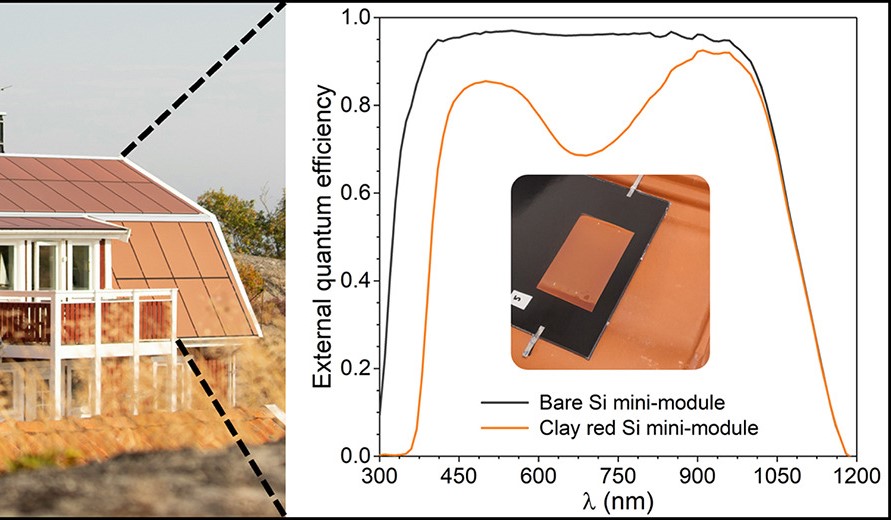
The use of a new roll-to-roll process and optimization technology resulted in polymer films for use in colored PV modules in a potentially wide range of colors with low iridescence and low levels of efficiency loss.
Danish researchers have developed color-tunable film technology, made in a roll-to-roll process, for building integrated PV modules (BIPV).
In two recent papers, the researchers detailed an optimization algorithm and process to structure the surface of a polymer film called Colorfoil. This film, which is placed between the encapsulation layer and crystalline silicon (c-Si) solar cells in PV panels, enables color-matching panels with low iridescence.
“Colorfoil was born to develop structurally colored interlayers with low iridescence that can be deposited by roll-to-roll magnetron sputtering on top of a flexible polymer film, and that can be easily incorporated into the PV laminate, before the photovoltaic cell, to customize the coloration with minimal loss of efficiency, regardless of size or geometry,” said the corresponding author of the study, Catarina G. Ferreira, pv magazinehighlighting several unique aspects of research.
“On the one hand, the concept of Colorfoil is itself innovative, as currently existing solutions in the color BIPV market either rely on absorbing pigments, which strongly influence PV efficiency, or apply structural colored layers directly onto the glass superstrate, severely limiting flexibility and adaptability to different PV module sizes,” said Ferreira.
“On the other hand, there is something new in the combination of nanoimprinting lithography and magnetron sputtering, both performed in roll-to-roll (R2R) production lines, to produce large quantities of low iridescence colored films, for which limited research has been done so far,” she said.
The researchers noted that distributed Bragg reflectors (DBRs) were considered for a “simple periodic design and color tunability covering a wide range of hues,” but DBRs were limited in producing certain colors and it was not possible to adjust color hues on demand.
“By modeling and optimizing the optical response of periodic multilayer systems, we show that not only can we match virtually any target color in the sRGB color space, but, more importantly and innovatively, that we can do so while significantly minimizing iridescence. Finally, we have a close match between modeling and the experimental results using full R2R production tools,” Ferreira said.
The researchers demonstrated red-colored silicon PV mini-modules that mimic the color of clay roof tiles typical of Danish architecture, with a low efficiency loss of “about 18%” and “remarkable color similarity.”
“In fact, such clay red mini-modules were able to maintain more than 80% of the PV performance compared to an equivalent bare c-Si PV mini-module, without any coloring interlayer element, from the same surface area and with the same BOM,” the researchers said.
The work is described in detail in “Colored planar multilayers with minimal angular color dependence for building integrated solar photovoltaics”, published in Nanoenergy.
In an additional study Structurally colored planar multilayers with minimal angular color dependence for building integrated solar photovoltaicspublished in Solar RRLan alternative methodology for low iridescence optimization was detailed.
An alternative “optimization-based inverse design methodology” was used to identify “simple planar multilayer configurations with a relatively low number of layers and capable of reflecting selected target colors with minimal angular variation.” The team assessed that this would not increase design complexity with potential for use in large-scale production of PV modules.
The research was led by the University of Southern Denmark with researchers from the Technical University of Denmark Stensborg A/S participate.
Looking ahead, the researchers want to explore large-scale implementation and application of the optical optimization methodology to find the ideal trade-off between color matching and efficiency. “A third and very important topic is to demonstrate the durability of the foil in the laminate to ensure durable colored PV modules, enabling aesthetically pleasing energy-producing facades,” says Ferreira.
This content is copyrighted and may not be reused. If you would like to collaborate with us and reuse some of our content, please contact: editors@pv-magazine.com.
Popular content

