

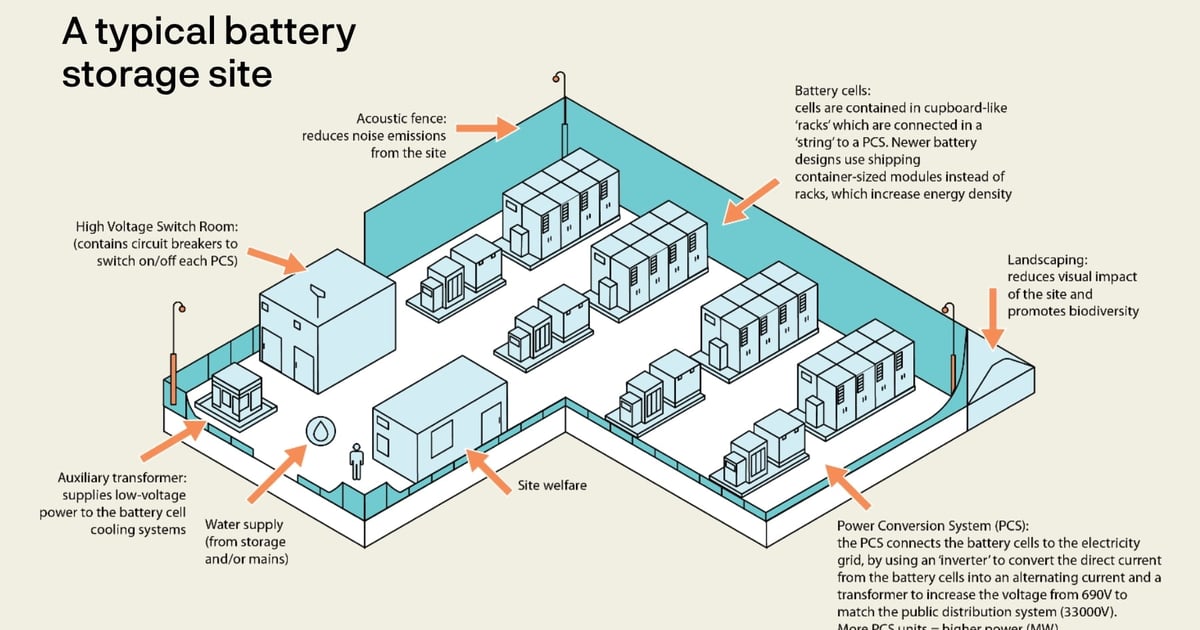
The document, Battery Energy Storage Systems Explored, addresses some of the most frequently asked questions surrounding grid-scale battery projects, covering topics such as fire safety, environmental impacts, land use, noise, cybersecurity and emergency planning.
According to ESN, 108 GW of new battery storage capacity was deployed globally in 2025, representing a 40% increase year-on-year. In Britain, around 2 GW of new BESS capacity became commercially operational during the year, generating an estimated £1.2 billion in investment.
ESN said the guide has been developed to provide clear, evidence-based information as battery storage plays an increasingly important role in supporting the UK’s transition to a low-carbon electricity system.
The guide outlines how developers deal with the key issues that often arise during the planning process, including fire risks, visual impacts, biodiversity, traffic disruption and electromagnetic fields.
Ten common BESS problems
In terms of safety, ESN highlighted that battery storage facilities are operating below par guidance from the UK Health and Safety Executive and the National Fire Chiefs Council (NFCC). It noted that battery fires remain rare and are typically located in individual battery containers. Citing international data from the Electric Power Research Institute (EPRI), the guide said battery failure incidents fell by about 97% globally between 2018 and 2023 as safety standards and system designs improved.
Another issue being addressed by the trade association is the environmental impact of battery fires. ESN said smoke plumes are generally confined to the site and spread quickly, while developers implement containment measures to prevent contaminated runoff from reaching soil and waterways.
Furthermore, the report highlights that UK developers operate under the guidance of the Health and Safety Executive and the National Fire Chiefs Council (NFCC), with projects requiring detailed emergency response plans developed in partnership with local fire and rescue services. Modern battery systems include multiple layers of protection, including thermal monitoring, fire suppression systems and spacing requirements designed to prevent incidents from spreading beyond individual containers.
In terms of land use, ESN argues that battery storage occupies a relatively small footprint compared to the total agricultural land in Britain. The report estimates that grid-scale battery projects in Britain would cover around 125 hectares by 2025, equivalent to around 0.0007% of the country’s agricultural land. Developers are encouraged to avoid high quality agricultural land and environmentally sensitive areas where possible, while net gain requirements for biodiversity are driving habitat improvement measures in many locations.
The publication further seeks to address concerns around visual impact, stating that battery storage facilities are generally low-rise developments that can be shielded using landscaping, hedges and earthen dams. Noise impacts are also assessed during planning through acoustic surveys, with mitigation measures such as barriers and fencing deployed where necessary.
According to the guide, traffic impacts associated with battery storage construction are generally limited to the installation phase. Although deliveries of abnormal loads may be required for transformers and other heavy equipment, developers are expected to draw up transport management plans in consultation with local authorities to minimize disruption.
The report also addresses concerns around electromagnetic fields (EMFs), noting that battery cells do not generate electromagnetic fields themselves and emissions from associated electrical infrastructure remain subject to government regulations and guidance from the UK Health Security Agency.
In terms of cybersecurity, the guide states that battery storage operators use multiple layers of digital protection, including encryption, authentication systems and network segmentation. Network compliance requirements ensure that systems can disconnect or isolate themselves if a threat is detected, limiting the risk of broader network disruption.
