

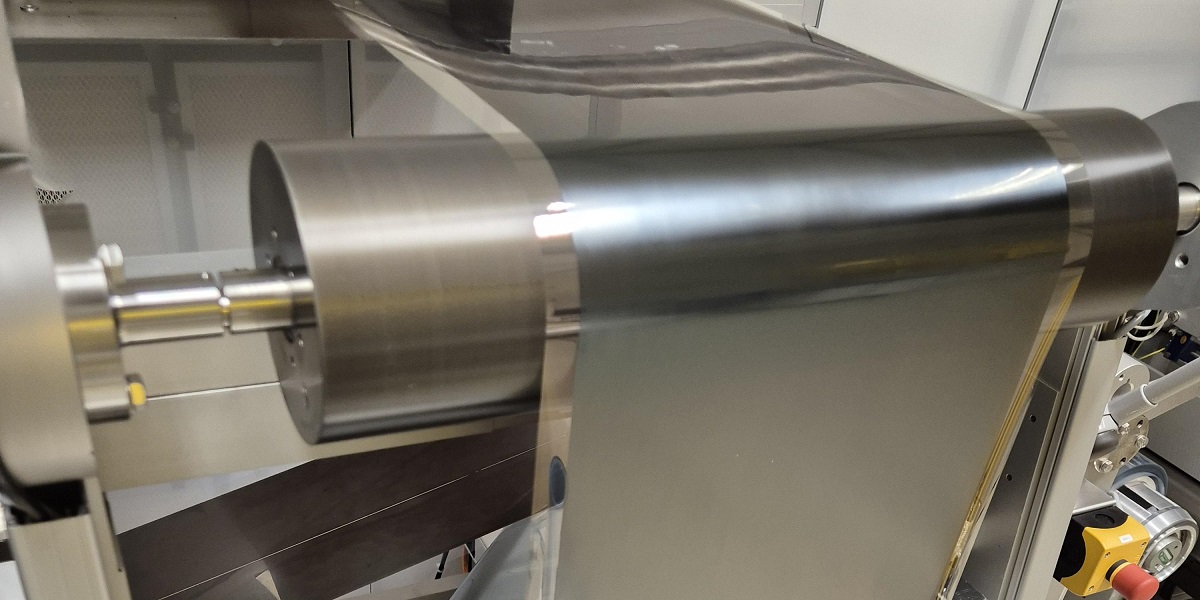
The LUMINOSITY project consortium aims to develop 20% efficient metal halide perovskite prototype modules over 900 cm², designed for a 20-year service life and compatibility with roll-to-roll (R2R) processing.
A team in Europe aims to develop 20% efficient metal halide perovskite prototype modules over 900 cm2 with a target lifespan of 20 years. The consortium will use industrially compatible R2R processing. The project is funded by the Horizon Europe program and its members include representatives from industry, universities and research and technology organizations (RTOs).
“Flexible perovskite solar cells are being developed in many places in Europe,” says Ilker Dogan, team leader for energy and materials transition at TNO. pv magazine. “In the laboratories, an efficiency of up to 26% is already achieved, but this is done under highly controlled conditions, without taking into account operational safety and the impact on the environment.”
The team proposes using established industry processes such as R2R and laser processing, as well as vacuum deposition. The researchers also aim to design perovskite modules to be low-carbon and environmentally sustainable from the start.
The project’s abbreviation LUMINOSITY stands for large-scale, uniform, industry-compatible perovskite solar cell technology. It is a four-year project that started in May with a budget of 6.9 million euros.
“In (the) LUMINOSITY project, we are demonstrating the technology in industrially relevant processing environments, bringing the technology readiness level (TRL) to seven,” Dogan said. “We do this with a consortium consisting of universities, RTOs and companies, which will promote the various parts of the technology to a commercial level.”
The team used an aluminum (Al) fluorinated tin oxide (FTO) electrode foil sourced from Hyet Solar BV, the Netherlands. The AI/FTO is considered superior to alternative substrates because it allows high-temperature processes, better stability and efficiency, while maintaining material flexibility, Dogan said.
“Most of the layers deposited in this perovskite solar cell stack are processed below 150 degrees Celsius. In this aspect it is compatible with most flexible substrates. However, the limitation of the process at low temperatures is not a problem for the Al/FTO foil we use here,” Dogan explains. “The biggest challenge is to match industrial-scale processing speeds with suitable solvent systems while maintaining uniformity and efficiency over large areas that is comparable to the efficiency of small-scale devices.”
The project includes stability and service life testing, including open air testing, a life cycle analysis and a techno-economic analysis.
Several applications are envisioned for the large-area flexible perovskite devices in building-integrated PV and building-deployed PV. “The first intended application areas are buildings, roofs and facades,” says Dogan. “In addition, it can also be applied at utility scale and in agricultural areas.”
Participating industry partners include Hyet Solar BV from the Netherlands, Czech Republic-based consultancy AMIRES sro, Danish materials and equipment supplier Infinitypv, and two Germany-based equipment suppliers, Von Ardenne and LPKF Solarquipment.
Research groups from the following institutions are participating: TNO, TU Delft, Eindhoven University of Technology, Hasselt University, Lund University, Cyprus University of Technology (CUT), Swiss Federal Laboratories for Material Science (EMPA), Helmholtz-Zentrum Berlin für Materialien und Energie (HZB), Fraunhofer Institute for Electron Beam and Plasma Technology (FEP), Consiglio Nazionale delle Ricerche (CNR).
This content is copyrighted and may not be reused. If you would like to collaborate with us and reuse some of our content, please contact: editors@pv-magazine.com.
