

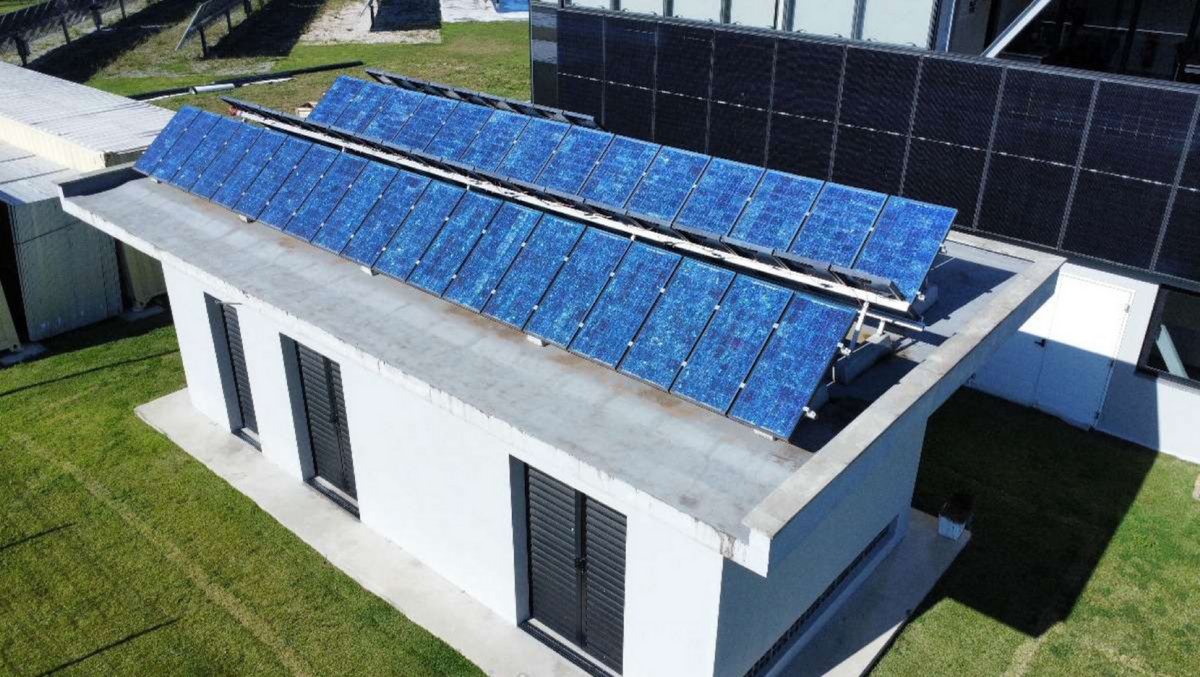
Researchers in Brazil tested second-life polycrystalline PV modules for two years and found that they retained 87-88% of their original power, with minimal degradation and stable performance. Despite strong sustainability and circular economy benefits, economic incentives remain limited due to the falling costs and short warranties of new, state-of-the-art silicon PV modules.
Researchers from the Federal University of Santa Catarina (UFSC) in Brazil have conducted two years of testing on polycrystalline solar panels deployed on their campus and found that they can still guarantee ‘stable’ behavior, with performance consistent with annual degradation rates of up to 0.44%.
“Despite the many aspects that make it a tough sell, circular economy and sustainability issues could work in favor of second-life photovoltaic modules, due to the enormous amount of solar panels that will become available due to the exponential growth that this technology has been experiencing for almost a decade,” says the study’s lead author, Ricardo Rüther. pv magazine.
“Despite the clear arguments for second-hand PV regarding technical issues, sustainability and aspects of the circular economy, it is difficult to argue this on economic grounds as the price of state-of-the-art silicon PV continues to fall.” he continued. “It It is currently difficult to believe that anyone would opt for a second life Si PV module at a price that is at least 50% below current market prices for brand new, state-of-the-art Si PV modules. Moreover, the warranty periods in this market are a bit unclear.”
For the experiment, the research team used second-life multicrystalline PV modules sourced from a decommissioned off-grid system on Ratones Island, Brazil, which was originally installed to replace diesel generation. The system consisted of 76 modules totaling 4.7 kW and operated for more than 22 years before being repowered with higher efficiency technology in 2022.
After dismantling, the modules were transported to UFSC’s PV laboratory for detailed evaluation under similar coastal environmental conditions. In 2023, all modules underwent visual, electrical and safety assessments, leading to 68% approval for second-life use.
Experimental setup
The approved modules were then tested in two configurations: an outdoor installation at module level and a grid-tied installation at system level. At the module level, two representative modules were installed on a single-axis tracker, with continuous IV curve measurements at one-minute resolution.
This setup allowed detailed monitoring of electrical parameters such as maximum power, current, voltage and degradation behavior under real operating conditions. Highly accurate sensors measured irradiation and temperature, allowing correction of the results to standard test conditions.
Strict data filtering ensured high-quality datasets, resulting in 49 valid clear-sky days over a two-year monitoring period.
Electroluminescence imaging was performed both after dismantling and after two years of outdoor exposure to detect defects and monitor track degradation. This combined electrical and imaging approach provided insight into the long-term stability of reused modules.
System performance was evaluated using performance ratio (PR), including weather-corrected PR to account for temperature variations.
Electrical and environmental data were collected and processed with filtering criteria to ensure reliability, resulting in 128 valid days of analysis.
Additional field tests including IV curve tracking, insulation resistance measurements and thermal drone inspections were conducted to assess system integrity. Operating temperature was estimated using established models due to the lack of direct sensors.
Results
The tests were carried out between 2023 and 2025 and showed that the modules were able to maintain 87-88% of their original power, with a minimum additional degradation of approximately 0.4% per year, with clear sky IV curves confirming stable electrical behavior for two years, consistent with post-decommissioning measurements.
Electroluminescence imaging, meanwhile, detected only moderate luminescence reductions, with no inactive cells or severe defect propagation.
Furthermore, system-level degradation was found to average around 0.7% per year, slightly higher due to module mismatch, but still below manufacturer expectations.
Safety tests, including insulation resistance and thermal inspections, confirmed the modules were reliable, even for repaired units with minor cracks. Repaired modules showed only mild hot spots, which posed no immediate risk to performance or safety.
“Overall, the study provides extensive evidence on the performance, reliability and degradation behavior of second-life PV modules,” said Rüther. “It shows that, despite obsolescence, a significant portion of decommissioned modules can still function effectively. However, financial incentives are still needed to establish and scale reuse markets in a sustainable way.”
The research results are available in “Second-Life Solar Photovoltaics in Practice: Performance Results from a Brazilian Case”, published in Advances in solar energy.
The UFSC also houses Brazil’s oldest PV system. It was deployed by Rüther himself in 1997, after completing a post-doctorate in solar energy systems at the German Fraunhofer Institute for Solar Energy Systems (Fraunhofer ISE) in Freiburg, Germany.
This content is copyrighted and may not be reused. If you would like to collaborate with us and reuse some of our content, please contact: editors@pv-magazine.com.
