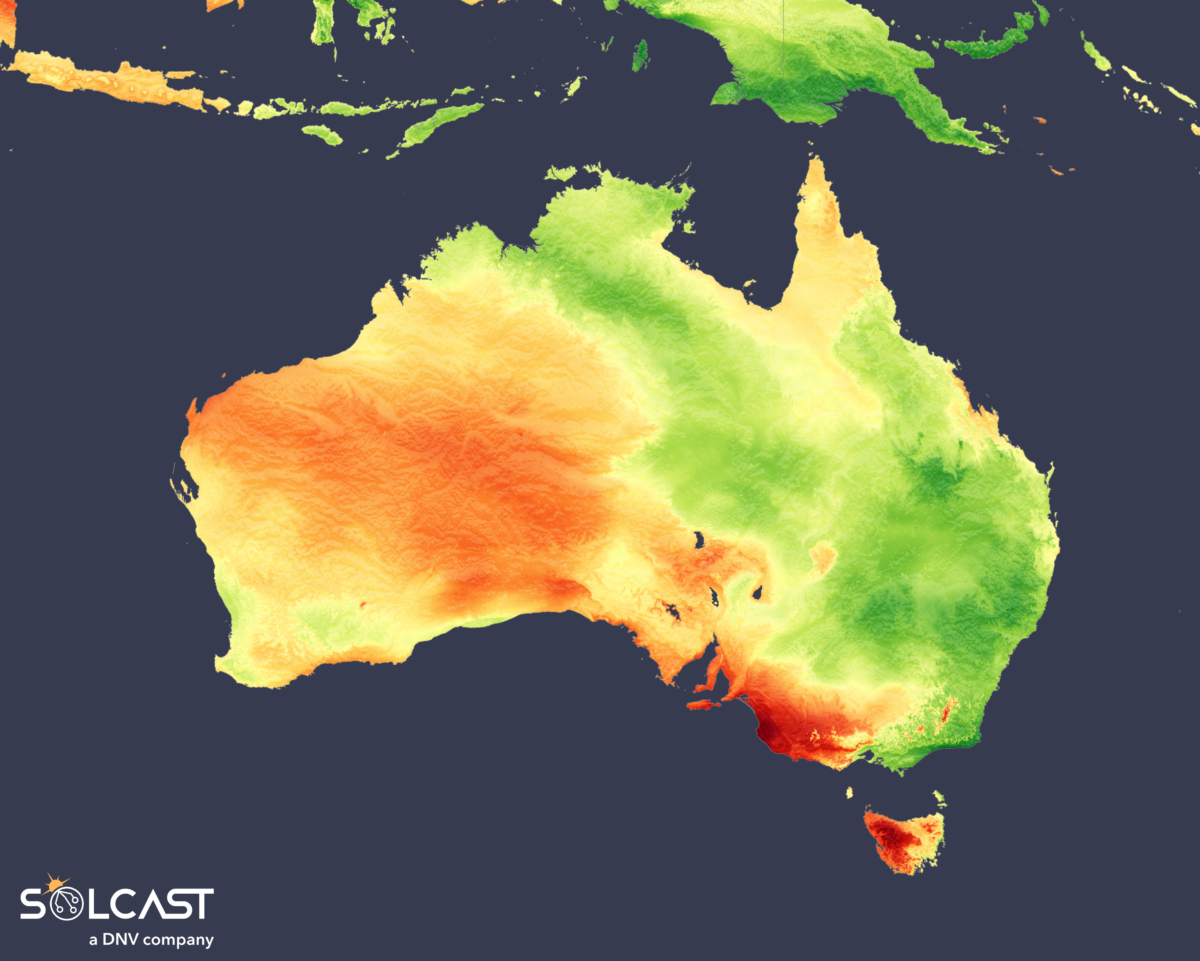
In a new weekly update for pv magazineSolcast, a DNV company, reports that Australia experienced extreme and diverse weather in July and August, resulting in varying solar radiation impacts across the country’s states.
Unstable polar vortex conditions and persistent high-pressure systems led to a season of extreme weather events across Australia in July and August, resulting in both record-breaking cold and heat. These dynamic weather patterns had mixed impacts on solar radiation, with significant differences between different regions, according to an analysis using the Solcast API.
July was a challenging month for solar across most of Australia’s National Energy Market (NEM) as much of the population concentrated on the east coast experienced cloudier than normal conditions. This resulted in all but two states – Tasmania and South Australia – having lower normalized behind-the-meter PV generation than is typical for July. Western Australia recorded less production as most of the installed capacity is concentrated around Perth, where irradiation was below average. Meanwhile, almost all areas in Queensland reported lower than average insolation, with reductions of up to 10% in some regions.
In contrast, the western half of Australia enjoyed higher than average insolation, marking a clear divide between east and west. The difference is due to a near-record high-pressure system off the coast of Tasmania, which brought record cold to southeastern Australia early this month. This cold snap was quickly followed by a series of rain bands that further reduced insolation over much of the NEM.

August showed a more mixed result due to varying weather patterns across the country. Queensland, New South Wales, Tasmania and parts of Western Australia experienced increased cloud cover and rainfall, dampening solar radiation. However, the month ended with an extraordinary rise in temperatures, setting new winter records of more than 40 degrees Celsius in many areas. This was caused by a high pressure system over eastern Australia and the Tasman Sea, which cleared the air and brought warmer northerly winds. Despite this late temperature increase and clearer skies, earlier wet weather on the East Coast kept overall insolation moderate.

Victoria and the Northern Territory saw a change in fortunes, recording greater than average PV generation in August, joining South Australia as the only states to see a boost. Meanwhile, Tasmania experienced its lowest normalized generation in the past decade, with the entire state experiencing lower radiation intensity.
The pattern of above-average rainfall is expected to continue into the latter part of the year. The Australian Bureau of Meteorology is predicting increased chances of rain for most of central and eastern Australia, which could continue to impact solar radiation in these regions.
Solcast produces these figures by tracking clouds and aerosols worldwide at a resolution of 1-2 km, using proprietary satellite data AI/ML algorithms. This data is used to drive irradiance models, allowing Solcast to calculate high-resolution irradiance, with a typical deviation of less than 2%, as well as cloud tracking predictions. This data is used by more than 300 companies that manage more than 150 GW of solar energy worldwide.
The views and opinions expressed in this article are those of the author and do not necessarily reflect those of the author pv magazine.
This content is copyrighted and may not be reused. If you would like to collaborate with us and reuse some of our content, please contact: editors@pv-magazine.com.
Popular content