
Close Menu
  • News
  • Industry
  • Solar Panels
  • Commercial
  • Residential
  • Finance
  • Technology
  • Carbon Credit
  • More
    • Policy
    • Energy Storage
    • Utility
    • Cummunity
What's Hot

Dutch solar owners asked to switch off during peak periods to ease the distribution crisis

June 7, 2026

The hydrogen flow: Toyota demonstrates its racing prototype on liquid hydrogen

June 7, 2026

Era of electrification exposing Australia’s weakest link

June 6, 2026
Facebook X (Twitter) Instagram
Solar Energy News
Sunday, June 7
  • News
  • Industry
  • Solar Panels
  • Commercial
  • Residential
  • Finance
  • Technology
  • Carbon Credit
  • More
    • Policy
    • Energy Storage
    • Utility
    • Cummunity
Solar Energy News
Home - Solar Industry - Fault detection technology for PV modules based on deep electroluminescence learning
Solar Industry

Fault detection technology for PV modules based on deep electroluminescence learning

solarenergyBy solarenergyAugust 20, 2024No Comments3 Mins Read
Facebook Twitter Pinterest LinkedIn Tumblr Email
Share
Facebook Twitter LinkedIn Pinterest Email

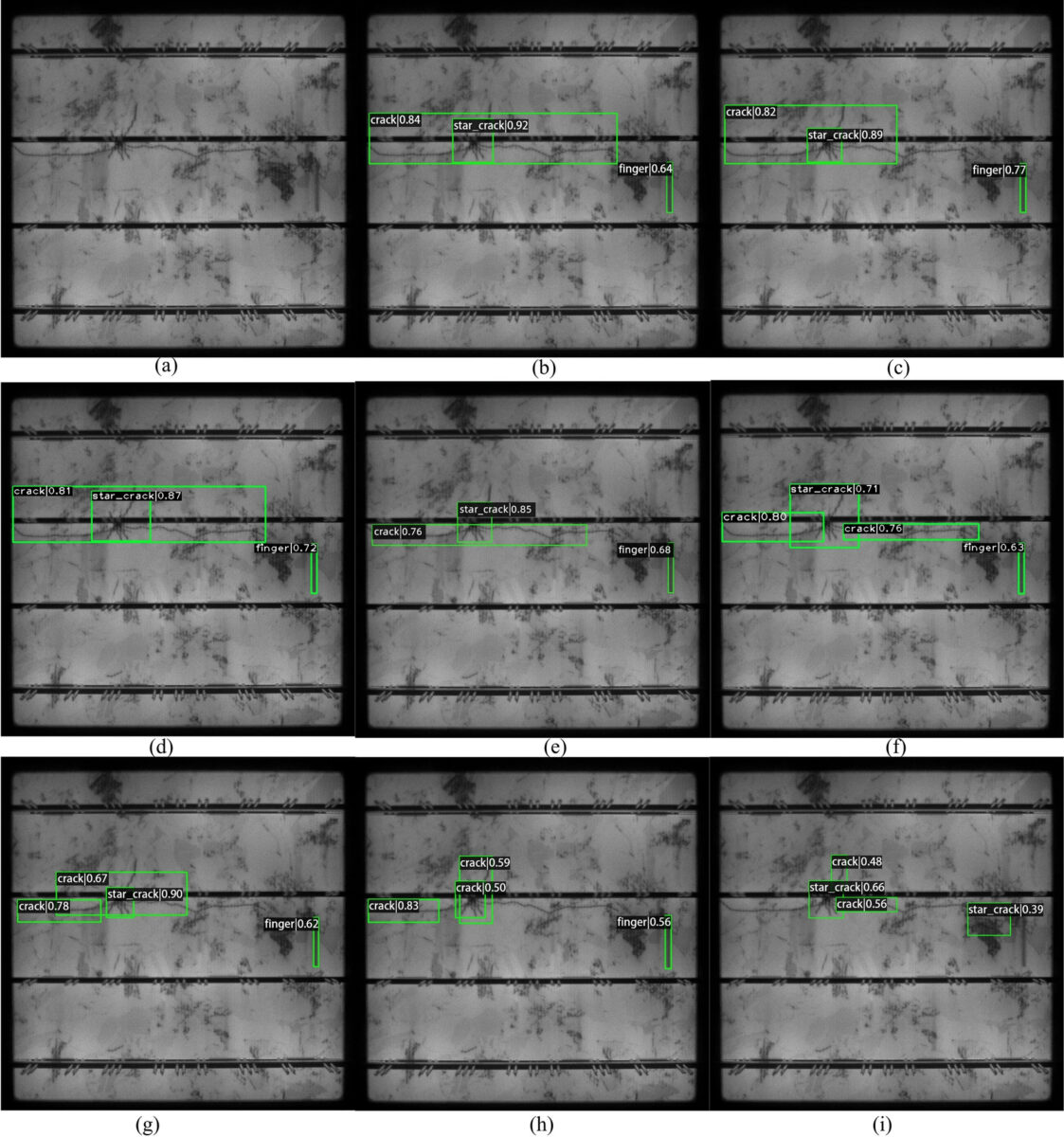
The new technique is based on the VarifocalNet deep-learning object detection framework, which has reportedly been modified to achieve faster and more accurate results. Compared to other similar methods, the new approach proved to be the most accurate and the third fastest.

August 20, 2024 Lior Kahana

A research group from China’s Beihua University and Northeast Electric Power University has developed a new PV defect detection method based on deep learning from electroluminescence (EL) imaging.

“Defects in PV cells can lead to module failures, which can result in reduced power output and pose safety risks to the system,” the researchers said. “It is therefore essential to carry out regular inspections and maintenance on photovoltaic modules to ensure maximum output of the PV system throughout its life.”

The proposed method is based on the VarifocalNet deep-learning object detection framework, a method aimed at accurately ranking a large number of candidate detections in object detection. Deep convolutional neural network ResNet-101 is used as the backbone for feature extraction. To make the VarifocalNet faster, the group designed a bottleneck module with smaller parameters, that is, a layer of the neural network designed to reduce the number of parameters and computational complexity.

“To improve detection accuracy, we design a bottleneck module without reducing the feature map size, replacing the first bottleneck module used in the final stage of the backbone convolution group in VarifocalNet,” the academics explained. “To further improve the detection accuracy, we also designed a new feature interpreter and improved the regression loss function.”

The new detection method was trained and tested on the PVEL-AD dataset, which contains 4,0000 near-infrared images with a range of defects including cracks, finger scratches, black cores and horizontal dislocations. In addition, for reference, other detection methods were tested on the same database: RetinaNet, DDH-YOLOv5, Faster GG R-CNN, Cascade R-CNN, the unenhanced VarifocalNet, enhanced Faster R-CNN, and enhanced YOLOv7.

See also  HY Solar unveils 670 W TOPCon modules with an efficiency of 24.8% – SPE

In EL images, defects appear as dark gray lines and areas, and the new method would detect these quickly and accurately.

“Our method exhibits the highest average Average Precision (mAP) and Recall, indicating that the defect detection accuracy of our method is higher than that of other methods,” the team said. “Moreover, it also has a higher detection rate than other methods except the DDH-YOLOv5 method and the improved YOLOv7 method.”

The researchers emphasized that although their model is a two-phase method, both DDH-YOLOv5 and the improved YOLOv7 belong to the single-phase method. “The two-stage method has a complex network structure, which results in higher detection accuracy and slower detection speed, while the one-stage method uses a relatively simpler network structure, which leads to higher detection speed and lower detection accuracy,” they further explained.

The new approach was described in the article “Defect detection of photovoltaic modules based on improved VarifocalNet”, published in Scientific reports.

This content is copyrighted and may not be reused. If you would like to collaborate with us and reuse some of our content, please contact: editors@pv-magazine.com.

Popular content

Source link

based deep detection electroluminescence Fault learning modules technology
Share. Facebook Twitter Pinterest LinkedIn Tumblr Email
solarenergy
  • Website

Related Posts

ComEd starts a new energy pilot with a solar rebate on the roof of a brewery

June 5, 2026

Video: Understanding Safe Harbor Programs | Power forward!

June 3, 2026

Illinois board approves massive Pride of the Prairie site | Projects Weekly

June 1, 2026
Leave A Reply Cancel Reply

Don't Miss
Energy Storage

Cubico signs Tesla deal for 95MWh Dorset BESS project – Solar Power Portal

By solarenergyJanuary 2, 20250

Cubico’s 50MW Owl’s Hatch solar PV installation, the company’s largest UK solar project to date.…

‘I had to prove my knowledge before I was taken seriously’ – SPE

September 28, 2024

Thermal developer of Solar Energy ticks off the milestone of definitive technology – PV Magazine International

February 12, 2025

China’s first consolidation steps in polysilicon unlikely to impact first-quarter prices – SPE

December 20, 2025
Stay In Touch
  • Facebook
  • Twitter
  • Pinterest
  • Instagram
  • YouTube
  • Vimeo
Our Picks

Dutch solar owners asked to switch off during peak periods to ease the distribution crisis

June 7, 2026

The hydrogen flow: Toyota demonstrates its racing prototype on liquid hydrogen

June 7, 2026

Era of electrification exposing Australia’s weakest link

June 6, 2026

‘Come out from behind your screen, our industry is ultimately about people’

June 6, 2026
Our Picks

Dutch solar owners asked to switch off during peak periods to ease the distribution crisis

June 7, 2026

The hydrogen flow: Toyota demonstrates its racing prototype on liquid hydrogen

June 7, 2026

Era of electrification exposing Australia’s weakest link

June 6, 2026
About
About

Stay updated with the latest in solar energy. Discover innovations, trends, policies, and market insights driving the future of sustainable power worldwide.

Subscribe to Updates

Get the latest creative news and updates about Solar industry directly in your inbox!

Facebook X (Twitter) Instagram Pinterest
  • Contact
  • Privacy Policy
  • Terms & Conditions
© 2026 Tsolarenergynews.co - All rights reserved.

Type above and press Enter to search. Press Esc to cancel.