

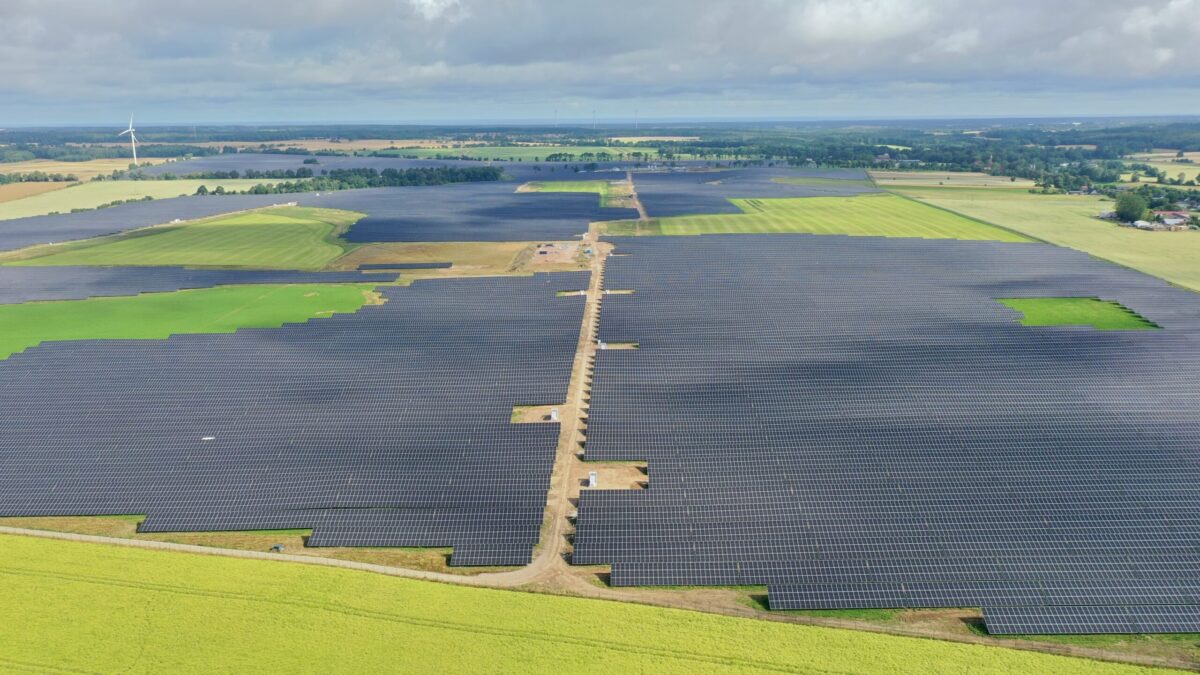
Zwartowo’s 204 MW solar power plant is the first large-scale solar project authorized to provide balancing services in Poland.
A 204 MW solar project has become the first large-scale solar power plant to go live on the Polish balancing market.
The Zwartowo solar power plant, located in northern Poland, was developed and built by the German solar company Goldbeck Solar. Respect Energy, one of the leading energy trading and direct marketing companies in Poland, is, as an aggregator, responsible for the asset’s participation in the balancing market.
Affan Ahsan, Head of Asset Management at Goldbeck Solar, explains pv magazine that due to recent restrictions and negative prices in the electricity market, the company was looking for opportunities to improve project economics.
“Participating in the balancing market was a clear choice as it is expected to offset losses from the restriction and add further revenue streams,” Ahsan explains. “We estimated the additional revenue we could achieve by participating in the balancing market and compared it with the investments and operational efforts required for qualification. We decided to continue because it was very profitable to do so.”
Although the Zwartowo project is legally required to qualify for balancing services due to its installed capacity, Ahsan also shared that the project faced technical barriers to entry due to particularly strict eligibility requirements for solar installations. The qualification process took approximately 14 months in total.
“We had to meet strict regulatory conditions based on stable power plants such as gas and coal,” Ahsan explains pv magazine. “Due to the intermittent nature of solar power plants, it was difficult to meet these requirements. We also had regulatory challenges where we had to discuss the terms of participation with [Polish transmission system operator] PSE and adjust timelines for participation due to weather-related delays.”
Goldbeck Solar’s internal modeling indicates that solar assets can realize up to 10% revenue increases in the short term through balancing market participation, Ahsan added, with long-term gains of around 4%, compared to standard energy market participation.
Participation in the balancing market can also help reduce curtailment, improve shipment predictability, and strengthen resilience to market volatility. “These services enable renewable assets to move beyond being passive price takers,” says Ahsan. “They protect downside risk, stabilize cash flows and ensure that solar power plants can actively support system stability.”
Poland added 3.6 GW of solar energy last year, bringing its cumulative capacity to 24.8 GW.
This content is copyrighted and may not be reused. If you would like to collaborate with us and reuse some of our content, please contact: editors@pv-magazine.com.
