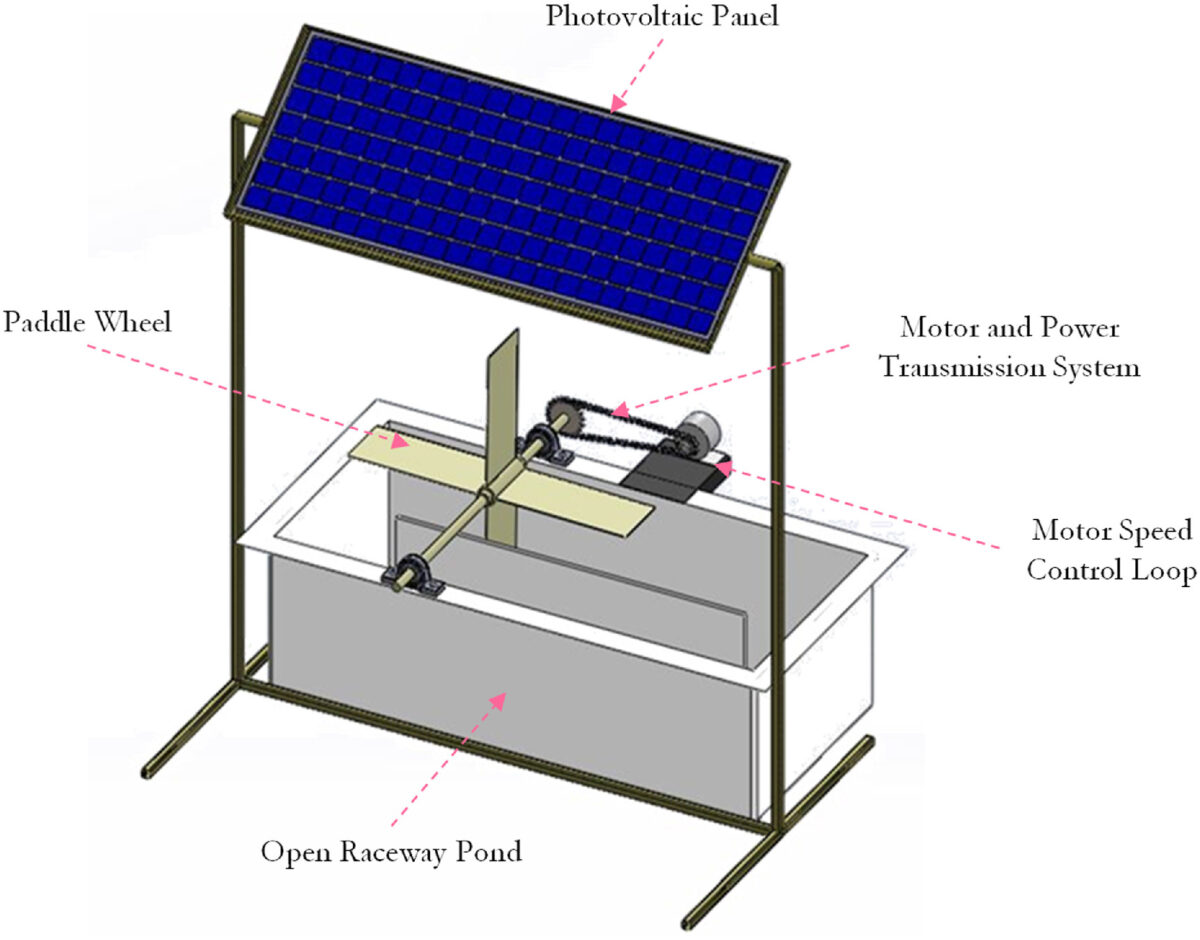
The system can reportedly reduce electricity costs in aquaculture. It consists of an open pond, a mechanical paddle wheel, a motor and power transmission system, a motor speed control circuit, a 100 W photovoltaic module and a 12 V battery with a capacity of 60 Ah, an inverter and a 10 W battery. -A charge controller.
Scientists from the German Fraunhofer Institute for Solar Energy Systems (Fraunhofer ISE) and Tarbiat Modares University (TMU) in Iran has designed a PV system for the co-production of microalgae and electricity.
They explained that aquaculture facilities typically have high electricity costs, representing approximately 40% of their total energy costs, with approximately 0.5% of global greenhouse gas emissions attributable to aquaculture. “The cultivation of microalgae in open pond systems, when integrated with PV technology, can improve energy efficiency and reduce water evaporation, further aligning aquaculture practices with climate change mitigation goals,” they pointed out.
The research group described the proposed technology as a “small aquavoltaic” system consisting of an open pond, a mechanical paddle wheel, a motor and power transmission system, a motor speed control circuit, a 100 W photovoltaic module and a 12 V battery with a capacity of 60 Ah, an inverter and a 10 A charge controller.
The key element of the system, the polyethylene raceway pond, was designed with an open design to allow access to sunlight and air. Typically, these ponds have a shallow design to reduce evaporation and pollution, and to promote continuous water circulation.
The academics determined the optimal water depth for microalgae production in the pond at 0.3 meters. “By controlling this specific water depth together with other parameters such as rotation speed and reaction time, it is possible to create favorable conditions for both microalgae production and electricity generation in the aquavoltaic system,” they further explained.
The system’s performance was assessed through a series of experimental tests conducted from May 9 to 15 under different weather conditions. The most important parameters were solar radiation, air temperature and wind speed.
The analysis found that the shade caused by the solar panel has a “significant” impact on controlling the temperature and pH range in the microalgae production pond. However, the module was able to cover approximately 98.6% of the annual electricity demand of the aquaculture facility.
The team also conducted a techno-economic analysis of a system hosting Spirulina cultivation. blue-green algae that contain vitamins, minerals, antioxidants and proteins, and found that it could achieve 7% lower electricity costs compared to a reference system powered by electricity from the grid.
“The cost of Spirulina produced with the aquavoltaic system in the fifth year was calculated at $0.4975/g at an interest rate of %5 and $0.331/g at an interest rate of %10,” the scientists pointed out. “In addition, the cost per liter for Spirulina produced with the aquavoltaic system was calculated at $0.7133/g.”
The details of the system can be found in the paper “Development and experimental performance evaluation of a small-scale aquavoltaic system for microalgae production”, published in Results in technology. “The current study underlines that solar aquavoltaics could have the potential to further increase microalgae production and thus reduce production costs,” the researchers concluded.
This content is copyrighted and may not be reused. If you would like to collaborate with us and reuse some of our content, please contact: editors@pv-magazine.com.
Popular content