

Researchers have developed a thermal regulation strategy to improve the performance of inverted tin-lead-perovskite technology for all-perovskite tandem solar cells. It has an efficiency of 23.4% and contributed to an efficiency of 27.2% in a tandem cell, while ensuring stability.
A Chinese-Canadian research group has designed a monolithic all-perovskite tandem solar cell that uses an inverted perovskite PV device based on an absorber made with mixed tin-lead (Sn-Pb) perovskite via a newly developed thermal regulation strategy.
Inverted perovskite cells have a device structure known as “pin”, where hole-selective contact p is at the bottom of the intrinsic perovskite layer i with electron transport layer n at the top. Conventional halide perovskite cells have the same structure, but in reverse: a ‘nip’ arrangement. With nip architecture, the solar cell is illuminated via the electron transport layer (ETL) side; in the pin structure, it is illuminated by the surface of the hole transport layer (HTL).
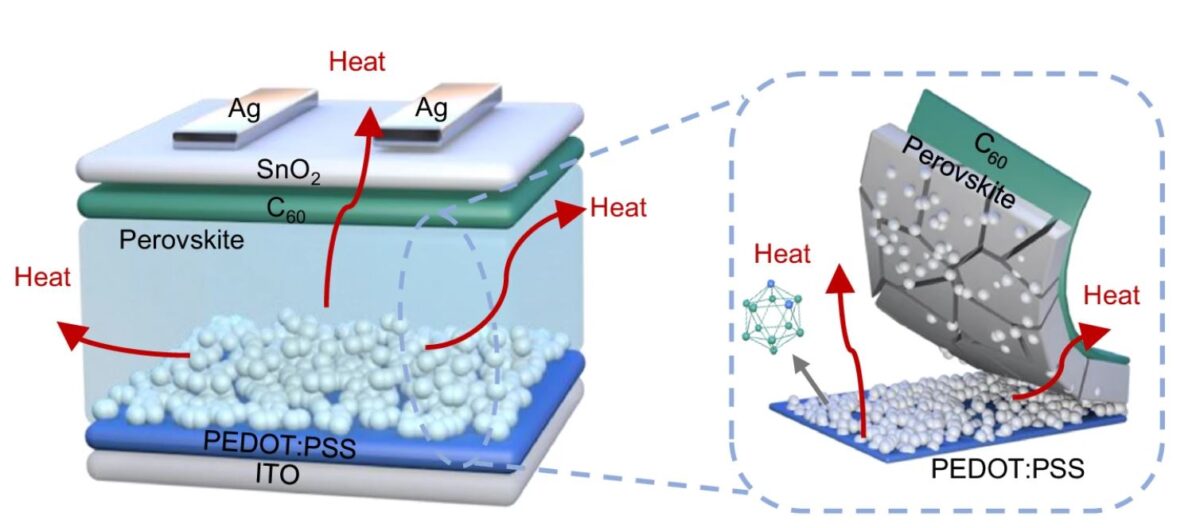
The scientists said their approach was to improve the thermal stability and ease of oxidation of Sn by incorporating carboranes into the perovskite material. These compounds, also known as dicarba-closo-dodecaboranes, are electron-delocalized clusters consisting of boron, carbon and hydrogen atoms with heat transfer capabilities.
“Carboranes are electron-delocalized carbon-boron molecules with significant overlap between atomic orbitals of neighboring atoms, allowing electrons to move freely and spread over a larger area within the materials,” they explained. “The characteristic of electron delocalization allows them to improve thermal conductivity and efficient carrier transport.”
The group selected a carborane type known as ortho-carborane (O-C.B., C2b10H12) and said it has “exceptional” heat transfer ability and chemical stability. It was placed in the cell to prevent direct contact between the perovskite and the PEDOT:PSS layer (HTL) to suppress degradation at elevated temperatures.
The top solar cell is built with a substrate made of indium tin oxide (ITO), a hole transport layer (HTL) that relies on PEDOT:PSS, the perovskite absorber. an electron transport layer (ETL) that relies on buckminsterfullerene (C60), a tin oxide (SnO2) buffer layerand a silver (Ag) metal contact.
Using density functional theory (DFT) calculations, the academics found that ortho-carborane and perovskite could be stably combined, and further ultraviolet photoelectron spectroscopy (UPS) measurements confirmed the improved interfacial energy level of the absorber.
“The valence band maximum of a perovskite film shifted from –5.42 to –5.31 eV after treatment with orthocarborane, which narrowed the band with the highest occupied molecular orbital of PEDOT:PSS and reduced interfacial recombination,” they explained out.
A champion solar cell built with this configuration achieved an energy conversion efficiency of 23.4%, an open-circuit voltage of 0.877 V, and a short-circuit current density of 32.19 mA cm3.2and a fill factor of 82.9%. The device was found to retain 90% of its original efficiency even after 1000 hours. By comparison, a cell without the carborane treatment retained only 62% of its original efficiency after 400 hours.
The cell was then integrated as a top device into a monolithically integrated fully perovskite solar cell based on bottom cells made of Sn-Pb perovskite. The tandem cell achieved an efficiency of 27.2%, an open-circuit voltage of 2.16 V and a short-circuit current density of 15.6 mA/cm2and a fill factor of 81%.
“We further tested the stability of the encapsulated tandem solar cells under simulated illumination from one sun at MPP,” the group said. The pristine tandem retained 87% of its original efficiency after 704 hours of continuous use.”
The new solar cell concept was introduced in the research “Sustainable thermal regulation improves stability and efficiency in all-perovskite tandem solar cells”, which was recently published in Scientific reports. The research team included academics from the University of Toronto in Canada and Qingdao University of Science and Technology in China.
Another research group at the University of Toronto recently unveiled a 25.1% efficient all-perovskite triple-junction solar cell that reportedly shows improved homogenization of the halide perovskite film.
This content is copyrighted and may not be reused. If you would like to collaborate with us and reuse some of our content, please contact: editors@pv-magazine.com.
