

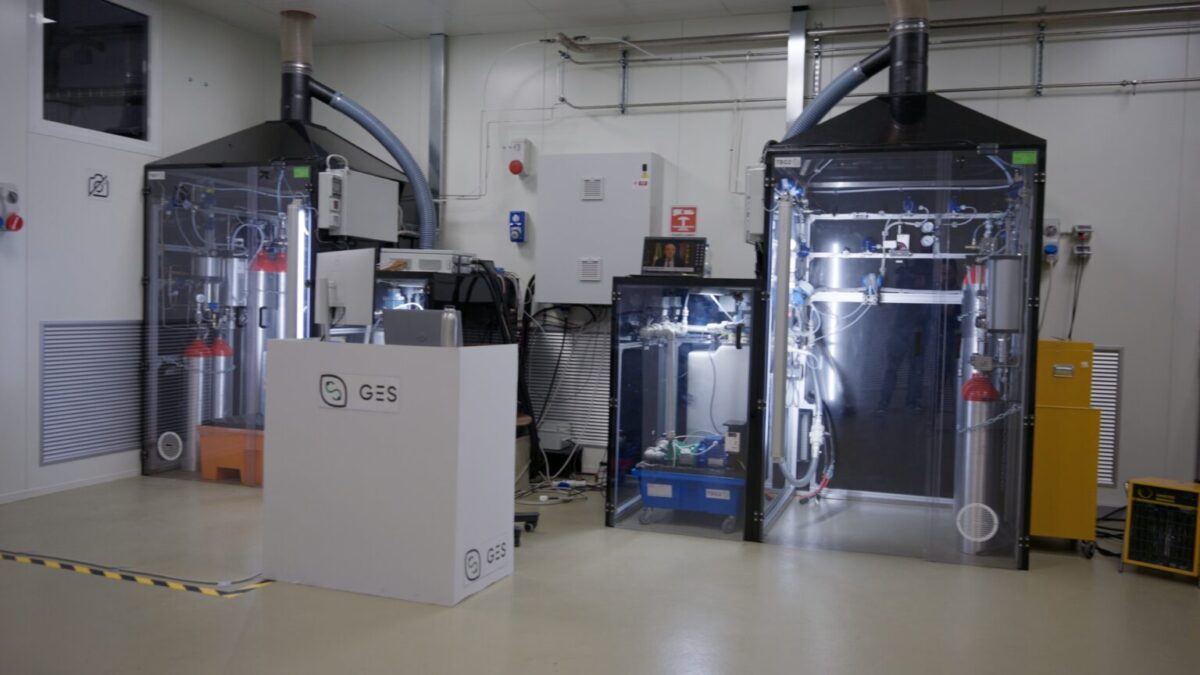
The Italian company said the manganese-hydrogen battery it has developed is an advanced solution for long-term energy storage. The technology allows energy to be stored for many hours or even days, overcoming the structural limitations of lithium-ion batteries.
By pv magazine Italy And ESS news
Taly’s Green Energy Storage (GES) has unveiled a new manganese-hydrogen flow battery aimed at industrial-scale applications, power grids and large renewable power plants. The company reports an efficiency of more than 75%, a lifespan of more than 10,000 cycles and a levelized cost of storage (LCOS) that is “significantly lower than that of dominant technologies.”
“The cost is €0.02 per kWh per cycle, which is very competitive compared to current commercial solutions such as lithium batteries,” said Matteo Mazzotta, CEO of the Trentino-based company. pv magazine Italy.
GES added that the battery is expected to be commercially available in 2027.
“We are in discussions with several parties interested in initial installations and, more broadly, we see strong market demand that we want to meet with our product as quickly as possible,” said Mazzotta.
According to GES, manganese is the battery’s core chemistry. The material was chosen for its abundance, established production chain – both in Italy and across Europe – cost-effectiveness and low environmental impact.
“The manganese-hydrogen battery developed by GES represents an advanced solution for long-term energy storage,” the company said in a press release. “The technology allows energy to be stored for many hours or even days, overcoming the structural limitations of lithium-ion batteries, which are primarily designed for short-duration applications.”
The battery stores energy in the form of self-produced hydrogen and is based on a flow architecture.
“From a technological perspective, the GES battery features a current-based structure that decouples energy and power, allowing storage capacity and power output to be sized independently,” the company said.
GES reported a collaboration with RINA in technology validation and technical optimization, with De Nora in test platforms, Manica in chemical production and Fraunhofer in research and development.
The presentation ceremony took place at the Trentino Sviluppo Agency of the Autonomous Province of Trento, which is committed to promoting the sustainable development of the regional economic system.
This content is copyrighted and may not be reused. If you would like to collaborate with us and reuse some of our content, please contact: editors@pv-magazine.com.
