

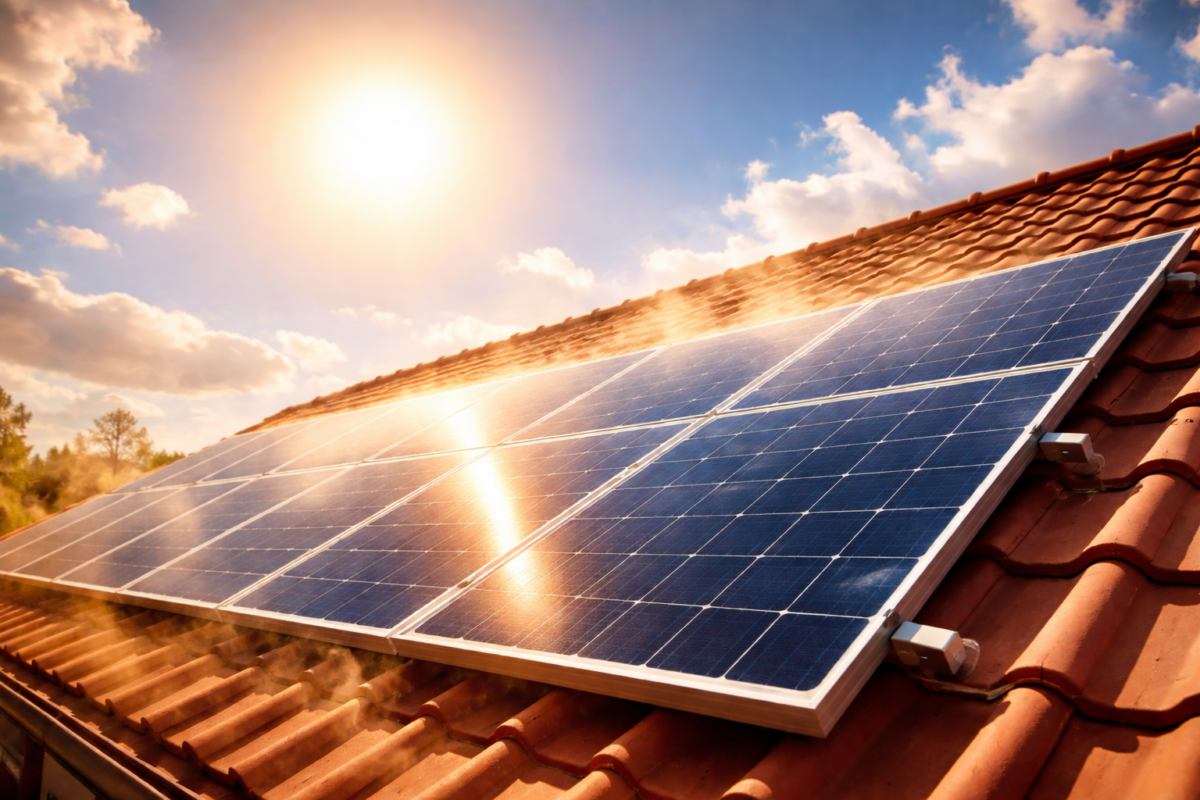
A global study shows that climate change will sharply increase the risks of high temperatures, accelerate degradation and increase the cost of rooftop PV, with economically disadvantaged regions hardest hit. Researchers warn that current IEC standards underestimate future risks and urge urgent updates to avoid stranded assets and rising electricity costs.
A study by an international team of researchers shows that climate change will increase the risks of high temperatures, accelerated degradation and higher costs for rooftop PV worldwide. By combining climate models with PV degradation and economic simulations, the researchers predicted which regions of the world’s rooftop solar would be most affected, and identified where modules are likely to suffer most from rising temperatures.
“This is the first global analysis to quantify how climate change will impact high temperature risks for rooftop solar panels, which are particularly vulnerable to degradation because limited mounting holes trap heat,” said lead author Haochi Wu. pv magazine. “Previous studies examined efficiency losses due to warming or changes in solar radiation – factors that cause modest, often uncertain impacts. We addressed a blind spot: accelerated degradation due to persistently high operating temperatures, which no one had systematically modeled on a global scale under future climate scenarios.”
Wu emphasized that his findings show that the solar industry must “urgently” adjust its high-temperature risk standards for a warmer future.
“The current international standard IEC-63126 defines where high temperature risks occur based on historical weather data – roughly the period 1998-2020,” he said. “Our analysis shows that this standard represents only 74% of global capacity at risk under 2 degrees Celsius of warming and only 48% under 4 degrees Celsius of warming. If the standards are not updated to reflect future climate projections, both investors and installers will underestimate degradation risk, leading to stranded assets and unexpected replacement costs.”
To create their projections, the team used a series of models with different components. The first contained future climate data from twenty CMIP6 models, a state-of-the-art collection of climate simulations that projected conditions through 2100, which were further corrected. Following the growing consensus on quantifying climate impacts, they assessed impacts at 1 to 4 degrees Celsius of warming, at 0.5 degree Celsius intervals, relative to the pre-industrial period.
Operational PV models then calculated how warm roof systems would become. Using climate models – including expected solar radiation, air temperature and wind speed – they estimate module temperatures and hourly energy generation worldwide. All simulations assumed crystalline silicon (c-Si) modules on 20° tilted roofs facing the equator (azimuth 180° or 0°). According to International Electrotechnical Commission (IEC) standards, a standard high temperature risk (HTR) occurs when the 98th percentile of module temperatures exceeds 70 C, while an extreme HTR occurs above 80 C.
Finally, the team applied the Arrhenius physicochemical model to simulate the aging of modules based on temperature. Assuming a base degradation of 0.66% per year and defining a module as unusable after 20% power loss, they calculated the levelized cost of electricity (LCOE) for modules with higher temperatures, shorter lifetimes and lower annual production.
“The magnitude of the LCOE increase was really striking. At 2.5 degrees Celsius of warming, some regions see levelized cost increases of up to 20% – about three times greater than the impacts of changes in efficiency or irradiation that previous research focused on,” Wu said. “The unevenness of this increase was also striking. Economically disadvantaged areas – Africa, South Asia and parts of South America – face significantly larger cost increases than wealthier regions. At 4°C, global warming doubles the LCOE burden in the most vulnerable regions compared to the less vulnerable regions. The solar industry often views distributed PV as a tool for energy equity, but our results show that without adaptation, climate change could destroy that promise Climate change is not just increasing degradation globally; it is widening the divide between regions.”
The team also found that at 4 degrees Celsius of warming, global rooftop PV capacity exposed to high temperatures almost doubles compared to historical levels.
“We provide updated global reference maps that can serve as a basis for standard revisions,” he concluded. “During our research, we contacted experts from the IEC Technical Committee 82, the body responsible for standards for solar photovoltaic energy systems. They showed a strong interest in our work to identify the risk of high temperatures under future climate scenarios. We look forward to deeper collaboration with the committee to help translate these findings into updated guidance.”
The research results are presented in “Climate change will increase the risks of high temperatures, degradation and the cost of rooftop solar photovoltaics worldwide”, published in Joule. Scientists from China’s Beijing University and Zhejiang University, as well as the University of Michigan and Purdue University in the United States, contributed to the research.
This content is copyrighted and may not be reused. If you would like to collaborate with us and reuse some of our content, please contact: editors@pv-magazine.com.
