

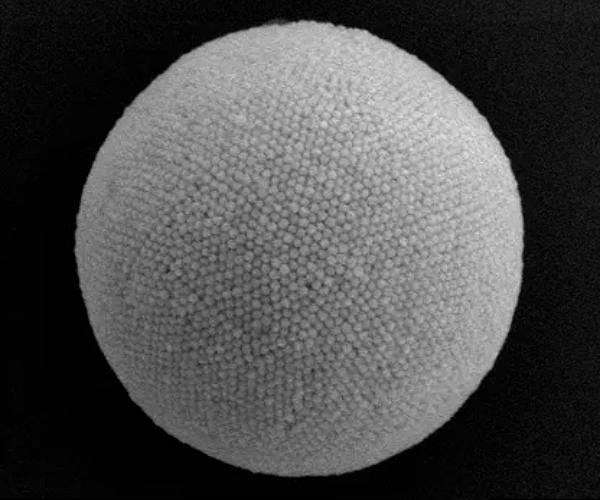
Sunlight has a wide range of wavelengths, but many solar technologies utilize only part of that spectrum, limiting their efficiency. Researchers have now shown that small self-assembled gold spheres known as supraballs can capture almost all wavelengths in sunlight, including those that conventional photovoltaic materials often miss, and can significantly increase the absorption of solar energy when used as a coating on standard devices.
Gold and silver nanoparticles are attractive for solar energy applications because they are relatively simple and cost-effective to produce. However, the light absorption of conventional metal nanoparticles is largely limited to visible wavelengths, meaning they affect only a fraction of the total solar spectrum. To go beyond this limitation and access additional wavelengths such as near-infrared light, a team led by Jaewon Lee, Seungwoo Lee and Kyung Hun Rho developed gold supraballs, in which many individual gold nanoparticles clump together into compact spherical structures.
The researchers used computer simulations to design supraballs that would interact strongly with the broad mix of wavelengths present in sunlight. By tuning the diameter of these spheres, they optimized the structures to maximize light absorption across the entire solar spectrum. The modeling results indicated that well-designed supraballs could absorb more than 90 percent of incident solar wavelengths, indicating great potential for broadband solar energy.
After the simulations, the team fabricated supraball films by drying a liquid solution of the gold spheres on the surface of a commercially available thermoelectric generator, a device that converts absorbed light into electricity via thermal gradients. The films were manufactured under room conditions without specialized cleanrooms or extreme processing temperatures, indicating a simple and scalable production route. This approach allows the supraballs to function as a coating that can be added to existing solar thermal or photothermal components.
During tests with an LED-based solar simulator, the thermoelectric generator covered with the supraball film achieved an average solar absorption of about 89 percent. In contrast, an otherwise identical generator covered with a conventional film made of single, unassembled gold nanoparticles achieved only an average absorption of about 45 percent. The supraball layer therefore almost doubled the absorbed solar energy compared to the traditional nanoparticle coating, confirming the performance predicted by the simulations.
By concentrating many nanoparticles into a single sphere, the supraball design enhances the plasmonic interactions responsible for light capture at the nanoscale. These collective effects help the structures respond to a broader wavelength band than isolated particles can handle. The result is a broadband absorber that can capture visible and near-infrared light, which is important for technologies that rely on efficiently converting sunlight into heat or electricity.
The researchers describe their approach as a simple route to harnessing the full solar spectrum with a coating that can be applied to realistic devices. “Our plasmonic supraballs provide a simple route to harness the full solar spectrum,” says Seungwoo Lee. “Ultimately, this coating technology could significantly lower the barrier to high-efficiency solar thermal and photothermal systems in real-world energy applications.” Because the films can be formed by solution processing in standard laboratory or industrial environments, they can be integrated into a range of solar thermal generators, photothermal converters and hybrid energy systems.
Research report:Plasmonic Supraballs for Scalable Broadband Solar Energy Harvesting
