
Close Menu
  • News
  • Industry
  • Solar Panels
  • Commercial
  • Residential
  • Finance
  • Technology
  • Carbon Credit
  • More
    • Policy
    • Energy Storage
    • Utility
    • Cummunity
What's Hot

Dutch solar owners asked to switch off during peak periods to ease the distribution crisis

June 7, 2026

The hydrogen flow: Toyota demonstrates its racing prototype on liquid hydrogen

June 7, 2026

Era of electrification exposing Australia’s weakest link

June 6, 2026
Facebook X (Twitter) Instagram
Solar Energy News
Monday, June 8
  • News
  • Industry
  • Solar Panels
  • Commercial
  • Residential
  • Finance
  • Technology
  • Carbon Credit
  • More
    • Policy
    • Energy Storage
    • Utility
    • Cummunity
Solar Energy News
Home - Technology - Green light wavelength selective organic solar technology for greenhouses – SPE
Technology

Green light wavelength selective organic solar technology for greenhouses – SPE

solarenergyBy solarenergySeptember 5, 2024No Comments3 Mins Read
Facebook Twitter Pinterest LinkedIn Tumblr Email
Share
Facebook Twitter LinkedIn Pinterest Email

Japanese scientists have built organic solar cells and modules using donors and acceptors that are green light selective. They used a mixture of poly(3-hexylthiophene) and fluorinated naphtobistiadiazole.

September 5, 2024 Emiliano Bellini

A research team from Osaka University in Japan has developed wavelength-selective green light organic solar cells (OSCs) that emit blue and red light needed for crop growth and use green light, which makes only a small contribution to photosynthesis, for energy generation.

“This was developed by taking advantage of the wavelength selectivity of OSCs,” said the study’s lead author, Yutaka Ye. “Like OSCs are lightweight and flexible. If they can be installed in agricultural greenhouses, it will be possible to generate electricity and grow crops on the same agricultural land.”

The research was presented in “Green light wavelength-selective organic solar cells: module fabrication and crop evaluation towards agrivoltaic solar cells”, recently published in materialstoday.

The new cell technology consists of an organic PV device based on a poly(3-hexylthiophene) (P3HT) donor that, according to the scientists exhibits optimal green wavelength-selective absorption, and A wavelength-selective for green light fluorinated naphtobistiadiazole-based non-fullerene acceptor (FNTz-FA).

The researchers obtained the P3HT material for the cell from the American chemical company Sigma Aldrich and FNTz-FA was synthesized according to previous scientific research. The cell is built with a substrate made of indium tin oxide (ITO), a window layer of zinc oxide (ZnO), the P3HT donor, the FNTz-FA acceptor, a buffer layer made of molybdenum trioxide (MoO3) and a silver (Ag) metal contact.

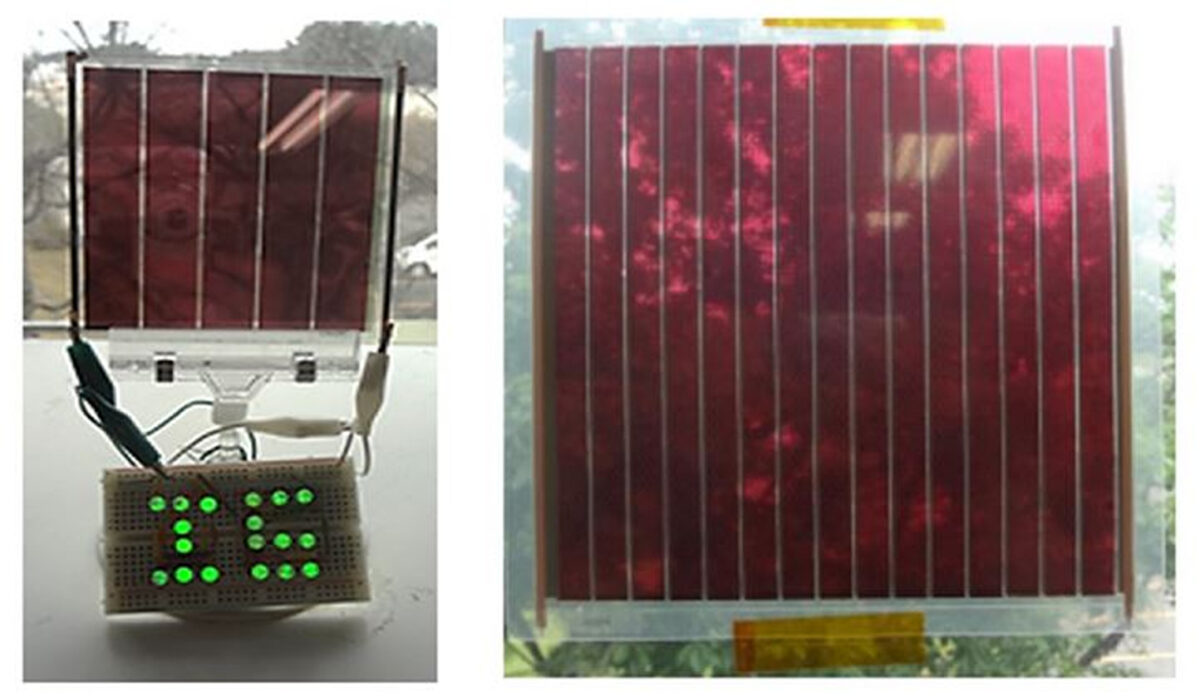
Using a similar cell architecture, but with aluminum-doped zinc oxide (AZO), polyethylenimine (PEI), and PEDOT:PSS layers, as well as a gold (Au) metal contact, the scientists then constructed organic solar modules on a surface area of ​​100 cm2 and a scale of 400 cm2.

See also  Pine Gate Renewables files for Chapter 11, which will sell its solar and energy storage fleet

Tested under standard lighting conditions, the module achieved a total transmission of 91% and an energy conversion efficiency of 1.32%. It also achieved an open-circuit voltage of 4.50 V, a short-circuit current density of 45.5 mA and a fill factor of 41%. “These results indicate that the P3HT:FNTz-FA films are applicable to module-sized OSCs for use in agricultural studies,” the scientists said.

They also found that the average transmittance value of the P3HT:FNTz-FA blend films was 46%. “Measurements of the photosynthetic rate showed that the P3HT:FNTz-FA blend film does not interfere with the growth of strawberries, and the wavelength-selective absorption in green light does not negatively affect the photosynthetic rate for tomatoes under the same emitted irradiation power. they explained further.

Through a series of preliminary tests, they also found that tomato growth was good under indoor light transmitted through the proposed solar panels photosynthesis rate and strong potential in agrivoltaic applications.

This content is copyrighted and may not be reused. If you would like to collaborate with us and reuse some of our content, please contact: editors@pv-magazine.com.

Popular content

Source link

Green greenhouses light organic selective solar SPE technology wavelength
Share. Facebook Twitter Pinterest LinkedIn Tumblr Email
solarenergy
  • Website

Related Posts

Dutch solar owners asked to switch off during peak periods to ease the distribution crisis

June 7, 2026

Letter from China’s PV Industry: Arctech wins 2.1 GW solar deal

June 5, 2026

ComEd starts a new energy pilot with a solar rebate on the roof of a brewery

June 5, 2026
Leave A Reply Cancel Reply

Don't Miss
News

Uniper to start construction of the British Solar Port Folio

By solarenergyFebruary 27, 20250

Both projects received permission from the planning and the Tamworth project in 2023 received a…

Avaada Electro reveals N-Type Topcon PV modules

September 9, 2025

Insights from IRENA’s Gender Report 2025 – SPE

October 25, 2025

“We try to be good stewards of the land,” BSR said

February 9, 2026
Stay In Touch
  • Facebook
  • Twitter
  • Pinterest
  • Instagram
  • YouTube
  • Vimeo
Our Picks

Dutch solar owners asked to switch off during peak periods to ease the distribution crisis

June 7, 2026

The hydrogen flow: Toyota demonstrates its racing prototype on liquid hydrogen

June 7, 2026

Era of electrification exposing Australia’s weakest link

June 6, 2026

‘Come out from behind your screen, our industry is ultimately about people’

June 6, 2026
Our Picks

Dutch solar owners asked to switch off during peak periods to ease the distribution crisis

June 7, 2026

The hydrogen flow: Toyota demonstrates its racing prototype on liquid hydrogen

June 7, 2026

Era of electrification exposing Australia’s weakest link

June 6, 2026
About
About

Stay updated with the latest in solar energy. Discover innovations, trends, policies, and market insights driving the future of sustainable power worldwide.

Subscribe to Updates

Get the latest creative news and updates about Solar industry directly in your inbox!

Facebook X (Twitter) Instagram Pinterest
  • Contact
  • Privacy Policy
  • Terms & Conditions
© 2026 Tsolarenergynews.co - All rights reserved.

Type above and press Enter to search. Press Esc to cancel.