

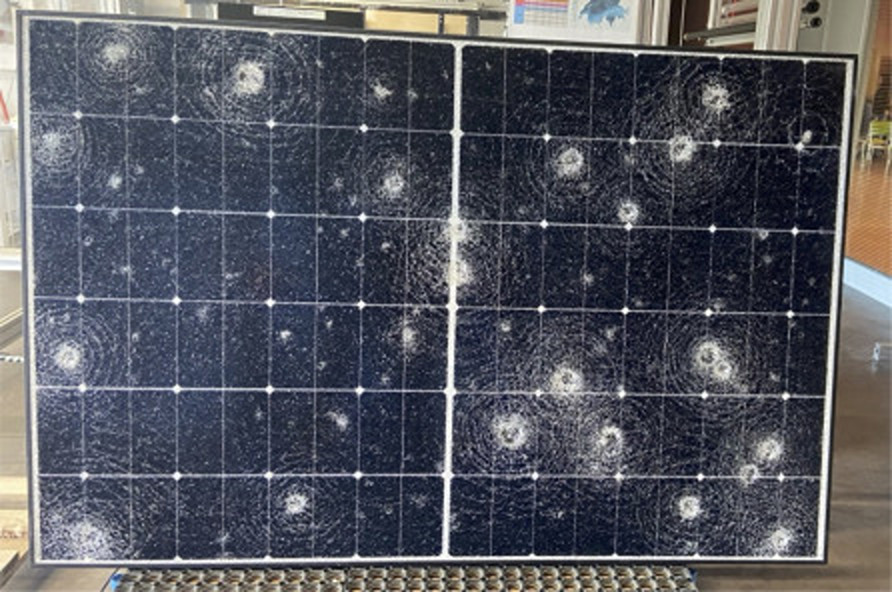
Insurers tell it pv magazine that severe convective storms (SCS) will cause $60 billion in insured losses by 2025, a rising toll that has become the main force tightening capacity and raising prices in the solar insurance market.
Severe convective storms were responsible for at least 47% of global insured catastrophe losses by 2025, generating a total of $60 billion in losses, according to Gallagher Re’s recently published “Improving Underwriting for Renewable Assets” report.
SCS and hail have accounted for more than $200 billion, or 42%, of all insured losses in the United States since 2020, compared to 34% from hurricanes. The United States was hit by at least $13 billion in insured SCS loss events in 2025 alone, making this the third most expensive SCS year on record for insurers, behind 2023 and 2024.
“Hail has emerged as a major cause of losses for solar energy, especially in regions exposed to severe convective storms,” said Tina Baacke, head of Germany and Austria at Swiss Re Corporate Solutions. “Swiss Re’s latest research shows that 2025 was the third most expensive year on record for SCS – including hailstorms and damaging winds, behind 2023 and 2024 (in 2025 prices) – adding $51 billion in insured losses globally. At the same time, other perils, such as fire, remain a major concern, with the potential to cause total losses if not managed effectively. This underlines the importance of robust safety concepts, including clear emergency response procedures and coordination with local fire services, to reduce the risk of high-severity events. At Swiss Re Corporate Solutions, we place great emphasis on site-specific hazard assessment, asset design and operational resilience when evaluating PV projects.”
Claim details
AXIS Capital’s analysis of closed solar claims between 2019 and 2025 found that hail was responsible for 27% of natural disasters and extreme weather losses worldwide, measured by total claim amount. Since 2019, more than 1 million PV modules have been damaged, amounting to a total gross claim of $342 million. The trend is driven in part by shifts in module technology: claims for heat-strengthened glass PV modules – now widely adopted due to weight and cost savings – are on average $50,000/MW higher than claims for fully tempered thicker glass, according to data from AXIS Capital.
Sophie Draper, renewable energy risk engineer at AXIS Capital, said the increased claims activity reflects the rapid expansion of solar in regions not historically associated with hail risk, where local convective weather patterns are less well understood. She said that as more projects come online worldwide, the growing field of glass panels is providing deeper data on the impacts of hail, and that AXIS Capital is monitoring scientific evidence that suggests climate change is contributing to stronger convective storms that can generate larger hailstones.
Reflecting this uncertainty, Edward Gillespie, senior underwriter for renewable energy at AXIS Capital, said the company is tailoring capacity deployment based on known and unknown exposure.
“In areas that we know are highly exposed to hail or where the exposure level is unknown, we need to be careful about the amount of capacity we deploy,” Gillespie said. pv magazine. “Our goal is to deliver solutions for customers while maintaining underwriting discipline. We place great emphasis on assessing a project from the outset, including the way it is designed, built and operated, as well as the customer’s approach to managing risk. It is important to see that customers place equal importance on each of these areas to appropriately mitigate these risks. Projects that demonstrate excellence can unlock more capacity, while customers with projects in highly vulnerable areas receive higher can compensate for price and capacity constraints if their overall portfolio is well diversified and exposed to low and high risk projects.”
Mitigation Gap
AXIS Capital sees this dynamic in South Africa, where new solar projects are increasingly located in the more hail-prone eastern and northeastern regions of the country – where energy demand and network capacity are highest.
Tim Topham, renewable energy underwriter at AXIS Capital, said the trend increases insurance risk.
“Combined with the growing size of these projects, this creates greater underwriting risk, and we need to take this into account when considering the terms we can offer, including limits and line sizes,” Topham said.
In terms of mitigation, Draper said the three pillars that AXIS Capital considers critical are accurate real-time forecasts, appropriate technology, including trackers capable of thrust beyond 60 degrees, and a well-informed operational strategy. North American developers have largely adopted these measures, she said, but their adoption lags in markets with shorter operating track records, where hail probability models warn of exposure.
AXIS Capital’s claims analysis has shown that the average cost of a PV hail claim is roughly halved when the panels are successfully stored, compared to claims where no storage has occurred or storage has failed. Modeling by Nextracker and RETC has shown that for 2.0 mm front glass in a headwind of 30 km per hour, the risk of breakage can be reduced by 83% by going from a storage angle of 30 degrees to a 75 degree angle.
Hail losses at large-scale solar facilities have attracted increasing attention in the US market. A solar project in Texas reduced its insurance costs by 72% through targeted hail mitigation measures, while a separate analysis found that Exposure to hail risk has increasing influence on the financing conditions of projects. In April 2025, VDE Americas and kWh Analytics launched a new tool to help developers quantify location-specific solar hail exposure before financial close.
This content is copyrighted and may not be reused. If you would like to collaborate with us and reuse some of our content, please contact: editors@pv-magazine.com.
