

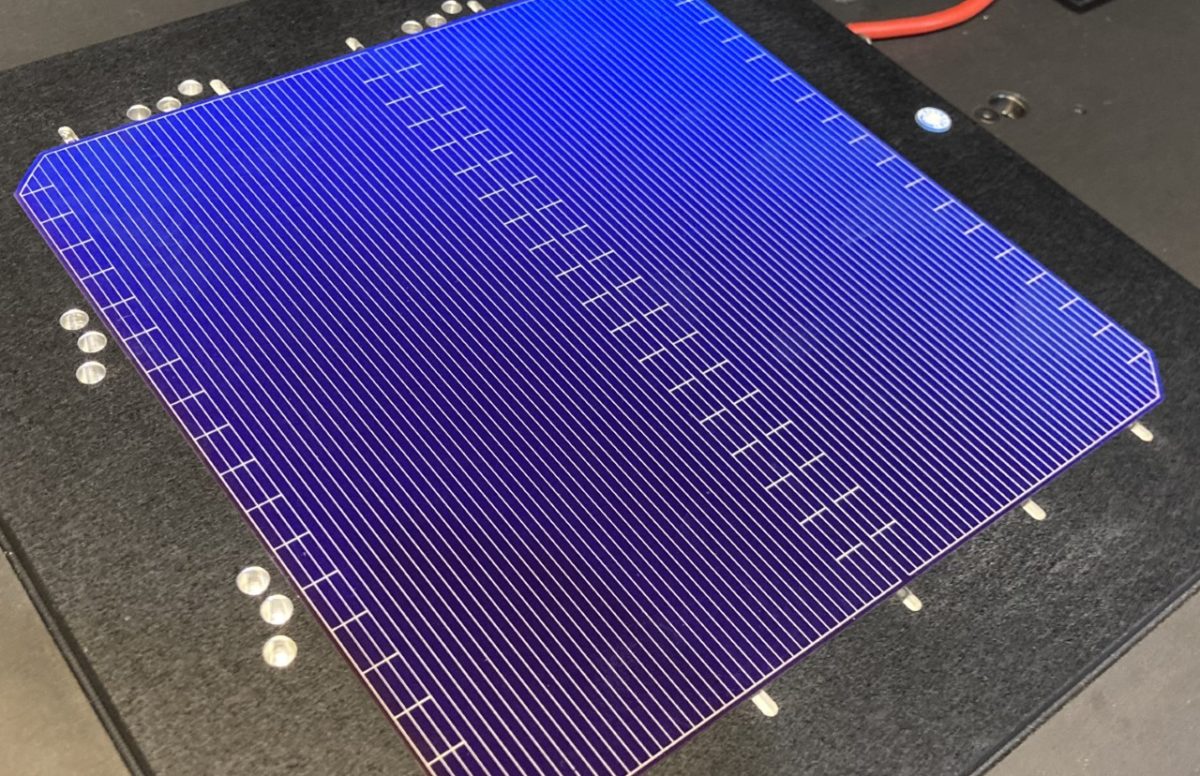
A new UNSW study shows that laser-enhanced contact optimization (LECO) can increase industrial TOPCon solar cell efficiency by improving contact properties and reducing recombination losses. By combining optimized ignition conditions with LECO contact ‘repair’, the approach balances recombination and resistance, providing conventional TOPCon cells with a practical path to compete with PV technologies that offer higher efficiency.
A new study from researchers at University of New South Wales (UNSW) and Chinese solar cell specialist Laplace suggest that laser-enhanced contact optimization (LECO) could deliver further efficiency gains in industrial TOPCon solar cells, potentially boosting performance above 26% through improved contact engineering.
The LECO process consists of using a very intense laser pulse at the front of the solar cell with a constant reverse voltage of more than 10 V, where the resulting current of several amperes significantly reduces the contact resistance between semiconductor and metal electrode.
The researchers combined numerical simulation and process modeling to better understand how LECO reduces recombination losses at the metal-emitter interface, which is considered a long-standing bottleneck for high-efficiency n-type TOPCon devices. “Our work provides a detailed, physics-based insight into how LECO improves contact passivation and reduces recombination losses in industrial TOPCon solar cells,” said corresponding author Bram Hoex. pv magazine.
“It also provides a clear physical explanation for the performance gains observed with LECO in industrial applications,” he continued. “It highlights that contact geometry, going beyond just materials or firing conditions, is a critical lever for optimizing next-generation TOPCon cells. Additionally, it provides practical guidance for balancing recombination and resistive losses through coordinated process and design optimization. Ultimately, it creates a viable path for conventional TOPCon cells to narrow the performance gap with more advanced architectures.”
The researchers found that lowering the peak temperature during metallization plays a key role in reducing recombination. Rather than changing the boron doping profile, which remains largely unchanged during firing, lower temperatures lead to non-uniform, partial metal contacts.
This partial contact formation reduces the effective recombination current density because a smaller portion of the emitter surface is in direct contact with metal. “The suppression mechanism is not driven by dopant redistribution, but by changes in contact morphology,” the study authors explain.
Although partial contacts help reduce recombination, they typically increase contact resistance, which is a trade-off that can harm overall performance. This is where LECO comes into the picture. The laser-based process locally improves poorly formed contacts, enabling low-resistance silver-silicon interfaces without the need for high-temperature baking.
According to the research team, LECO effectively ‘repairs’ underexposed regions, while retaining the benefits of reduced recombination.
Using a simulated industrial TOPCon cell with a base efficiency of 25.5%, the team showed that combining optimized baking conditions to reduce contact fraction and selective emitter doping to lower intrinsic recombination could increase efficiency up to 26.07%.
An important parameter is the partial metal contact ratio. This is the fraction of a solar cell’s emitter area that is actually in direct physical contact with the metal electrode, rather than being separated by a passivating layer. In the basic device this value was approximately 37%. The study suggests that with optimized processing this can be reduced to almost 1%, without significantly increasing contact resistance.
The authors concluded that LECO-assisted optimization provides “a viable path” to extend the life of mainstream TOPCon technology in the rapidly evolving solar market and compete with heterojunction (HJT) and back-contact (BC) PV technologies.
This content is copyrighted and may not be reused. If you would like to collaborate with us and reuse some of our content, please contact: editors@pv-magazine.com.
