

Researchers have studied the potential of combining photovoltaic systems with compressed air energy storage (CAES) to power a commercial building in South Africa. They found that a co-optimized system could reduce total capital costs by 15-20% compared to traditional sequential sizing approaches.
Researchers from South Africa’s University of Pretoria have conducted a multi-objective optimization study to combine commercial and industrial (C&I) PV systems with compressed air energy storage (CAES). The research aims to minimize total system investment (Capex) and operational costs (Opex), while improving reliability and maximizing renewable energy penetration under South African conditions.
“The core innovation of this work lies in its holistic, optimization-based approach. Unlike traditional methods that estimate CAES based on worst-case scenarios, which often lead to costly overdesign, we have developed a multi-objective framework that simultaneously optimizes the PV system and CAES components in real time,” said corresponding author Tshilumba Kalala. pv magazine.
“Our model dynamically balances energy capacity, power, thermodynamic efficiency and economic constraints, ensuring an optimally sized system that is both technically robust and economically viable for a wide range of microgrid applications,” he added. “It effectively bridges a critical gap between theoretical CAES design and practical, cost-effective implementation beyond solar.”
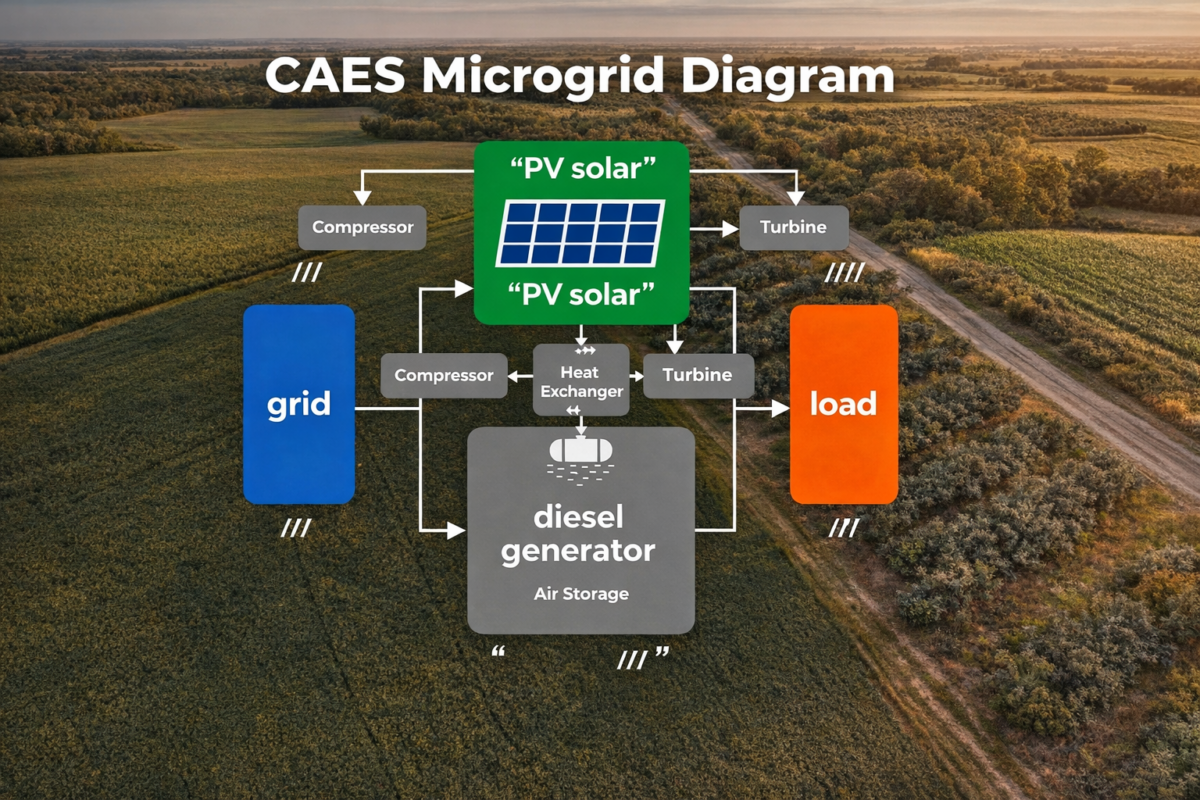
The team simulated a grid-connected hybrid microgrid for an unspecified commercial building in South Africa. It consists of three main components: a PV array, an adiabatic CAES (A-CAES) and a backup diesel generator. The A-CAES consists of three parts: compressors, turbines and an air storage tank.
The optimization problem was formulated as a multi-objective mixed-integer non-linear programming (MINLP) model with continuous and binary variables. It was solved for four scenarios: two normal conditions, where the irradiance is high and the amount of energy generated by the solar energy sources in the microgrid is high; and two extreme conditions, where the microgrid has lower levels of solar radiation. Each condition was tested with 2 and 6 hours of load shedding per day.
“One of the most compelling findings was the significant cost reduction achievable through concurrent optimization. Our model showed that a co-optimized PV-CAES system could reduce total capital costs by as much as 15-20% compared to conventional sequential sizing, while maintaining or even improving grid stability and renewable energy use,” said Kalala. “Furthermore, the results clearly showed that there is no ‘one-size-fits-all’ CAES configuration; the optimal power-to-energy ratio is highly sensitive to local demand profiles and solar radiation patterns, underscoring the need for tailor-made design tools such as the ones we propose.”
The analysis also showed that there is a clear trade-off between system performance and capital expenditure. A high-performance configuration of 37.5 kW PV, 200 m3 of storage, 10 bar pressure and 20 kW turbomachinery was found to achieve 41.5% renewable energy penetration and 94.1% reliability, while requiring a high capital investment of $13.57 million. On the other hand, a cost-constrained configuration of 28.15 kW PV and 3 bar CAES reduced initial costs by 32% to $9.2 million. However, it achieved a lower reliability of 92% and a renewable energy share of 18.6%.
“We are currently working on the transition from optimal design to optimal operation,” Kalala said of the future directions of the research. “We are developing an AI-powered energy management system to dynamically control and dispatch a CAES system in real time within a microgrid. The goal is to maximize the efficiency, longevity and economic returns of the storage asset by using machine learning to predict energy flows and adapt to network conditions in real time. This ‘smart CAES’ controller is the next critical step to unlocking the full value and network support capabilities of CAES technology in renewable networks.”
The system was presented in “Simultaneous sizing of a photovoltaic system and energy storage with compressed air in a microgrid”, published in Energy conversion and management: X.
This content is copyrighted and may not be reused. If you would like to collaborate with us and reuse some of our content, please contact: editors@pv-magazine.com.
