Researchers in Brazil found that retrofitting commercial PV panels into PVT systems can increase overall efficiency by about 46-50%, but the added thermal resistance limits heat dissipation and reduces electrical performance somewhat. Their experiments showed that performance is limited by interface quality and system design, requiring improved heat dissipation capabilities.
Researchers from the Federal University of Paraná (UFPR) in Brazil have assessed the potential for retrofitting commercial photovoltaic modules into photovoltaic-thermal (PVT) panels, identifying practical limitations that currently limit the technical and economic feasibility of the approach.
The scientists explained that previous research focused on custom-designed PV/T collectors with optimized integration, rather than standard commercial PV modules, with only a few studies having explored the retrofit of existing panels. Literature shows that effective performance depends not only on component optimization but also on overcoming inherent thermal limitations of commercial modules.
“Our work provides a design-oriented, experimental assessment of PVT retrofit, identifying key structural and operational parameters that determine system performance and establishing minimum requirements for heat extraction capacity to achieve effective thermal regulation under real operating conditions,” the academics emphasized, noting that their analysis focused on PVT modules using heat pipes and thermosyphons, which stand out for their high efficiency, passive operation and ability to transfer heat through phase change mechanisms with minimal temperature gradients.
Thermosyphons in particular rely on gravity-driven circulation between evaporator and condenser sections, allowing effective heat removal without capillary structures. Their performance depends on factors such as filling ratio, slope angle, working fluid and system geometry.
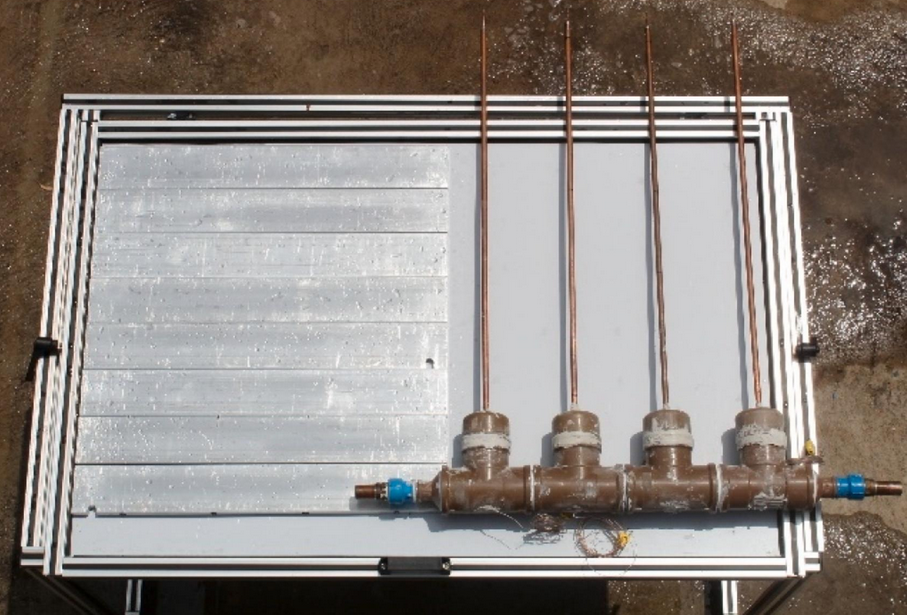
The experimental setup consisted of a standard 60 W polycrystalline photovoltaic panel with four back-mounted thermosyphons under real outdoor conditions. The thermosyphons, made of copper and filled with distilled water, are designed with different evaporator, adiabatic and condenser sections to enable passive heat transfer.
Aluminum absorption bars were used to ensure thermal contact between the panel and the thermosyphons, while the condenser sections were integrated into a water-cooled manifold that acted as a heat sink. A closed circulation system, including a thermal reservoir, a pump, an expansion tank and a flow meter, was used to manage water flow and heat recovery. According to the research team, the setup allowed continuous recirculation and storage of heated water for further use.
The PVT system was installed next to a reference PV panel to allow direct performance comparison under identical environmental conditions. Both panels were mounted at a 25° angle and faced north to maximize sun exposure. Temperature measurements were performed using thermocouples placed on the panel surface and in the water circuit, while solar radiation was recorded with a pyranometer. An Arduino-based IV curve tracer has been developed to measure electrical performance including voltage, current and output power.
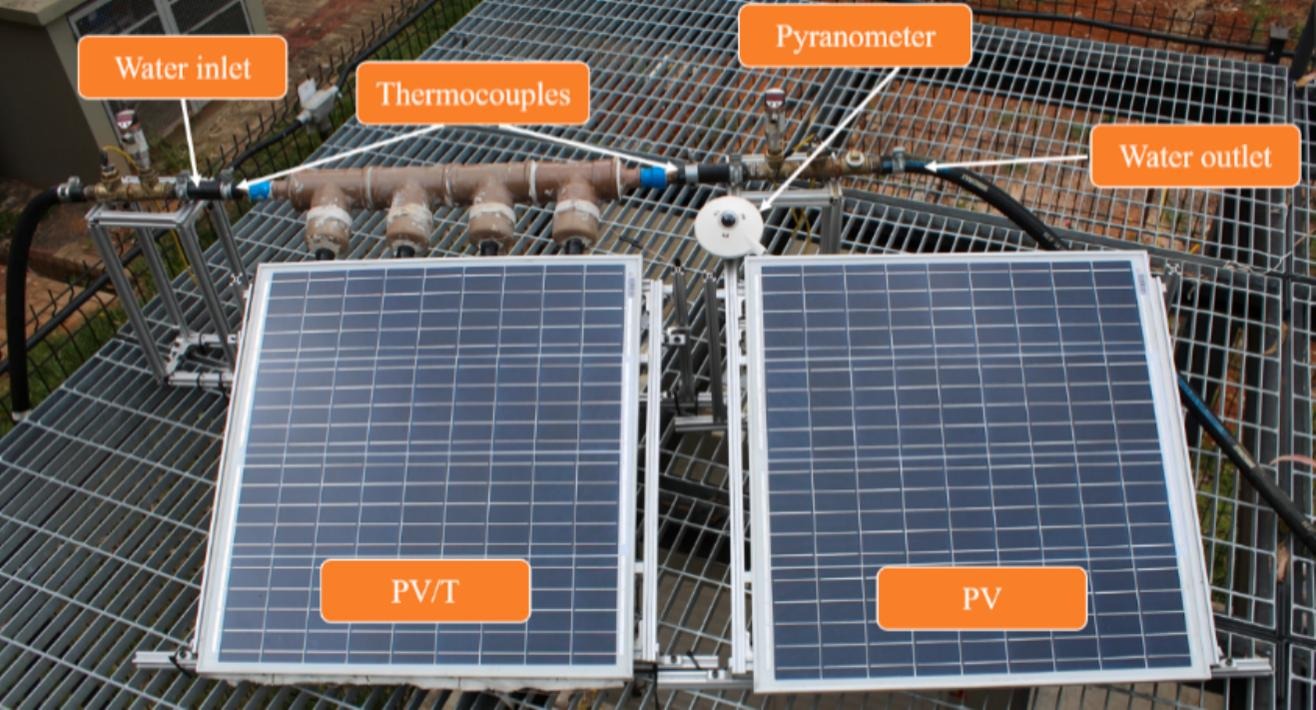
Image: Federal University of Technology-Parana, Energy Conversion and Management, CC BY 4.0
The two systems were experimentally evaluated under real outdoor conditions, using different water flow rates and weather scenarios. Tests were conducted on sunny and cloudy days at 6.5 l/min and on a sunny day at 1.5 l/min, with controlled inlet water temperatures to ensure consistency.
The results showed that the PVT module consistently operated at higher temperatures than the reference panel due to the added thermal resistance and reduced natural convection at the back end, resulting in a slight decrease in electrical efficiency, highlighting the thermal disadvantages associated with the retrofit design. However, the PVT system achieved significantly higher overall energy efficiency, up to approximately 45.75% under sunny conditions, thanks to effective heat recovery. The system also exhibited strong thermal inertia, smoothing out temperature fluctuations and allowing continued heat transfer even as solar radiation decreased.
On cloudy days, this thermal inertia further improved performance, increasing overall efficiency to more than 50% due to the delayed heat release from stored energy. However, the heat extraction rates showed a plateau, indicating an upper limit imposed by thermal resistances and thermosiphon capacitance. In the meantime, the flow rate turned out to be a critical parameter. At 6.5 L/min, efficient cooling improved electrical and thermal performance, while at 1.5 L/min reduced convection led to overheating, significantly reducing electrical efficiency to 10.93%, and overall efficiency to 19.02%.
Further findings confirmed that increasing the flow rate alone cannot completely overcome the limitations because heat extraction is ultimately limited by the quality of the interface and system design.
Overall, the results show that the performance of PVT retrofit is dependent on balancing heat extraction capacity with inherent thermal resistances. They also emphasize the existence of a maximum heat dissipation threshold and the need for optimized design parameters, such as flow rate and thermosiphon configuration.
“The current configuration with four thermosyphons is too small to achieve thermal parity with a standard PV module,” the academics emphasized. “An increase of approximately 60% in heat extraction capacity is required, which can be achieved by increasing the number of thermosyphons (to six or seven) or by increasing the effective thermal contact area. Despite these limitations, the system has demonstrated stable operation and consistent heat recovery under variable environmental conditions, supporting its applicability for low-value thermal energy use.”
Looking ahead, the scientists plan to prioritize improving heat extraction capacity by optimizing thermosiphon design, spatial configuration and thermal interface quality, and exploring alternative working fluids and geometries tailored to retrofit constraints. Additionally, they want to focus on long-term performance, system integration in real-world applications such as building-integrated PV, and comprehensive economic assessments to evaluate cost-effectiveness and scalability.
Their findings were presented in the article “Experimental assessment of thermal performance limits in a thermosiphon-based PV/T retrofit of a commercial photovoltaic panel”, published in Energy conversion and management.
This content is copyrighted and may not be reused. If you would like to collaborate with us and reuse some of our content, please contact: editors@pv-magazine.com.
Popular content