

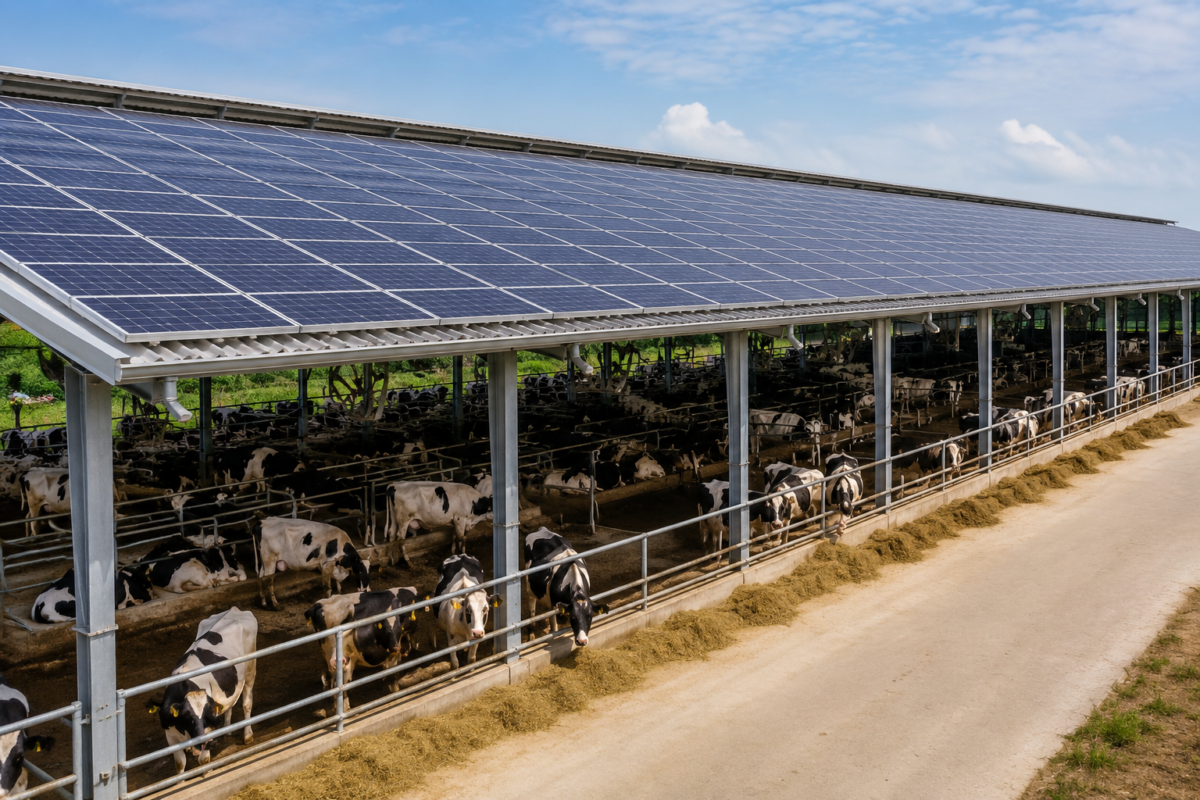
A study from China shows that PV systems on the roof of milking parlors can significantly reduce roof heat flow and improve indoor thermal conditions. Field measurements and simulations have shown a reduction in indoor temperatures of 2.3 degrees Celsius during peak periods of heat stress in the afternoon.
A research team from China has investigated whether rooftop PV systems can help reduce heat stress in dairy barns.
“This research provides quantified evidence to support advisory and decision-making processes for agricultural managers, agricultural policy makers and PV integrators,” the researchers said in a statement. “By demonstrating that rooftop photovoltaic systems serve the dual purpose of generating clean electricity and acting as a passive cooling solution that reduces peak indoor temperatures by as much as 2.3 C during critical midday hours, this work provides a direct basis for investment decisions in sustainable infrastructure.”
The scientists developed a numerical simulation and validated it with an operational PV system installed on top of a commercial dairy barn. The model allowed the calculation of the heat flux on the roof, which is the rate of heat transfer through the roof to the interior of the stable.
To assess the impact of PV modules on rooftop heat flow, the team conducted field measurements in a naturally ventilated dairy barn in Shandong Province, China. The barn has a span of 32 meters, a length of 372 meters and an eaves height of 4.5 meters. It has a south-facing gable roof with a slope of 17.17° and a single-layer profiled steel plate construction without insulation.
The facility was divided into two zones. One section remained without a PV installation, while the other was equipped with 1,152 PV modules with a total power of 299.52 kW. The modules were installed parallel to the roof slope, maintaining a ventilated air gap of 0.10 m between the panels and the roof surface, covering 60% of the south-facing roof area. The two zones housed 164 and 316 dairy cows respectively.
To compare thermal performance between the two sections, the researchers monitored indoor and outdoor dry bulb temperatures, relative humidity, air flow rate and solar radiation from June to September 2023. They also measured interior roof surface temperatures using infrared thermography and applied the temperature-humidity index (THI) to assess heat stress in the cows.
The measured datasets were then used to validate a computational model of the stable developed in SolidWorks. The validation showed mean absolute error percentage (MAPE) values of 4%–6% compared to field measurements. Now that the model had been validated, the researchers were able to quantify the dynamics of heat transfer across the stable shell.
“Linear mixed model analysis revealed that PV panels significantly reduced roof heat flow during the day (57.7% influence weight, p < 0.001), with the strongest reduction occurring during peak solar radiation between 11am and 1pm,” the researchers said. “This effect was mainly attributed to shading, photovoltaic conversion and convective cooling in the ventilated air cavity beneath the modules.”
“PV panels significantly reduced indoor temperatures during the day (8.7% influence weight, p < 0.05), achieving a maximum reduction of approximately 2.3 C during the critical heat stress period in the afternoon (2:00–4:00 PM),” she added.
Overall, the findings indicate that integrating PV systems into livestock farming can deliver measurable additional benefits by simultaneously generating renewable electricity and improving indoor thermal conditions for animal welfare under heat stress scenarios.
The research work was presented in “Rooftop photovoltaic systems can reduce dairy barn heat stress by suppressing roof heat flow: a temporal analysis”, published in Biosystems engineering. Researchers from China Agricultural University, China’s Key Laboratory of Agricultural Engineering in Structure and Environment of the Ministry of Agriculture and Rural Affairs, Shandong Agricultural University and Beijing Engineering Research Center on Animal Healthy Environment participated in the study.
This content is copyrighted and may not be reused. If you would like to collaborate with us and reuse some of our content, please contact: editors@pv-magazine.com.
