

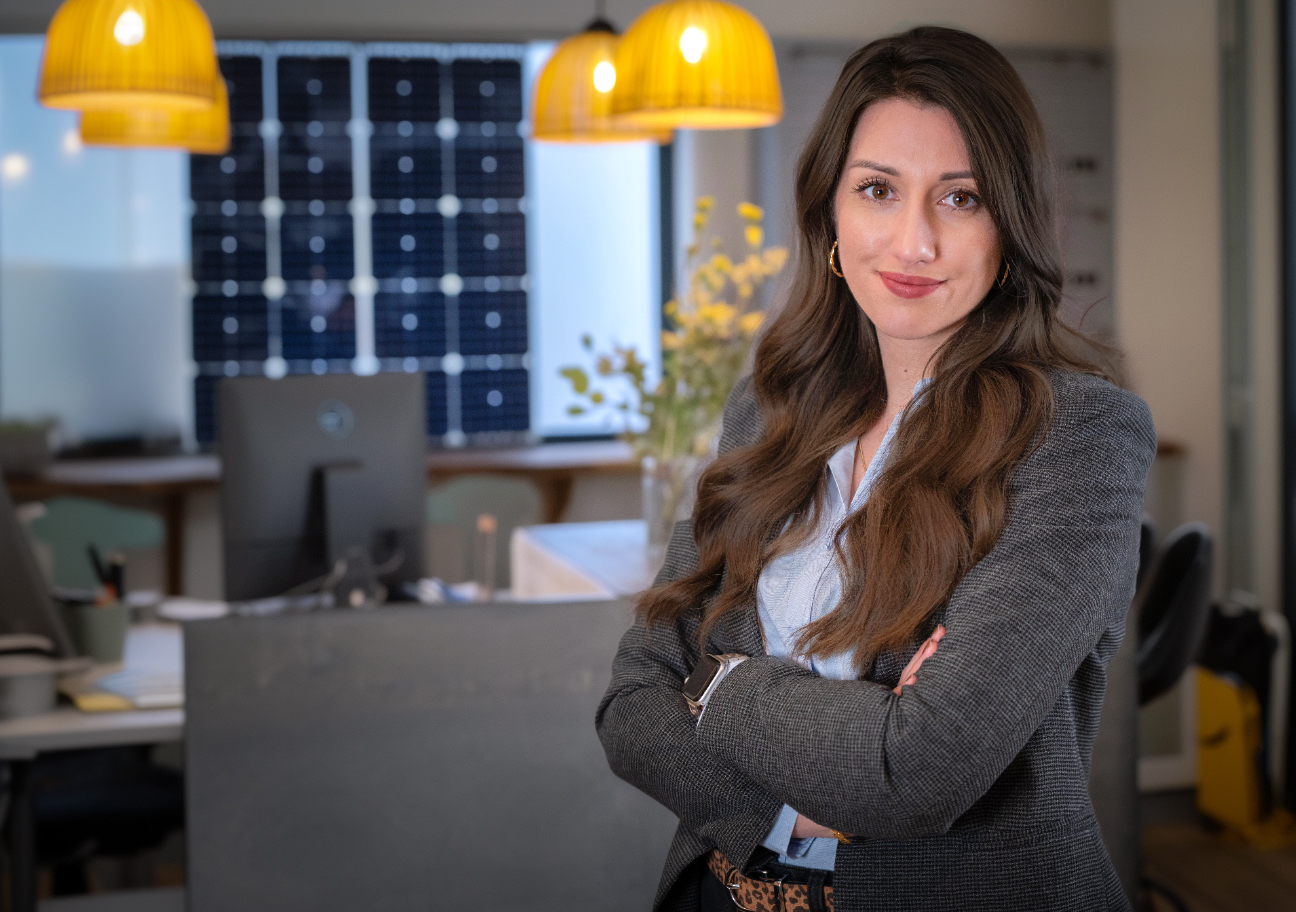
Solar energy is one of the rare industries that brings together fieldwork, engineering, finance and administration: as many playing fields as possible for all genders and all abilities. As a young industry, born without specific degree requirements, it escaped the traditional glass ceiling of engineering. Solar energy is the most gender-balanced renewable energy sector in the world, with 40% of jobs held by women, far ahead of construction or fossil fuels, according to IRENA. Women have access to truly crucial positions, as project leaders rather than just assistants. Finally, it is a work of conviction: we promote values of sustainability shared by all genders.
This diversity is one of the reasons why our sector is so resilient. Solar appeals to everyone and can therefore be built by anyone. An industry that reflects its customers better understands their needs and inspires trust. Through the regulatory cycles that our sector has faced in France, I have seen diverse teams bring different perspectives, identify risks earlier and create a broader range of solutions. Diversity also stimulates innovation. Solar energy also creates local jobs that cannot be displaced. These jobs must be accessible to every profile in the region, and that is exactly what makes it such an attractive and innovative sector.
Finding my voice in the field
I am a woman, without an engineering degree and without a political mandate, the daughter of factory workers. A recycled person from another industry. In 2026, I arrived at a ministerial meeting as federation chairman. The secretary offered me a seat to the side to take notes and only offered coffee to my male colleagues. A scene straight out of the 1950s.
How do you overcome these barriers? By learning on rooftops, in the middle of crises. In the beginning, I simply translated technical texts into plain language for my ex-colleagues on social media, before I realized that my voice had an impact and remembered one thing: no one will give you your voice. You have to go get it.
That experience has also determined how I approach my work every day. One observation stands out: men are hired and listened to based on their potential, women only based on evidence. I see it every day: with equal skills, women are harder to hire, even though one in three companies say their best team builder and knowledge transferor is a woman.
My answer has always been the same: competence as a shield. Prepare every file better than anyone else. Knowing the regulations word for word. Don’t try to convince the skeptics, but move on: the results speak for themselves. And humor too. I wear Timberlands more than a suit, and I own it.
Leadership changes
Visible female leaders are finally emerging in the French solar sector: founders, CEOs, heads of installation companies. This was rare ten years ago. At the same time, the definition of leadership itself is evolving: less attitude, more coordination and collective intelligence.
During a recent industry crisis, I created a group of 300 angry business leaders, including five women. These five women channeled the most vengeful voices toward concrete, non-violent actions and led the government to consult with grassroots actors within days. Women’s networks are being organised, but women remain underrepresented in the sector’s governing bodies. The journey continues.
Throughout my career, mentorship has not come from one person. My mentors are the people in the field: the pioneers, the most experienced, the creators of our industry. They are the ones I learn from every day. In return, I hope to be a mentor myself: paving the way, showing that other figures can emerge without the expected suit.
At the federation we have institutionalized this transfer. Our working groups function as collective mentorship, where everyone transfers knowledge from his or her field. Mentoring is not always one-on-one; sometimes it is a relay that is passed on through an entire sector to all the curious and passionate, regardless of their age or gender.
The mechanism does the work
To me, inclusion is built into the mechanics of an organization. Who gets a seat at the table? Our federation is open to the entire value chain and is not based on membership fees. Who is allowed to speak? Open working groups, consultation before any position we take. Who is hired? My solar recruitment agency offers anonymous applications when all genders are represented. Who gets the resources to work? I have just created an association for the integration of women in the field: appropriate PPE, tools and workstations so that skills can be deployed on an equal footing. At every level, the mechanism does the work that good intentions alone cannot do.
That is also why I believe that inclusion should go beyond good intentions and symbolic actions. Encouraging diversity, equality and inclusion at board level remains a challenge. In an industry that faces ongoing regulatory crises, DEI always comes second. We will deal with it ‘when it gets better’. But it never gets better.
There is also the pitfall of a photo, a panel or a one-day event without changing the underlying mechanisms. We also lack data. Our industry already struggles to count its workers, let alone count them by gender. Without numbers, progress cannot be objectified or measured. Finally, as a woman defending this issue, I am suspected of preaching my own cause, while a man who says the same is heard as a strategist.
Making inclusion practical
Inclusion is also about providing people with practical tools to succeed. First provide the material resources to work: appropriate PPE, tools and workplaces. You cannot retain ill-equipped talent. Second, offer real positions: project leaders with responsibilities and prospects, not assistants for life. Salvation comes through perspective.
Third, measure the pay and promotion differences, because without measurement there is no correction possible. Fourth, adapt without stigmatizing: Remote work and flexible hours must be accessible to all genders, otherwise flexibility will become a pitfall for women’s careers. Finally, show trajectories. If no one “like you” has ever stepped up, you leave.
Solar energy as a social lift
For me, diversity is also about social background and field. Can solar energy be a social lift? Yes, and that is its power.
I am living proof. Solar offers jobs that are accessible without lengthy degrees, real opportunities for career changers, and local jobs that can’t be relocated. But the elevator must work for everyone, including on roofs. That’s why I founded an association dedicated to women in the field: appropriate PPE, tools and workplaces so that skills can be used on an equal footing. Inclusion doesn’t stop at the office door; it must climb all the way to the rooftops.
One word: Dare
If I could give one piece of advice to a young woman entering the solar and renewable energy industry today, it would be this: TO DARE. Dare to enter an industry whose codes are currently being written. Now is the time to arrive as the sector takes shape. Dare to come forward with your atypical profile: career change, no engineering degree, modest background… that’s exactly what allows you to see what others can’t see.
Dare to go into the field and learn from the makers, because technical credibility is your best passport. And dare not wait for an invitation, because no one will invite you. Solar needs you, exactly as you are.
Floriane de Brabandère is founder and president of the Fédération Nationale de l’Énergie Solaire (FNES), the federation representing the entire French solar energy value chain. She is recognized as a representative voice of the industry and a strong advocate for small businesses. She combines a deep understanding of business and market challenges with day-to-day practicality in the field, where she still works. She embodies a new generation of leaders who bring a fresh perspective and shake up institutional communications, with a self-declared specialty: making technical and regulatory topics accessible to all. She is operational and multi-entrepreneur and co-author of a legislative proposal. She advocates common sense solar energy: solar energy that serves people, defends the right to produce and consume clean, citizen-driven and local electricity, and creates value in local communities. Her priority battles include employment in the solar industry and inclusion in the sector.
Interested in participating Floriane de Brabandère and other female market leaders and experts at Women in Solar+ Europe? More information: www.wiseu.network
