
Close Menu
  • News
  • Industry
  • Solar Panels
  • Commercial
  • Residential
  • Finance
  • Technology
  • Carbon Credit
  • More
    • Policy
    • Energy Storage
    • Utility
    • Cummunity
What's Hot

Zendure launches battery ranges for residential PV – SPE

April 23, 2026

The CFO’s Guide To Nature Based Solutions

April 23, 2026

Inside PV Manufacturing: Belga Solar’s module factory in Belgium

April 23, 2026
Facebook X (Twitter) Instagram
Solar Energy News
Thursday, April 23
  • News
  • Industry
  • Solar Panels
  • Commercial
  • Residential
  • Finance
  • Technology
  • Carbon Credit
  • More
    • Policy
    • Energy Storage
    • Utility
    • Cummunity
Solar Energy News
Home - Solar Industry - Increasing the voltage in cadmium telluride solar cells via a nickel oxide back buffer layer
Solar Industry

Increasing the voltage in cadmium telluride solar cells via a nickel oxide back buffer layer

solarenergyBy solarenergyAugust 5, 2024No Comments3 Mins Read
Facebook Twitter Pinterest LinkedIn Tumblr Email
Share
Facebook Twitter LinkedIn Pinterest Email

Cadmium telluride solar cells are usually based on non-ohmic back contacts that affect the open-circuit voltage of the device. Researchers in the United Kingdom attempted to address this problem by adding a nickel oxide back buffer layer, which formed an ohmic back contact and increased open-circuit voltage levels.

August 5, 2024 Emiliano Bellini

Researchers at Loughborough University in the United Kingdom have designed a cadmium telluride (CdTe) solar cell with a buffer layer of nickel oxide (NiO) deposited without oxygen, which reportedly significantly improves the device’s open-circuit voltage.

They explained that CdTe cells generally suffer from low open-circuit voltage levels because these devices rely on low minority carrier lifetimes, low carrier density, and non-ohmic back contacts. To solve this problem, they used NiO, an efficient electron reflector due to its large conduction band offset, as a back buffer layer to form an ohmic back contact.

“Optical transmission and band gaps are affected by oxygen input, and generally decrease in both aspects as oxygen increases,” the scientists explained. “NiO begins to show structural changes upon introducing oxygen, creating nickel vacancies. These characteristic changes suggest that there is a trade-off that needs to be studied regarding their use as a back buffer layer for CdTe solar cells.”

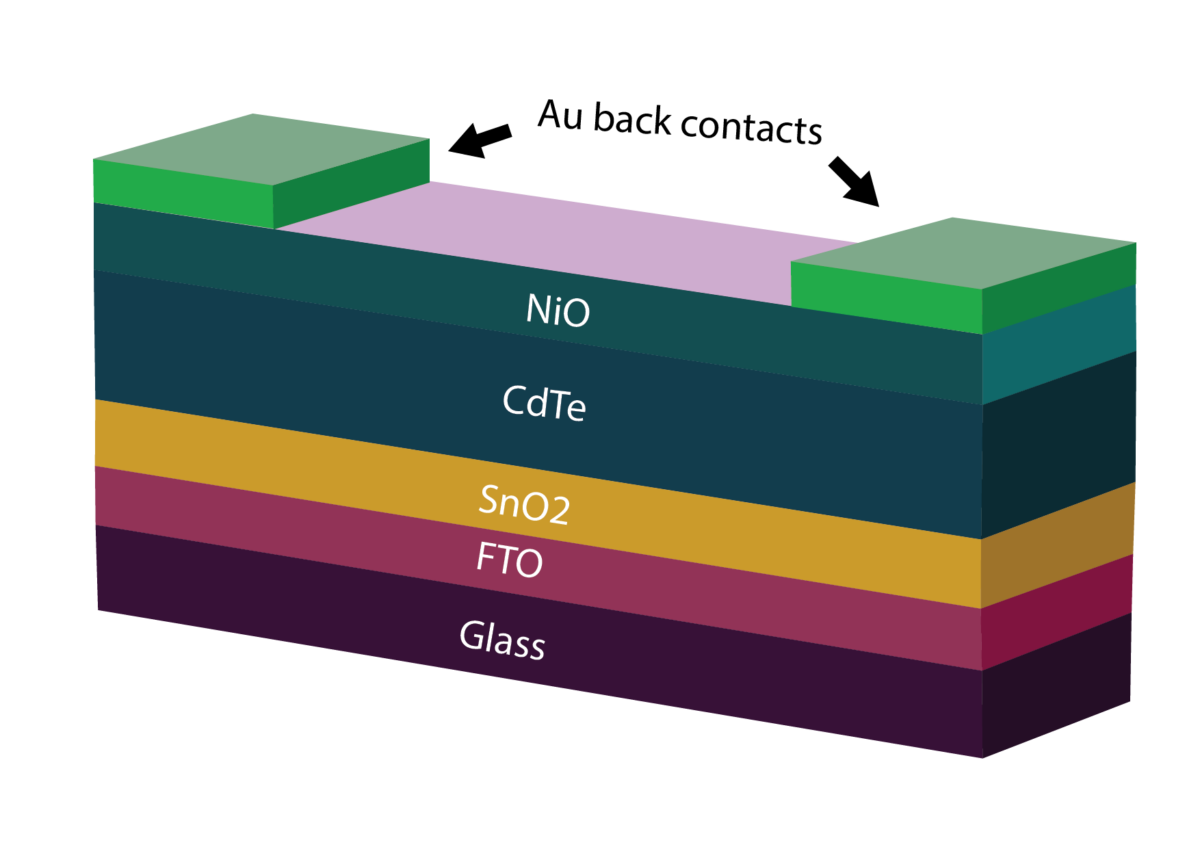
The research group uswith the SCAPS-1D solar cell capacity software, developed by Ghent University, to simulate a new CdTe cell configuration. The 0.25cm2 device was based on a substrate made of glass and fluorine-doped tin oxide (FTO), a tin oxide (SnO2) electron transport layer (ETL), a CdTe absorber, the Nio buffer layer with a thickness of 100 nm, and gold (Au) metals contacts.

See also  Huasun achieves 34.02% Efficiency for Perovskiet-Heterojunction Solar Cell-PV Magazine International

In the proposed cell architecture, the NiO back buffer layer increases the device efficiency by reducing the barrier height at the Au back contact and improving the valence band offset at the CdTe/NiO interface.

“The NiO layer also leads to a large conduction band shift at the CdTe/NiO interface, forming an efficient electron reflector to reduce interfacial recombination and increase open-circuit voltage,” the team explained, noting that the conduction band shift between NiO and CdTe is large.

“Where between 0-20% is oxygen, the value is between 2.65 eV and 2.86 eV and between 40-60% it is reduced to 2.18 eV and 2.21 eV,” the academics further explained. “It increases again by 80% to 2.62 eV. The large conduction band offset would directly improve the open-circuit voltage by being efficient electron reflectors, which prevent accumulation of electrons at the interface and reduce interfacial recombination.”

The new solar cell concept was introduced in the research “The effect of oxygen on NiO as a back buffer layer in CdTe solar cells”, published in the Royal Society of Chemistry. Looking ahead, the team said it plans to further improve the NiO layer by optimizing the substrate temperature during sputtering.

This content is copyrighted and may not be reused. If you would like to collaborate with us and reuse some of our content, please contact: editors@pv-magazine.com.

Popular content

Source link

buffer cadmium cells increasing layer nickel oxide solar telluride voltage
Share. Facebook Twitter Pinterest LinkedIn Tumblr Email
solarenergy
  • Website

Related Posts

Inside PV Manufacturing: Belga Solar’s module factory in Belgium

April 23, 2026

Solar energy’s rebound effect could increase European electricity demand by 5% by 2050 – SPE

April 23, 2026

Repowering key for Japanese solar assets nears end of feed-in tariff – SPE

April 23, 2026
Leave A Reply Cancel Reply

Don't Miss
Energy Storage

Daikin launches air-to-water heat pumps for single-family homes – SPE

By solarenergyDecember 16, 20240

Daikin Europe NV, a subsidiary of Japanese heating systems manufacturer Daikin, has introduced a new…

Mena H2 projects rise in 2024 – PV Magazine International

February 7, 2025

Safe, long-lasting, high-temperature lithium-metal battery – SPE

July 26, 2024

Do solar farms encourage biodiversity?

May 10, 2025
Stay In Touch
  • Facebook
  • Twitter
  • Pinterest
  • Instagram
  • YouTube
  • Vimeo
Our Picks

Zendure launches battery ranges for residential PV – SPE

April 23, 2026

The CFO’s Guide To Nature Based Solutions

April 23, 2026

Inside PV Manufacturing: Belga Solar’s module factory in Belgium

April 23, 2026

Solar energy’s rebound effect could increase European electricity demand by 5% by 2050 – SPE

April 23, 2026
Our Picks

Zendure launches battery ranges for residential PV – SPE

April 23, 2026

The CFO’s Guide To Nature Based Solutions

April 23, 2026

Inside PV Manufacturing: Belga Solar’s module factory in Belgium

April 23, 2026
About
About

Stay updated with the latest in solar energy. Discover innovations, trends, policies, and market insights driving the future of sustainable power worldwide.

Subscribe to Updates

Get the latest creative news and updates about Solar industry directly in your inbox!

Facebook X (Twitter) Instagram Pinterest
  • Contact
  • Privacy Policy
  • Terms & Conditions
© 2026 Tsolarenergynews.co - All rights reserved.

Type above and press Enter to search. Press Esc to cancel.